
INSIDE EMBRYO · Patient Education
Your questions.
Clearer answers.
Fertility treatment brings unfamiliar words and important decisions. Explore the pictures, understand the ideas and take one useful question into your next appointment.

LOOK. READ. UNDERSTAND.
What would you like to understand?
Ten visual explanations, from follicles and eggs to embryo transfer and warming. Swipe to explore, then read the explanation below each image.
This image could not load. Use the full-size image link above to try opening it directly.
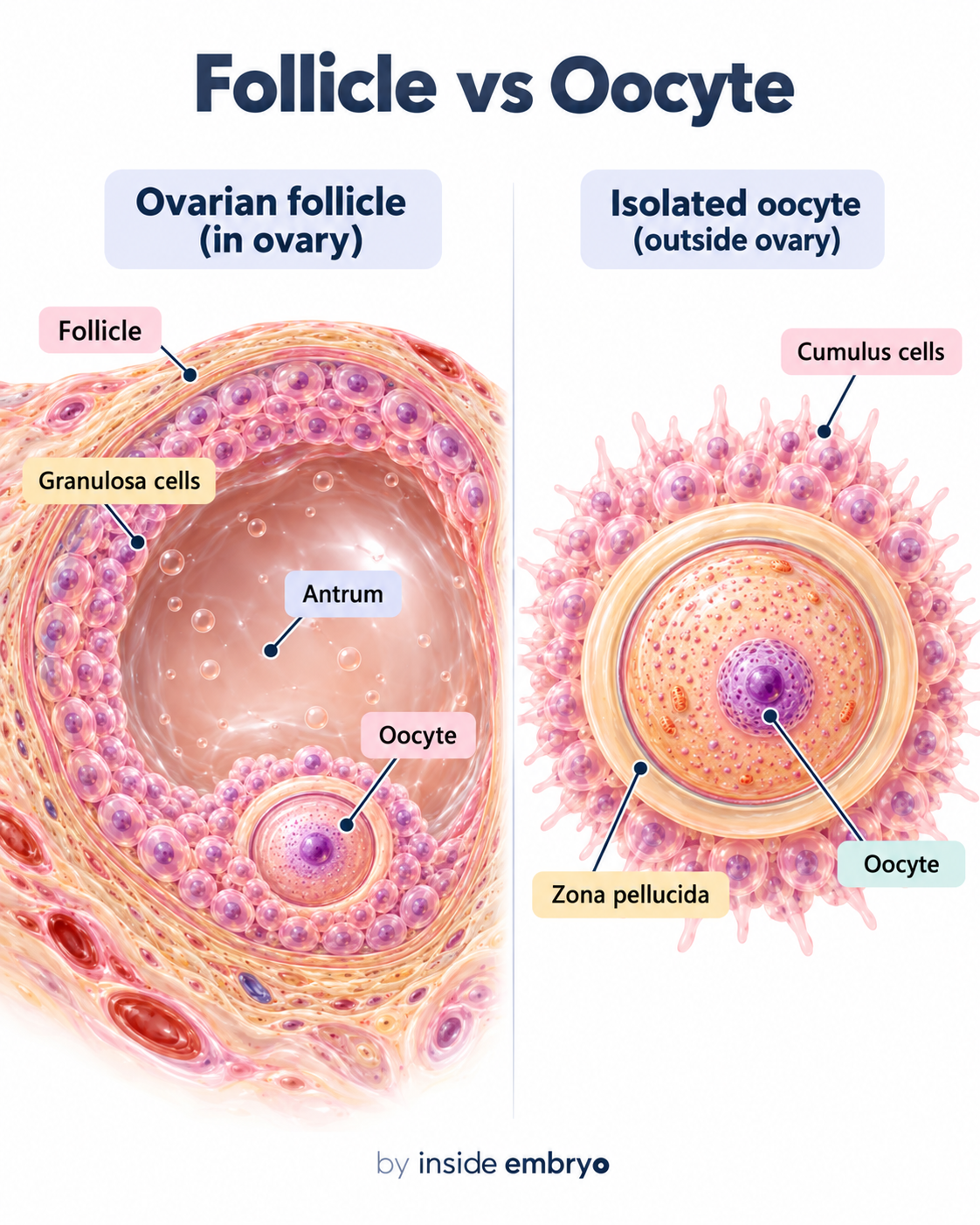
Follicle vs Oocyte
A follicle and an oocyte are not the same thing. The follicle is a structure inside the ovary that contains and supports the developing oocyte. The oocyte is the female reproductive cell located within the follicle.
This image could not load. Use the full-size image link above to try opening it directly.
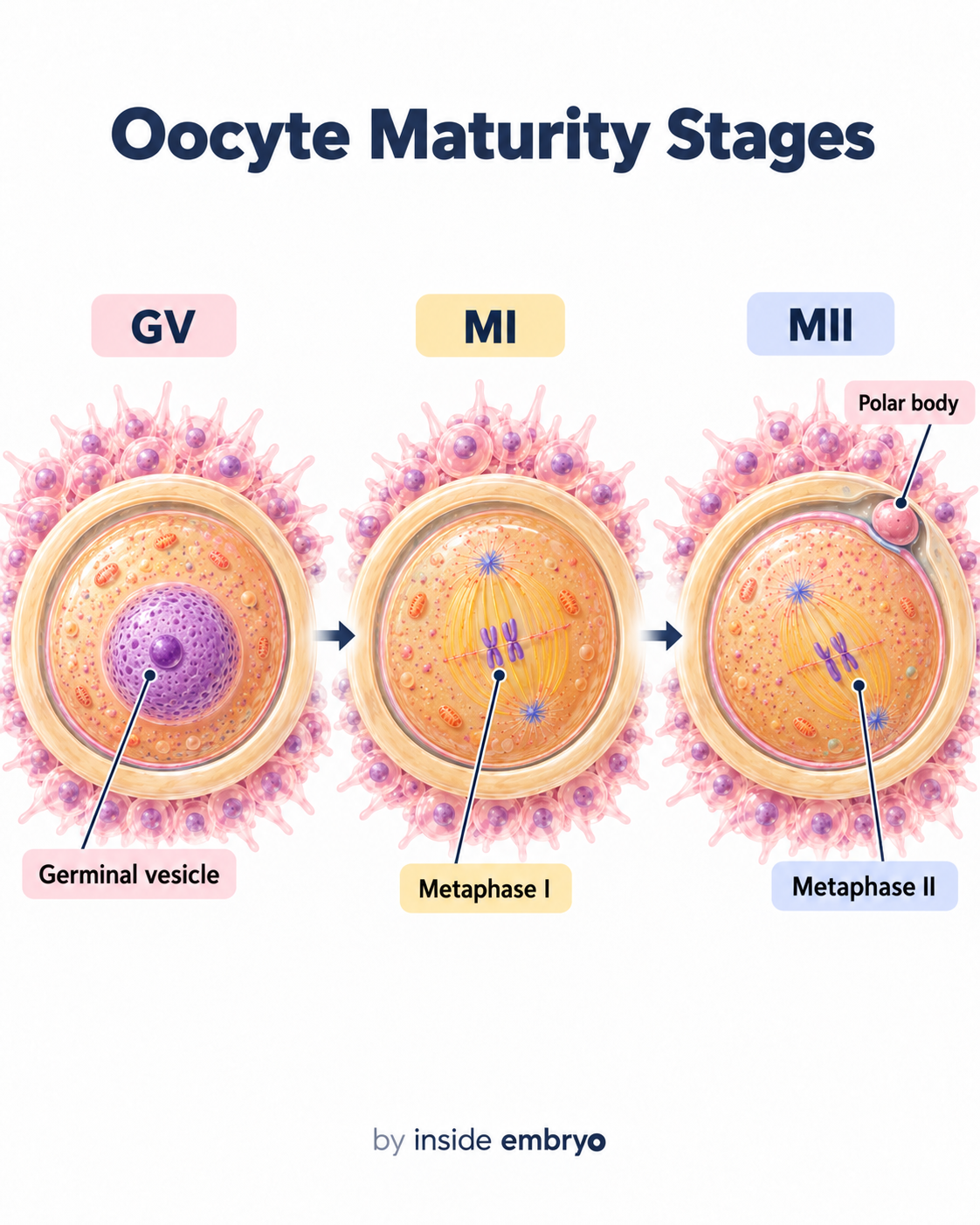
Oocyte Maturity Stages
Oocytes can be observed at different stages of nuclear maturation. GV represents the germinal vesicle stage, MI represents metaphase I, and MII represents metaphase II.
This image could not load. Use the full-size image link above to try opening it directly.
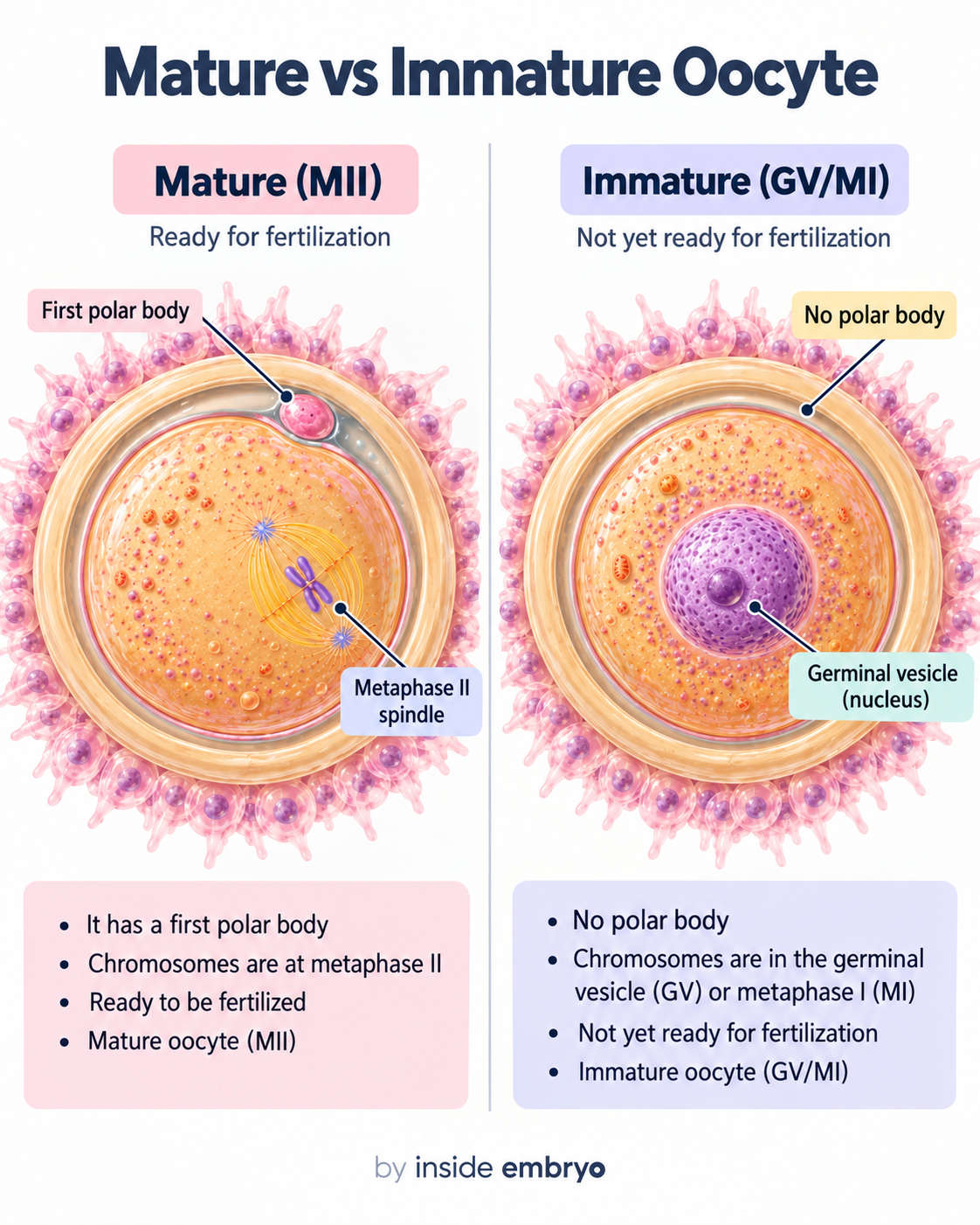
Mature vs Immature Oocyte
A mature MII oocyte has completed the first meiotic division and typically shows the first polar body. GV and MI oocytes are earlier stages of nuclear maturation.
This image could not load. Use the full-size image link above to try opening it directly.
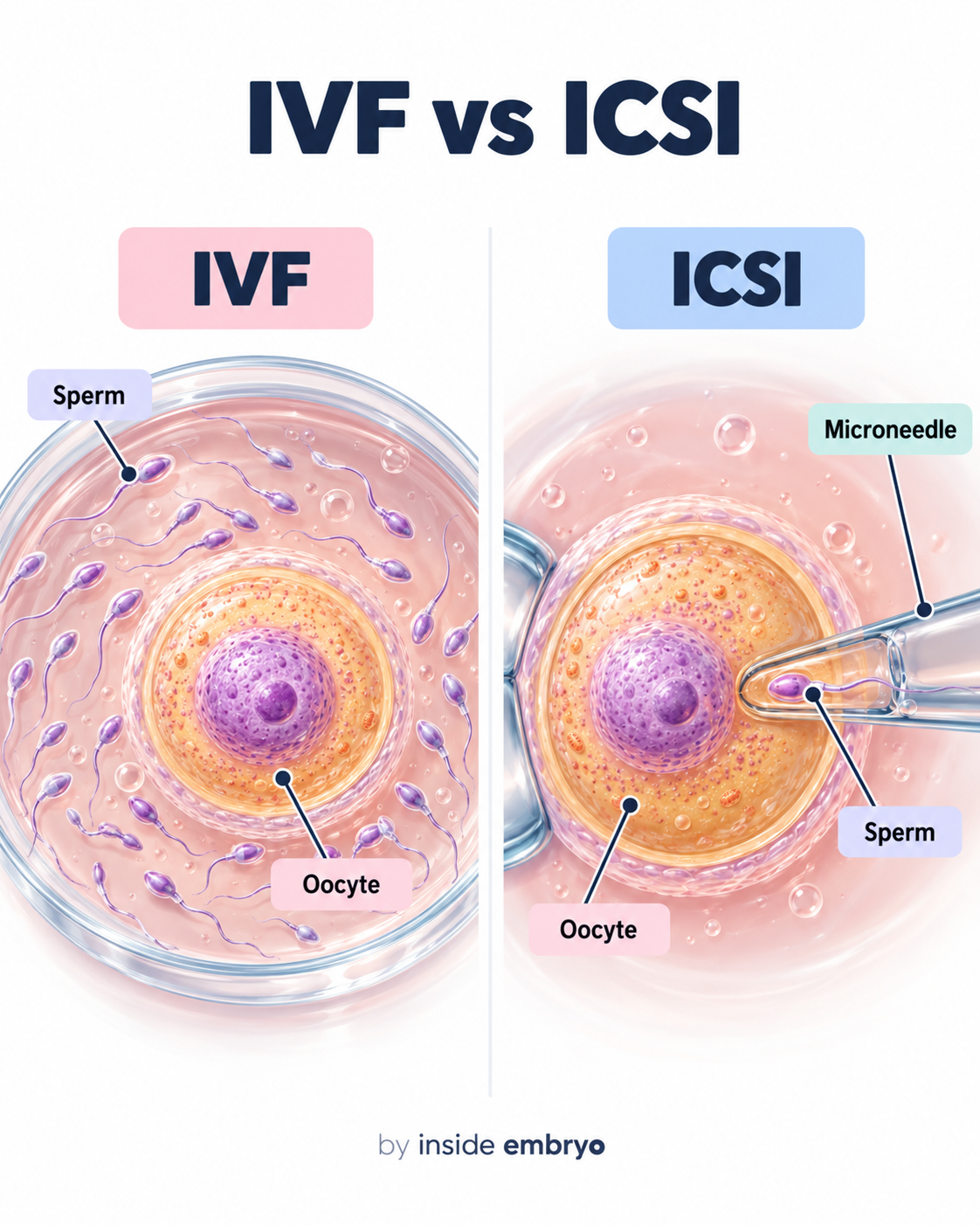
IVF vs ICSI
IVF and ICSI are two laboratory approaches used to attempt fertilisation. In conventional IVF, prepared sperm and oocytes are placed together. In ICSI, an embryologist introduces a single selected sperm directly into an oocyte.
This image could not load. Use the full-size image link above to try opening it directly.
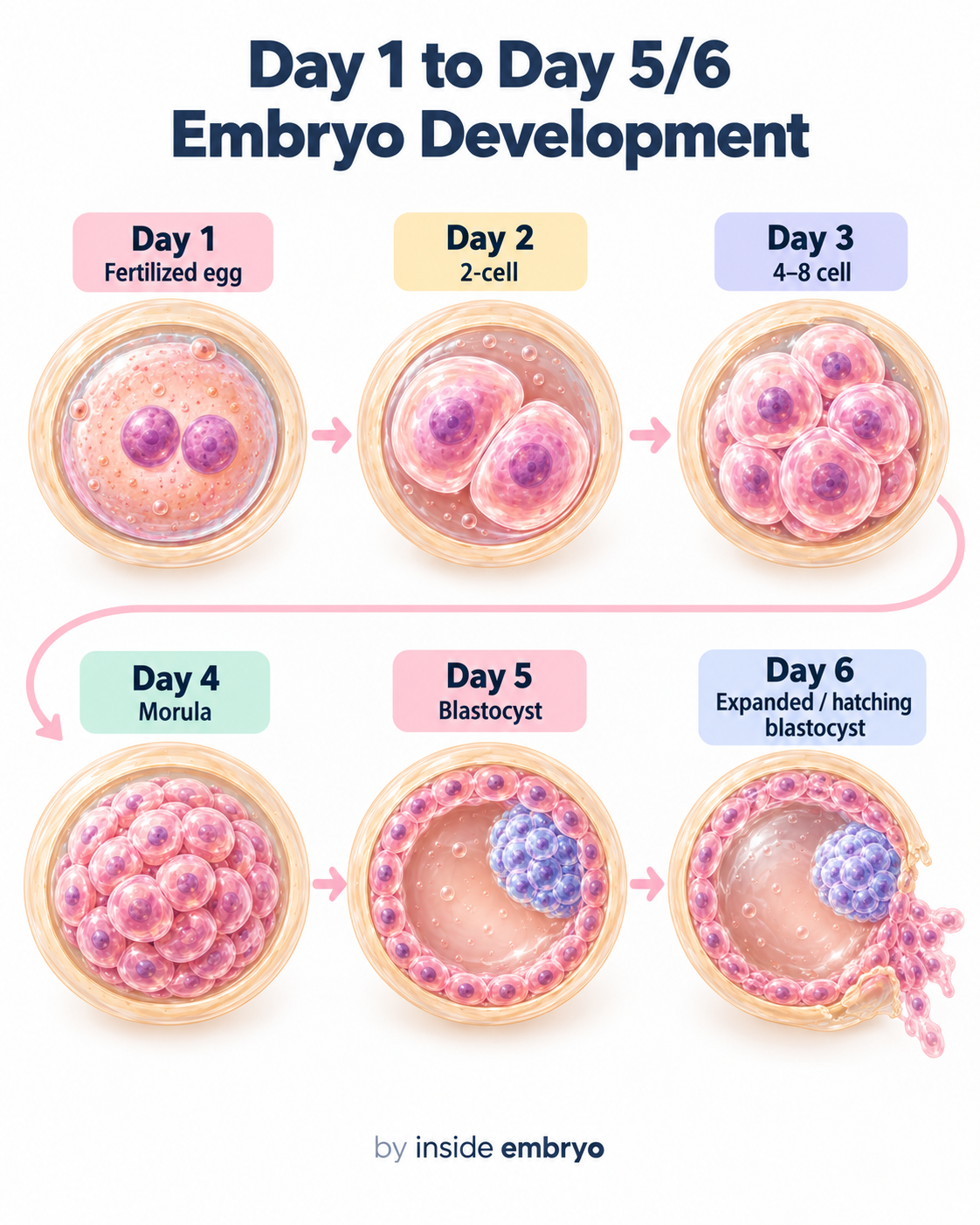
Day 1 to Day 5/6 Development
In embryos that continue developing after fertilisation, cleavage divisions are followed by compaction, morula formation and blastocyst development. The timing can vary, and some embryos stop developing before reaching the next stage.
This image could not load. Use the full-size image link above to try opening it directly.
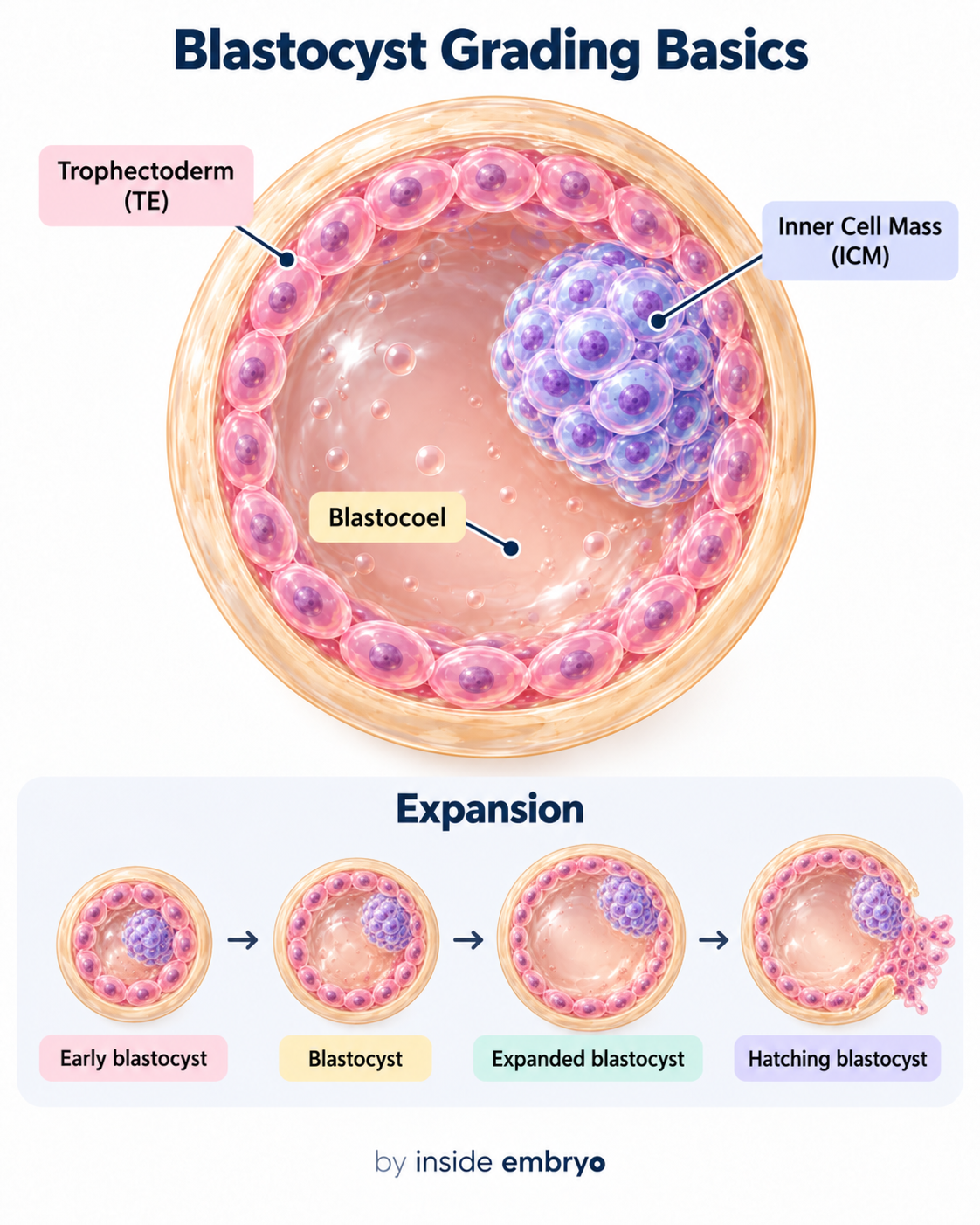
Blastocyst Grading Basics
Blastocyst grading describes visible features observed under the microscope. Assessment commonly considers blastocyst expansion, the inner cell mass and the trophectoderm.
This image could not load. Use the full-size image link above to try opening it directly.
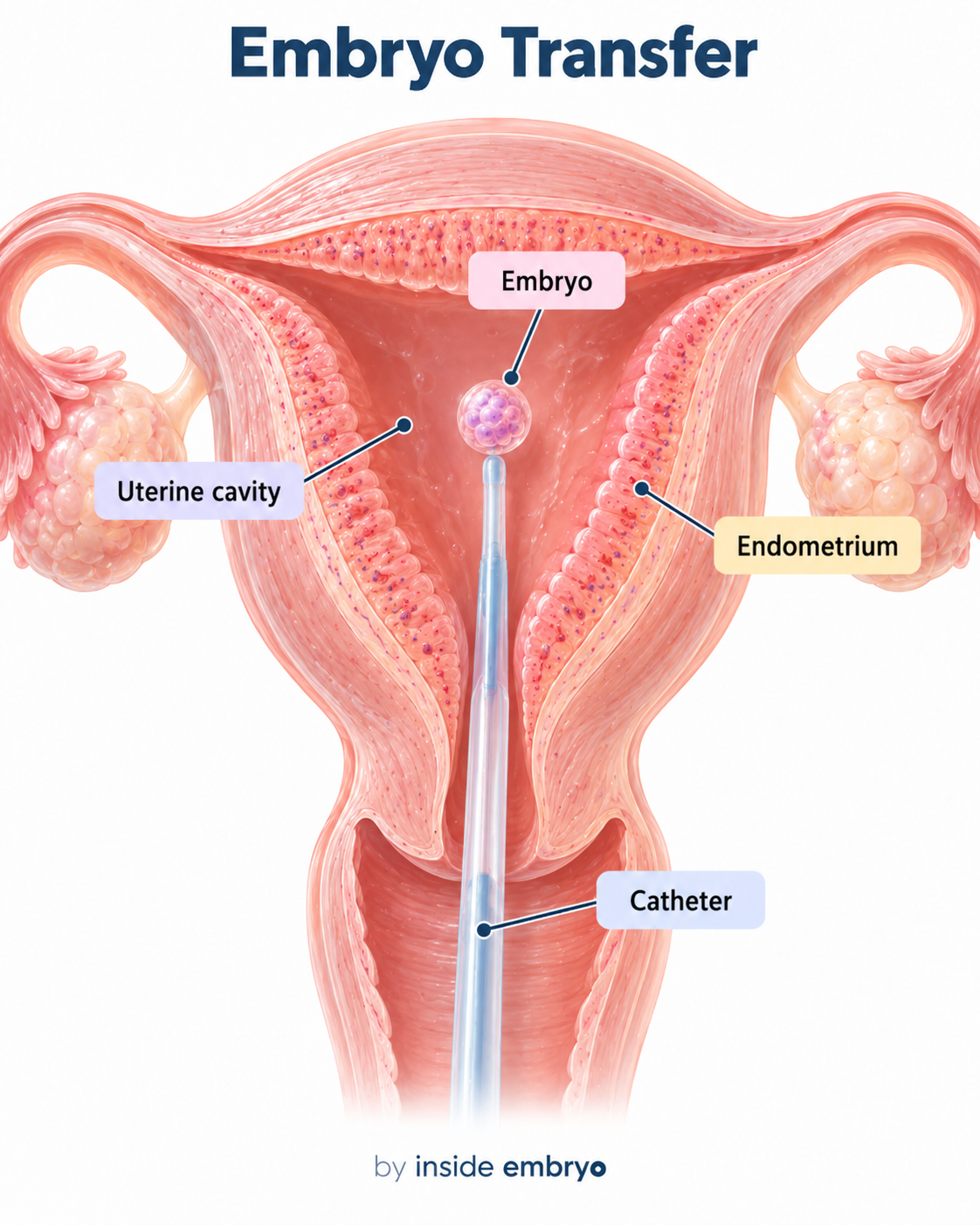
Embryo Transfer
During embryo transfer, an embryo is carried in a thin transfer catheter and released into the uterine cavity. The diagram shows the relationship between the catheter, uterine cavity and endometrium.
This image could not load. Use the full-size image link above to try opening it directly.
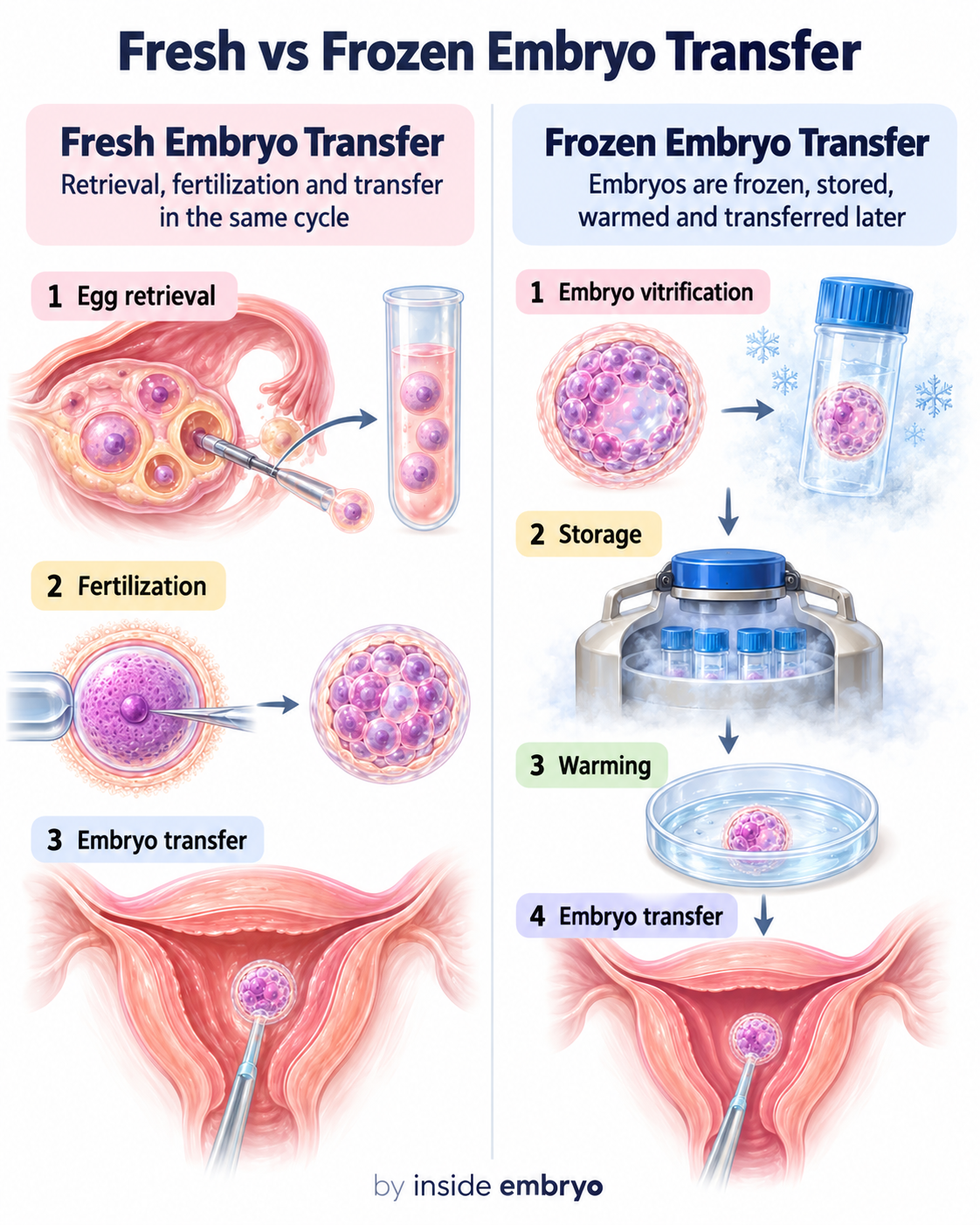
Fresh vs Frozen Embryo Transfer
A fresh embryo transfer occurs within the treatment cycle in which the oocytes were collected. For a frozen embryo transfer, an embryo is cryopreserved, stored and later warmed before transfer.
This image could not load. Use the full-size image link above to try opening it directly.
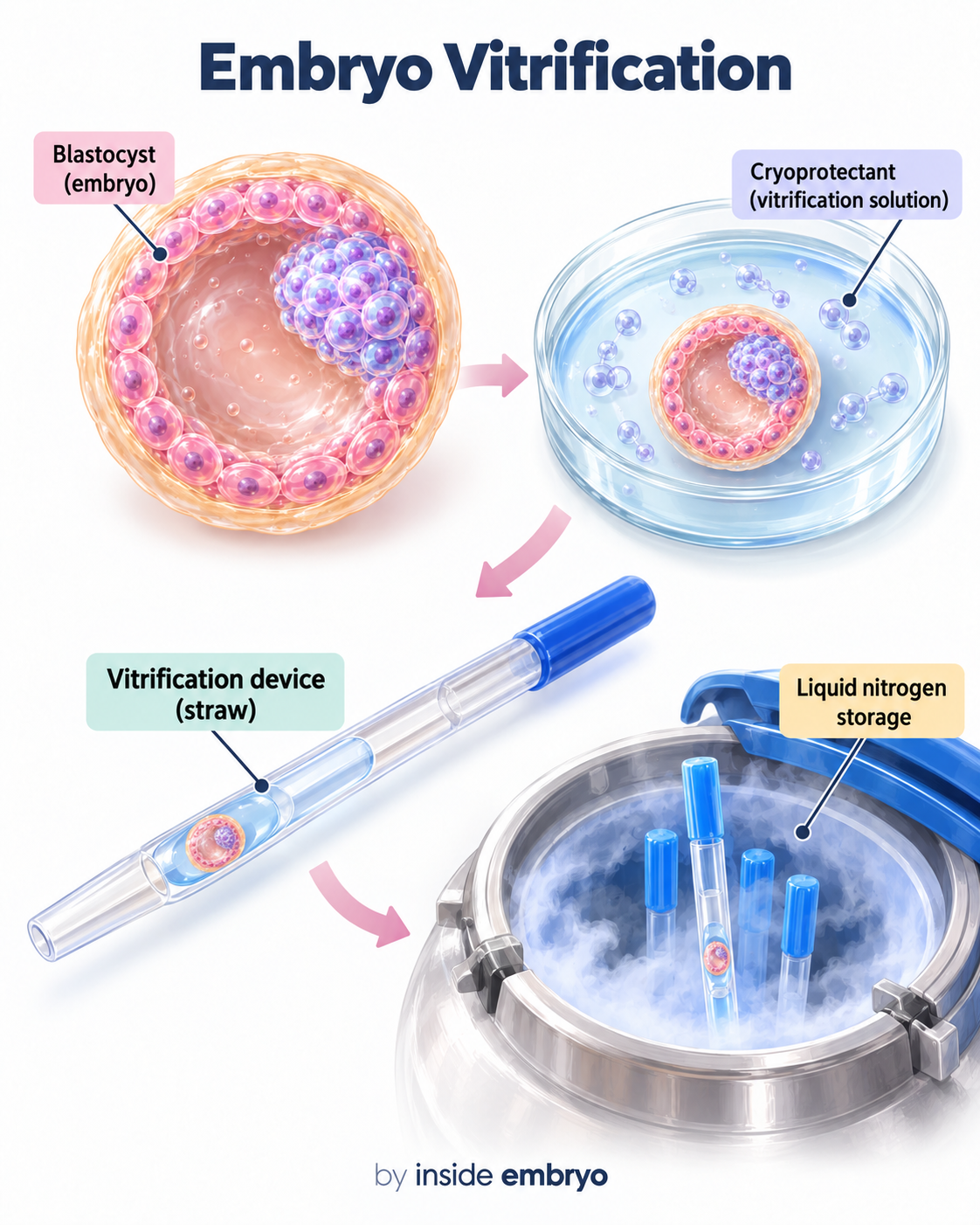
Embryo Vitrification
Vitrification is a rapid cryopreservation method. Embryos are exposed to specialised cryoprotective solutions, loaded onto a vitrification device and stored at very low temperature in liquid nitrogen.
This image could not load. Use the full-size image link above to try opening it directly.
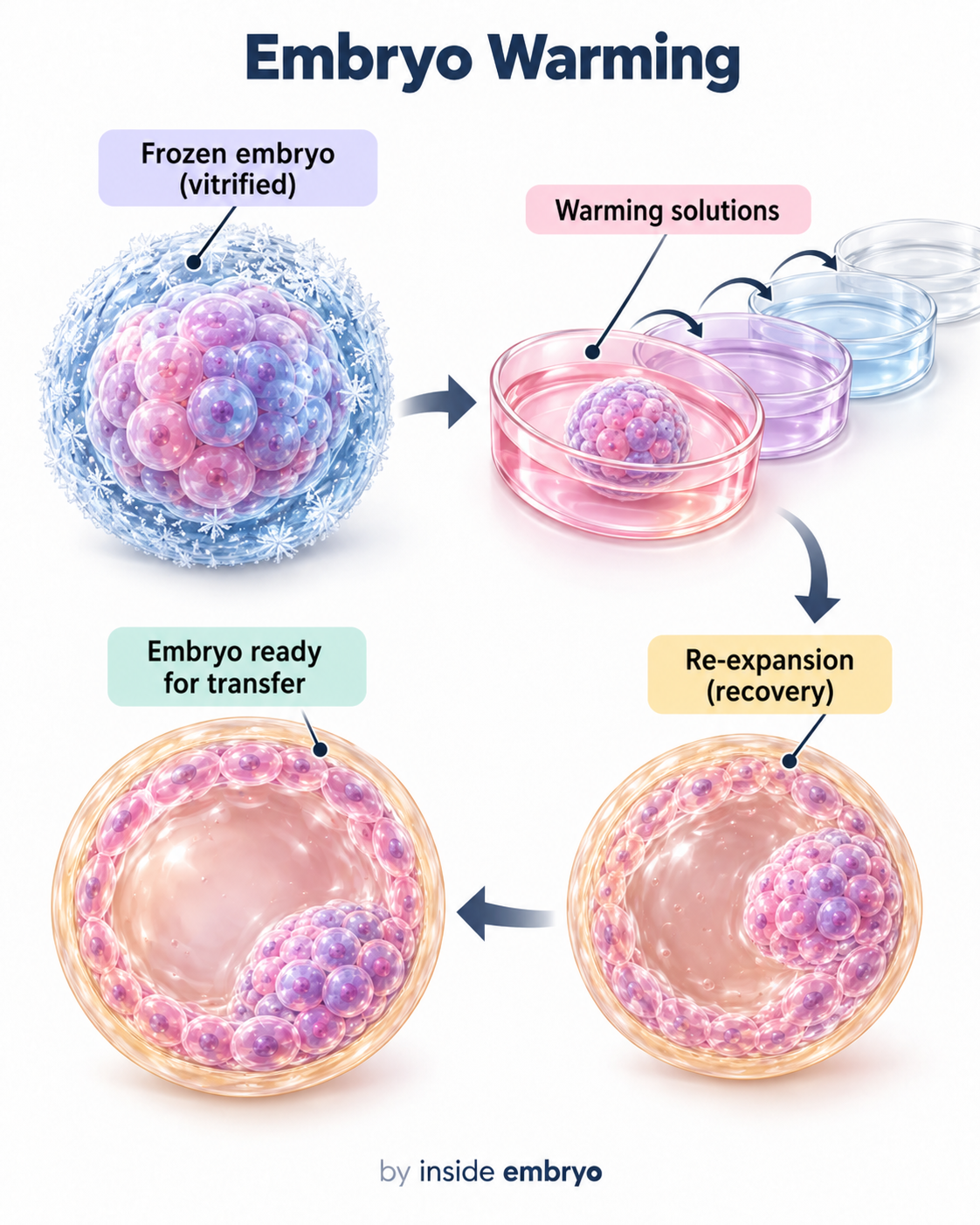
Embryo Warming
A cryopreserved embryo passes through a controlled laboratory warming sequence. Cryoprotectants are removed gradually and the embryo is assessed for survival. A surviving blastocyst may re-expand during further culture.
Swipe across the pictures. On a computer, use the arrows or focus the carousel and press ← / →.
CONTINUE YOUR READING
The latest in Patient Education.
A little more detail, one article at a time.
The latest published article will load here on the website.
A LITTLE CLARITY GOES A LONG WAY
You may have heard…
Let’s look at the facts.
Five common misunderstandings about patient education. Explore the facts beside each one.
01 / Patient Education
Infertility is always a female problem.
Fertility difficulties can involve male factors, female factors, or an unexplained cause. Assessment should consider the people involved in the treatment plan.
02 / Patient Education
Everyone with fertility difficulties needs IVF.
Treatment depends on the cause and individual circumstances. Options can include medicines, selected surgery, IUI or IVF. Your assessment helps guide the discussion.
03 / Patient Education
An AMH result is a score for egg quality.
AMH mainly helps estimate ovarian reserve and likely response to stimulation. It does not directly measure egg quality or give a personal pregnancy prediction on its own.
04 / Patient Education
IVF automatically means having twins.
IVF does not inevitably lead to twins. Transferring one embryo reduces multiple-pregnancy risk; the number to transfer should be discussed with the clinic.
05 / Patient Education
If a treatment add-on is offered, its benefit is already proven.
Evidence differs between add-ons and patient groups. Ask what benefit is supported for your circumstances, what the risks are, and what it costs.
EXPLORE MORE IN THIS CATEGORY
Keep learning about Patient Education.
Take the next question a little further. Browse the articles below, with the newest reads first.
Articles from this category load here. You can also use the archive link below.
CONNECT THE IDEAS
Where would you like to go next?
IVF Journey
See how appointments, laboratory updates and treatment steps connect.
Explore IVF Journey →IVF & Fertility Basics
Build confidence with reproductive anatomy and the essential terms.
Explore IVF & Fertility Basics →Fertility Glossary
Look up the words you hear during treatment.
Explore Fertility Glossary →TAKE A QUESTION WITH YOU
From reading
to a clearer conversation.
What does this result mean for my own treatment?
Which options are suitable for me, and why?
When should I expect the next update?
You do not have to understand everything today.
Begin with the question that matters most to you. This guide can help you prepare for a conversation with your team about your own care.
Sources and notes about this page
- WHO · Infertility
- NHS · Fertility treatment options
- ASRM · Understanding ovarian reserve tests
- HFEA · Decisions about embryos
- HFEA · Evidence for treatment add-ons
- ESHRE · Good practice in IVF laboratories (2015)
- OpenStax · Embryonic development
Illustrations explain concepts and are not diagnostic images, grading tools or laboratory protocols. Some diagrams simplify structures or timing. Your care team interprets findings from your own treatment.
By Manoj Kumar K, Embryologist · Medical disclaimer · Back to top ↑