
Clinical Governance: Definition, Relevance and Application in Assisted Reproduction
ART Standards, Laws and Ethics
| Term | Clinical governance |
| Author | Manoj Kumar K |
| Publisher | Inside Embryo by Aurion |
| Website | insideembryo.com |
| Publication date | 22 August 2026 |
| Jurisdiction | Global, with examples from India, the United Kingdom, the European Union and the United States |
| Information current | 22 August 2026 |
Direct definition
Definition
Clinical governance is the organisation framework through which an ART service accepts accountability for the quality, safety, ethics and continual improvement of clinical and laboratory care. It links leadership, clear responsibilities, competent staff, evidence-based practice, patient involvement, risk management, audit, incident learning, traceability and reliable records so that standards are implemented, monitored, reviewed and improved across the complete treatment pathway.
Table of Contents
Key facts
- Clinical governance emerged from United Kingdom health-service quality reforms in the late 1990s, but the term is now used more broadly in healthcare.
- It is not a single policy, committee or inspection; it is the connected system by which an organisation directs, assures and improves care.
- In ART, governance must join clinical decisions with laboratory processes, consent, identity, traceability, cryostorage, records and outcome reporting.
- A quality management system is a central operational component of clinical governance, but clinical governance is wider because it also includes leadership, ethics, patient experience and accountability.
- Its legal force depends on jurisdiction-specific legislation, regulations, licence conditions and adopted standards; the phrase itself is not a universal legal category.
- ART outcomes are multifactorial. Good governance improves the reliability and safety of care but cannot guarantee pregnancy or live birth for an individual patient.
1. What Is Clinical Governance?
The classic formulation described clinical governance as a framework through which healthcare organisations are accountable for continually improving service quality and safeguarding high standards of care.[1] The concept arose in the United Kingdom National Health Service, where it made quality a corporate responsibility rather than leaving it solely to individual professional judgement. Current NHS material continues to connect governance with accountability, monitoring, patient safety and quality improvement.[2]
In assisted reproduction, clinical governance means translating that accountability into a coordinated system spanning the fertility clinic, procedure areas, embryology and andrology laboratories, cryostorage, counselling, administration, data systems and senior leadership. Corporate governance directs the organisation as a whole; information governance protects and controls information; a quality management system controls operational quality. Clinical governance connects all three around the safety, effectiveness, ethics and experience of patient care.
2. Why Clinical Governance Matters in ART
ART combines invasive clinical care with the identification, manipulation, culture, testing, storage and transfer of reproductive material. Some errors may be irreversible, may affect more than one person and may not become apparent immediately. The pathway also generates sensitive reproductive, genetic and outcome data. Governance therefore provides the structure for preventing avoidable harm, detecting weak signals, escalating concerns, communicating honestly and demonstrating that corrective action has worked.
For patients, this supports understandable consent, respect for choices, continuity of information, privacy and a fair response to complaints or incidents. For professionals, it clarifies decision rights, supervision, competency, documentation and escalation. For the organisation and regulator, it supplies evidence that care is controlled and reviewed. Responsible outcome reporting is also a governance function: a rate is meaningful only when the outcome, denominator, population, treatment stage, exclusions, observation period and uncertainty are stated. No single laboratory metric, embryo grade or performance indicator independently determines an individual result.

3. Scientific and Professional Basis
Clinical governance is grounded in systems thinking: outcomes arise from interactions between people, processes, equipment, environment, information and organisational decisions. WHO describes high-quality services as effective, safe, people-centred, timely, equitable, integrated and efficient, and identifies governance, a competent workforce and usable information as enabling conditions.[3,4] These principles are especially relevant to ART because the clinical and laboratory parts of the pathway are interdependent.
Assurance and improvement have different but complementary purposes. Assurance asks whether defined requirements are being met through audit, validation, review and evidence. Improvement uses data, staff and patient feedback, incident analysis and structured change to make care better. A mature system also considers human factors: workload, interruptions, interface design, fatigue, communication and the ease with which staff can report concerns without inappropriate blame.
4. Application Across the ART Pathway
Governance follows the patient and reproductive material rather than starting at the laboratory door. Controls should be proportionate to risk, connected across departments and supported by evidence that can be retrieved and reviewed.
Table 1. Clinical governance controls across the ART pathway
| Stage | Governance controls | Evidence or assurance |
| Consultation and consent | Identity verification; accurate information; valid and current consent; privacy; documentation of choices and withdrawal routes. | Consent records, information versions, communication audit and complaints learning. |
| Assessment and planning | Clinical indication; risk assessment; treatment authorisation; multidisciplinary decisions; donor or genetic pathways where applicable. | Approved plan, decision record, eligibility checks and documented exceptions. |
| Laboratory procedures | Witnessing; unique identification; traceability; validated SOPs; equipment and environmental control; staff competency. | Witnessing logs, audit trails, validation, QC trends and competency records. |
| Cryostorage and transfer | Consent status; inventory control; tank mapping; alarms; contingency; release checks; transport controls. | Inventory reconciliation, alarm tests, incident logs, transfer and chain-of-custody records. |
| Follow-up and reporting | Outcome definitions; complete follow-up; denominator clarity; required registry reporting; incident review and improvement. | Validated datasets, audit reports, CAPA effectiveness and governance minutes. |

5. Standards and Guidelines
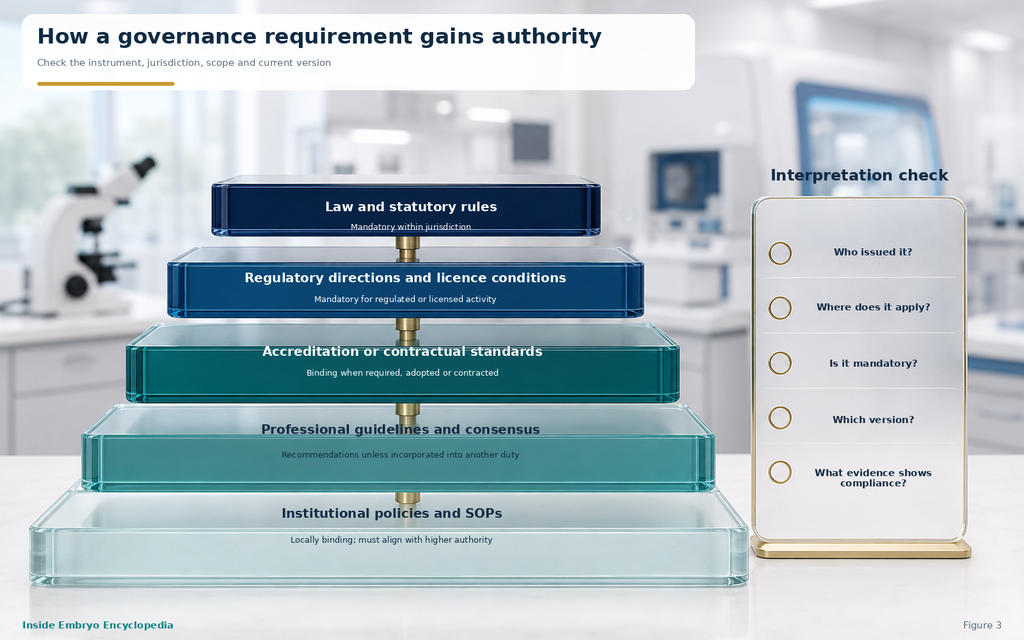
No single global document creates a complete clinical-governance code for every ART service. Organisations should maintain a controlled register of applicable requirements and distinguish their authority. The 2026 ESHRE good-practice recommendations address staffing, quality management, safety, traceability, validation, risk, audit and emergency planning for IVF laboratories.[5] They are professional recommendations, not automatically legislation outside a jurisdiction that incorporates them.
ASRM/SART/SRBT publications provide professional frameworks for United States ART programmes and laboratories, including personnel, consent, records, quality control and operational management.[6,7] ISO 15189:2022 specifies requirements for quality and competence in medical laboratories, but whether it formally applies to a particular ART laboratory depends on scope, national arrangements and the accreditation sought.[8] WHO quality publications provide a health-system foundation rather than ART-specific legal requirements.[3,4]
Table 2. Distinguishing sources of authority
| Instrument | Typical issuer | How to interpret it |
| Law or statutory rule | Legislature or authorised rule-maker | Mandatory within its jurisdiction and scope. Confirm commencement, amendments and transitional provisions. |
| Regulator direction or licence condition | Competent regulator or licensing body | Mandatory for the regulated activity or licence holder when validly imposed. |
| Accreditation or contractual standard | Accreditation body, payer or contracting party | Binding when accreditation, contract or local law requires it; not automatically legislation. |
| Professional guideline or consensus | Professional society or expert group | Evidence-informed recommendation. It may influence expected practice but is not automatically law. |
| Institutional policy or SOP | Clinic or laboratory governance authority | Locally binding for staff and operations; must not conflict with higher legal or regulatory duties. |
6. Legal and Regulatory Context
India. The Assisted Reproductive Technology (Regulation) Act, 2021 has been in force since 25 January 2022. It establishes registration and supervisory structures and contains duties concerning consent, records, gametes, embryos, storage and handling.[9] The ART Rules 2022 have been amended, including by the ART (Regulation) Amendment Rules, 2026, effective on publication on 17 June 2026.[10] The Act does not make ‘clinical governance’ a defined universal checklist; a clinic’s governance system is a practical means of organising and evidencing compliance, not a substitute for checking the Act, Rules, Regulations and competent-authority requirements.
United Kingdom. The Human Fertilisation and Embryology Act 1990, as amended, provides the statutory basis for HFEA licensing and oversight of regulated fertility treatment, storage and embryo research. HFEA licensing, directions and the Code of Practice combine different forms of authority; the HFEA identifies Code of Practice version 9.4 as effective from 26 October 2023.[11,12] A clinic must identify which parts state law, licence conditions or directions and which provide guidance. Other healthcare-provider requirements may also apply.
European Union. Regulation (EU) 2024/1938 creates a new quality and safety framework for substances of human origin, including reproductive cells, tissues and embryos. It is in force, but most provisions apply from 7 August 2027; Directive 2004/23/EC is repealed from that date.[13] Until then, the existing directives and national transposing laws remain central, and Member States may impose additional requirements.
United States. Federal oversight addresses particular domains rather than creating one uniform national ART governance code. The Fertility Clinic Success Rate and Certification Act requires annual clinic reporting to CDC, which publishes clinic-specific success rates and laboratory accreditation status.[14] State law, professional guidance, accreditation, facility rules and federal requirements for relevant activities must therefore be mapped together.
Educational legal disclaimer
This encyclopedia entry is intended for scientific and educational purposes and does not constitute legal advice. ART legislation, regulation and professional requirements vary between jurisdictions and may change over time. Readers should consult current official regulatory and legal sources applicable to their location.
7. Ethical Considerations
Clinical governance operationalises ethical duties without replacing ethical reasoning. Respect for autonomy requires valid consent, understandable information and protection of reproductive choices. Beneficence and non-maleficence support proportionate risk control, competent care and timely response to harm. Justice concerns fair processes, avoidance of discriminatory practice and attention to access. Privacy and confidentiality are particularly important where fertility, donor and genetic information may affect several people.
Transparency after an error is both an ethical and governance issue. ASRM’s 2024 Ethics Committee opinion states that clinically significant errors involving gametes or embryos should be disclosed, recommends written policies and root-cause analysis, and treats near-miss disclosure differently from disclosure of harmful or clinically significant events.[15] This is professional ethical guidance; legal reporting and disclosure duties must still be checked locally. A just culture supports reporting and learning while preserving individual accountability for reckless or deliberately unsafe conduct.
8. Laboratory and Clinical Application
Day-to-day governance should be visible in decisions and evidence, not only in a policy folder. A workable system commonly includes:
- named clinical, laboratory and organisational accountabilities, with clear deputies and escalation routes;
- controlled SOPs, forms and patient information, with approval, version control and withdrawal of obsolete copies;
- risk assessment, change control, process validation, equipment qualification, preventive maintenance and emergency planning;
- positive patient and specimen identification, witnessing and complete chain-of-custody traceability;
- documented induction, supervision, competency assessment, continuing education and retraining where required;
- proportionate incident and near-miss reporting, investigation, corrective and preventive action, and effectiveness checks;
- internal audit, external assessment where applicable, quality indicators with defined populations and denominators, and management review; and
- patient feedback, complaints learning, honest communication and secure, accurate, retrievable records.
Governance meetings should turn information into decisions: identify material risks, assign an owner and deadline, record the rationale, check completion and verify whether the change reduced risk. The 2026 ESHRE recommendations emphasise documented quality systems, non-conformity analysis, CAPA, risk-based change control, audit, validation, performance review and emergency preparation.[5]

9. Interpretation and Limitations
Clinical governance is an organising framework, not a validated treatment intervention and not a promise of success. Its boundaries differ between organisations and countries, and evidence for particular governance tools may be indirect. Small programmes may need simpler structures, but they still require clear accountability, independence of review where practicable and reliable escalation. Documentation volume should be proportionate: excessive paperwork can obscure risk just as inadequate records can.
Metrics can be affected by case mix, missing follow-up, changing definitions and small denominators. They should be used to identify signals and support learning, not to attribute complex outcomes automatically to one practitioner or process. Requirements and guidance change; every service needs an assigned process for surveillance, impact assessment and timely revision of policies, consent materials, data definitions and SOPs.
10. Common Misunderstandings
Misconception: Clinical governance is the same as legal compliance. Reality: compliance is essential, but governance also includes quality improvement, culture, ethics, patient experience and organisational learning.
Misconception: A guideline is law. Reality: a professional guideline is generally advisory unless legislation, a regulator, a licence, accreditation or contract incorporates it.
Misconception: Accreditation proves every treatment is safe and effective. Reality: accreditation assesses a defined scope against specified standards; it does not remove biological uncertainty or replace ongoing risk management.
Misconception: More indicators always mean better governance. Reality: a small set of valid, interpretable and actionable measures is more useful than a large dashboard without ownership or follow-through.
Misconception: An incident report completes the response. Reality: containment, appropriate communication, investigation, corrective action and verification of effectiveness are needed to close the loop.
Misconception: Good governance guarantees ART success. Reality: it reduces avoidable variation and harm and improves reliability, but ART outcomes remain multifactorial and patient-specific.
11. International Perspective
Internationally, the components of clinical governance are more consistent than the label. Most mature frameworks expect accountable leadership, competent staff, controlled processes, traceability, valid consent, incident learning, reliable data and continual improvement. The source of authority differs: the United Kingdom uses a specialist licensing regulator; India has a national ART statute, Rules, Registry and appropriate authorities; the European Union combines Union quality-and-safety law with Member State implementation; and the United States combines specific federal reporting requirements with state law, accreditation and professional guidance. Requirements vary by jurisdiction, so international recommendations should be adapted only after a local applicability review.
12. Quick Summary
- Clinical governance is organisation-wide accountability for safe, effective, ethical and continually improving care.
- In ART it must link clinic, laboratory, cryostorage, counselling, administration, data and leadership.
- A quality management system is central but does not represent the whole governance framework.
- Law, regulation, licence requirements, standards, guidelines and local policies have different sources and levels of authority.
- Consent, identity, traceability, competency, risk management, incident learning and responsible reporting are core applications.
- Outcome measures require clear definitions, denominators, populations, timeframes and limitations.
- Governance should produce evidence of learning and improvement, not merely more documentation.
14. FAQs
Is clinical governance a law?
Not by itself. It is a governance concept. Particular duties become mandatory through applicable legislation, regulations, licence conditions, regulator directions, accreditation commitments, contracts or institutional rules.
Is clinical governance the same as a quality management system?
No. The quality management system is the operational framework for controlled quality processes. Clinical governance is broader and also includes leadership, professional accountability, ethics, patient experience and organisational oversight.
Who is responsible for clinical governance in an ART service?
Responsibility is shared but not vague. The governing body or owner, senior clinical and laboratory leaders, quality personnel and individual staff should each have documented duties, with one clear route for ultimate accountability and escalation.
What evidence shows that governance is working?
Examples include controlled documents, competency records, complete traceability, audit results, meaningful indicators, incident learning, timely CAPA, effectiveness checks, management-review decisions and demonstrable responses to patient feedback.
Does compliance with ESHRE or ASRM guidance satisfy the law?
Not automatically. These are professional sources. A clinic must separately identify current legal and regulatory requirements in its jurisdiction and determine whether any guidance has been incorporated into a mandatory instrument.
How should an ART clinic use success rates?
Define the outcome, denominator, population, treatment stage, exclusions and observation period; explain uncertainty and case mix; and avoid implying that one metric predicts an individual’s chance of success.
How often should governance arrangements be reviewed?
Review frequency should be risk-based and meet local requirements. Review should also be triggered by legal or guidance changes, incidents, audit findings, new technology, significant process changes or evidence that existing controls are ineffective.
15. References
- Scally G, Donaldson LJ. Clinical governance and the drive for quality improvement in the new NHS in England. BMJ. 1998;317(7150):61-65. Source
- NHS England. Governance, patient safety and quality [Internet]. London: NHS England; [cited 2026 Aug 22]. Available from: https://www.england.nhs.uk/mat-transformation/matrons-handbook/governance-patient-safety-and-quality/
- World Health Organization. Quality of care [Internet]. Geneva: WHO; [cited 2026 Aug 22]. Available from: https://www.who.int/health-topics/quality-of-care
- World Health Organization. Handbook for national quality policy and strategy: a practical approach for developing policy and strategy to improve quality of care. Geneva: WHO; 2018. Source
- ESHRE Good Practice in the IVF Lab Working Group, Arroyo G, Barrie A, Coticchio G, et al. ESHRE recommendations on Good Practice in the IVF laboratory. Hum Reprod. 2026;41(8):1245-1269. doi:10.1093/humrep/deag096. Source
- Practice Committees of the American Society for Reproductive Medicine, Society for Assisted Reproductive Technology, and Society of Reproductive Biologists and Technologists. Minimum standards for practices offering assisted reproductive technologies: a committee opinion. Fertil Steril. 2021;115(3):578-582. Source
- Practice Committees of the American Society for Reproductive Medicine and the Society for Reproductive Biologists and Technologists. Comprehensive guidance for human embryology, andrology, and endocrinology laboratories: management and operations: a committee opinion. Fertil Steril. 2022;117(6):1183-1202. Source
- International Organization for Standardization. ISO 15189:2022 Medical laboratories – Requirements for quality and competence. 4th ed. Geneva: ISO; 2022. Source
- Government of India. Assisted Reproductive Technology (Regulation) Act, 2021, Act No. 42 of 2021 [Internet]. New Delhi: Ministry of Law and Justice; 2021 [cited 2026 Aug 22]. Available from: https://www.indiacode.nic.in/handle/123456789/17031?locale=en
- Government of India. Assisted Reproductive Technology (Regulation) Amendment Rules, 2026, G.S.R. 491(E), 17 June 2026 [Internet]. New Delhi: Ministry of Health and Family Welfare; 2026 [cited 2026 Aug 22]. Available from: https://dhr.gov.in/static/uploads/2026/06/383d0a7b4f1a702ff24a8b28b022ec75.pdf
- Human Fertilisation and Embryology Authority. How we regulate [Internet]. London: HFEA; [cited 2026 Aug 22]. Available from: https://www.hfea.gov.uk/about-us/how-we-regulate/
- Human Fertilisation and Embryology Authority. Code of Practice version 9.4 [Internet]. London: HFEA; 2023 [cited 2026 Aug 22]. Available from: https://www.hfea.gov.uk/about-us/news-and-press-releases/2023/the-code-of-practice-version-94-is-now-available/
- European Parliament and Council of the European Union. Regulation (EU) 2024/1938 of 13 June 2024 on standards of quality and safety for substances of human origin intended for human application. Off J Eur Union. 2024;L 2024/1938. Source
- Centers for Disease Control and Prevention. National ART Surveillance System [Internet]. Atlanta: CDC; [cited 2026 Aug 22]. Available from: https://www.cdc.gov/art/php/nass/index.html
- Ethics Committee of the American Society for Reproductive Medicine. Disclosure of medical errors and untoward events involving gametes and embryos: an Ethics Committee opinion. Fertil Steril. 2024;122(5):814-820. Source
Publication notice
Inside Embryo provides scientific and educational information. This entry does not replace medical advice, supervised laboratory training, validated institutional procedures, regulator instructions or legal advice.