BEGINNER SCIENTIFIC ARTICLE
How Adverse Reproductive Outcome Reporting Works
Risk, Safety and Terminology in Clinical Governance
| Learning level | Beginner |
| Major category | ART Standards, Laws and Ethics |
| Subcategory | Clinical Governance and Quality Assurance |
| Author | Manoj Kumar K, Embryologist |
| Publisher | Inside Embryo by Aurion |
| Publication date | 24 August 2026 |
| Country context | Global; local reporting rules must be checked |
Article overview
Adverse reproductive outcome reporting is a structured way of recording, reviewing and learning from unfavourable outcomes and safety signals across fertility care. It helps an organisation understand what occurred, protect patients and reproductive material, meet legal or regulatory duties, identify system weaknesses and prevent recurrence. The central principle is simple: a report is useful only when it leads to proportionate action and verified learning.
| KEY DISTINCTION An adverse reproductive outcome is not automatically evidence of an error. Pregnancy loss, ectopic pregnancy or preterm birth may occur despite appropriate care. Reporting becomes a clinical-governance function when the outcome is captured consistently, assessed for preventability and causation, escalated when required and used to improve the system. |
What you will learn
- The difference between outcome surveillance, incident reporting and regulatory vigilance.
- How to use the terms adverse outcome, adverse event, adverse reaction, serious event and near miss correctly.
- Which reproductive, clinical and laboratory signals may require local or external reporting.
- How risk grading, investigation, corrective action and feedback fit into clinical governance.
- Why standard terminology, confidentiality and a just culture improve reporting quality.
1. What does adverse reproductive outcome reporting mean?
The phrase describes the organised capture and review of an unfavourable reproductive outcome or related safety signal. Depending on the purpose, the information may enter a clinical record, an ART outcome registry, a local incident-learning system, a tissue-and-cell vigilance system, a complaint process or more than one of these. These systems share data, but they do different jobs.
Outcome surveillance asks what happened across cycles and pregnancies: for example, pregnancy loss, ectopic pregnancy, multiple gestation, preterm birth or live birth. Incident reporting asks whether care, equipment, communication, identity control, consent, traceability or another system factor caused or could have caused avoidable harm. Regulatory vigilance focuses on defined serious adverse events and reactions that must be notified to a competent authority within prescribed timeframes. In the United States, for example, the National ART Surveillance System follows each reported ART cycle and its resultant pregnancy and birth outcomes; this is principally surveillance and public reporting, not a substitute for a clinic’s internal incident system.[6]
| BEGINNER RULE First record the outcome accurately. Then ask a separate safety question: was there an incident, deviation, reaction, preventable factor or regulatory trigger associated with it? |
2. Why reporting belongs to clinical governance
Clinical governance is the framework through which a healthcare organisation remains accountable for quality, safety, effectiveness and continuous improvement. Reporting contributes evidence to that framework. It makes risk visible, supports timely escalation, creates an audit trail and allows leaders to test whether changes actually reduced risk.
A mature reporting system is designed for learning rather than blame. WHO guidance stresses that incident reports can reveal the nature of harm and opportunities for improvement, but the data must be interpreted cautiously. Voluntary reporting counts are influenced by reporting culture, awareness and system design; a rise in reports may represent better detection rather than deteriorating care.[1] The HFEA similarly notes that prompt incident reporting is a sign of a responsible fertility sector.[5]
In practical terms, reporting connects six governance activities: patient protection, regulatory compliance, risk management, quality improvement, staff learning and transparent communication. Weakness in any one of these can leave the organisation with reports that are filed but not converted into safer practice.
3. The terminology beginners must separate
Terms are not interchangeable. Their exact legal meaning varies between countries and regulatory systems, so the local policy and governing legislation always take precedence. The table below provides a safe conceptual starting point based on international patient-safety language and reproductive-cell vigilance terminology.[1-4]
| Term | Beginner-friendly meaning |
| Adverse reproductive outcome | An unfavourable reproductive, pregnancy, maternal, fetal, neonatal or offspring outcome. It describes what happened; it does not by itself prove preventability or error. |
| Patient-safety incident | An event or circumstance that could have resulted, or did result, in unnecessary harm associated with care. |
| Adverse event | Commonly, an incident that results in harm. Some tissue/cell regulations instead use “event” for a process problem that creates a risk of harm, so the governing definition must be checked. |
| Adverse reaction | Harm experienced by a donor, recipient or, in some regulatory frameworks, offspring, that may be associated with collection or application of reproductive cells or tissues. |
| Serious adverse event/reaction | A regulatory category meeting defined seriousness criteria, such as death, life-threatening harm, hospitalisation, major intervention, loss or mix-up of reproductive material, or loss of traceability. Criteria differ by jurisdiction. |
| Near miss | A safety incident that did not reach the patient, gamete or embryo, or reached them without causing harm, but had credible potential to do so. |
| Complication | An undesired clinical development that may occur despite appropriate care. A complication may still require reporting and review. |
| Non-conformance/deviation | A departure from an approved procedure, specification, licence condition or quality-system requirement; harm is not required. |
| Complaint | An expression of dissatisfaction. It may reveal an incident, but complaints and incident reports are governed through related, not identical, pathways. |
| Imputability | The assessed likelihood that the outcome or reaction is causally associated with the treatment, product, collection or application. |
| Severity | The actual degree of harm produced. |
| Likelihood | The probability of occurrence or recurrence. Risk combines consequence with likelihood, usually using a locally approved matrix. |
The European Union’s Regulation (EU) 2024/1938 provides a useful example of specialised terminology. It defines vigilance as organised surveillance and reporting procedures for adverse reactions and adverse events. In that framework, an adverse reaction involves harm, while an adverse event is an incident or error that creates a risk to quality or safety. It also specifies reproductive examples such as mix-up of reproductive material, loss of traceability and certain genetic transmission or PGT-related harms.[3] Most provisions apply from 7 August 2027, so services must currently follow the law in force in their jurisdiction while preparing for transition where relevant.[8]
4. What may count as an adverse reproductive outcome?
An adverse reproductive outcome is a descriptive result, not a conclusion about fault. The scope may extend from treatment and pregnancy to maternal, fetal, neonatal or offspring outcomes. Standard definitions are important because a registry, audit or research report is only comparable when the numerator, denominator, timing and outcome definition are explicit. The 2025 International Glossary on Infertility and Fertility Care was developed to support this consistency across clinical care, research and policy.[7]
Clinical and pregnancy outcomes
- Pregnancy loss, with gestational age at the end of pregnancy recorded; miscarriage rate should use clinical pregnancies with known outcomes as its denominator.[7]
- Pregnancy of unknown location, ectopic pregnancy or heterotopic pregnancy.
- Severe or critical ovarian hyperstimulation syndrome, hospitalisation, thromboembolism, significant bleeding, infection or another major treatment complication.
- Multiple gestation, preterm birth, low birth weight, stillbirth, neonatal death or maternal death.
- Congenital anomaly, genetic disorder or other outcome requiring follow-up under a local registry or vigilance rule.
- Cycle cancellation, failed fertilisation or failure to reach transfer when the result is clinically relevant; these are not automatically incidents.
Laboratory, product and governance signals
- Actual or potential patient, gamete or embryo misidentification; incorrect insemination, transfer or disposition.
- Loss, damage, contamination or unexplained change affecting gametes, embryos or reproductive tissue.
- Cryostorage alarm, temperature excursion, tank failure, inventory discrepancy or loss of traceability.
- Equipment, media, consumable or environmental failure with potential effect on safety or quality.
- Witnessing failure, labelling discrepancy, documentation error or unauthorised change to the treatment plan.
- Consent, confidentiality, data-integrity or communication failure that caused or could cause harm.
- PGT sample, result, interpretation or communication error, including a potential mismatch between tested material and embryo.
- A near miss intercepted before the wrong sample, embryo, treatment or information reached the patient.
5. Not every poor outcome is a safety incident
Fertility treatment occurs within biological uncertainty. A euploid embryo may not implant; a correctly managed pregnancy may miscarry; an ectopic pregnancy may occur without a process failure. Labelling every unfavourable outcome as an error creates misleading data and can promote defensive practice. Ignoring outcomes because they are recognised complications is equally unsafe.
The governance response should therefore be proportional. Record the outcome, apply the agreed definition, assess whether care deviated from policy or expected practice, look for contributory factors, and determine whether internal or external reporting thresholds are met. The presence of harm, seriousness, preventability and imputability are related questions, not synonyms.
| GOOD GOVERNANCE QUESTION Do not ask only, “Was there an error?” Ask, “What happened, what was the degree of harm, could the system have influenced it, does it meet a reporting threshold, and what can be learned?” |
6. How the reporting process works
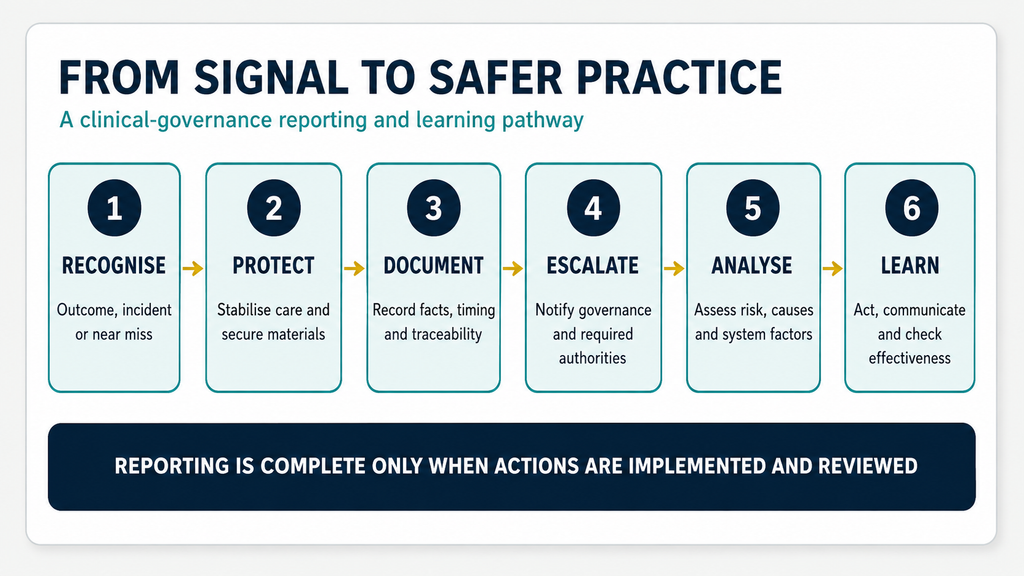
A safe reporting pathway starts with immediate care and ends with an effectiveness check. Local standard operating procedures should name the responsible persons, escalation thresholds, external authorities and time limits. The following six-stage model is suitable for beginner orientation; it must be adapted to local requirements.
| Stage | Action |
| STEP 1 Recognise the signal | Confirm the immediate facts. Decide whether the observation is an outcome, incident, reaction, near miss, non-conformance or complaint. Do not delay urgent care while debating classification. |
| STEP 2 Protect people and material | Provide clinical assessment and treatment, stop the affected process when necessary, quarantine relevant material, isolate equipment, preserve records and prevent additional exposure. |
| STEP 3 Document facts promptly | Record what was observed, when and where it occurred, the people and material involved, objective evidence, immediate actions and current outcome. Avoid speculation and blame in the initial report. |
| STEP 4 Escalate and notify | Inform the designated clinical-governance lead, Person Responsible, quality manager or medical director. Apply the local seriousness criteria and notify the competent authority, registry, device-vigilance body or other agency within the required timeframe. |
| STEP 5 Analyse risk and causes | Assess actual harm, potential harm, likelihood of recurrence, number of people or samples at risk and preliminary imputability. Use an appropriate method such as a concise contributory-factor review, root-cause analysis or multidisciplinary case review. |
| STEP 6 Learn, act and verify | Agree corrective and preventive actions, assign owners and deadlines, communicate with affected patients and staff, update training or systems, and measure whether the action worked. Close the event only when evidence supports closure. |
7. What information should a report contain?
The report should be detailed enough for another trained reviewer to reconstruct the event while using only the minimum necessary identifiable information. WHO’s Minimal Information Model illustrates the value of a consistent core dataset for extracting learning from incident reports.[9] ART services also need strong traceability across people, cycles, reproductive material, devices, consumables, locations and time points.
| Information domain | Minimum useful content |
| Who and where | Unique identifiers; clinic/site; responsible service; reporter; people or reproductive material affected. |
| What happened | Factual sequence, date/time, procedure stage, device/material involved and how the signal was detected. |
| Outcome and harm | Clinical/reproductive outcome, harm severity, care required, hospitalisation and current status. |
| Traceability | Cycle, sample, donor/recipient, embryo/gamete, batch, incubator, cryostorage and witness-system identifiers as applicable. |
| Immediate controls | Treatment provided, quarantine/recall, equipment isolation, data preservation and notifications already made. |
| Risk assessment | Severity, likelihood, potential spread, recurrence risk, seriousness and preliminary imputability. |
| Follow-up | Investigation owner, regulatory deadlines, open disclosure, corrective actions, effectiveness checks and closure approval. |
Where possible, separate factual data from interpretation. Attach relevant witness logs, equipment records, environmental monitoring, photographs, electronic audit trails or batch details according to policy. Do not alter original records; corrections should remain traceable.
8. Risk grading: severity is not the same as likelihood
Risk grading helps the organisation decide how quickly and deeply to respond. Severity describes the consequence; likelihood describes the probability of occurrence or recurrence. A near miss may have no actual harm but extremely high potential severity. A common minor administrative error may have low severity but still deserve system redesign because it occurs frequently.
| Likelihood / consequence | Minor | Moderate | Major | Severe |
| Rare | Low | Low | Moderate | Moderate |
| Possible | Low | Moderate | Moderate | High |
| Likely | Moderate | Moderate | High | High |
| Almost certain | Moderate | High | High | High |
Figure 2. Illustrative risk matrix only. Use the matrix approved by the clinic and regulator; thresholds are not universal.
Risk matrices support prioritisation but do not replace clinical judgement or legal reporting criteria. A regulator may require notification regardless of the local score. The HFEA, for example, uses a grading approach for incidents and near misses that considers severity and recurrence risk, while defined events such as severe or critical OHSS are specifically reportable.[4,5]
9. Investigation and corrective action
Investigation should focus on how the system produced or failed to stop the event. Useful domains include patient factors, task design, staffing, competence, communication, workspace, equipment, digital systems, consumables, procedures, supervision and organisational pressures. Human error may describe the final action but rarely explains why it became possible.
Corrective action versus preventive action
A corrective action removes or controls the cause of the identified event. A preventive action addresses a credible risk before another event occurs. Training may be appropriate, but training alone is weak when the underlying problem is confusing software, look-alike labels, poor storage design, workload, ambiguous responsibilities or missing independent verification.
Effectiveness checking
An action is not complete when the policy is signed. The organisation should define what success will look like, when it will be checked and who will review it. Evidence may include an audit of compliance, repeated risk assessment, trend data, simulation testing, staff feedback or confirmation that an engineering control works as intended.
10. Communication, confidentiality and open disclosure
Reproductive data are highly sensitive because one event can concern patients, partners, donors, gestational carriers, embryos, gametes and future offspring. Reports should use secure systems, role-based access and data minimisation. Identifiable details should be shared only with those who need them for care, investigation or lawful reporting. Surveillance datasets may require de-identification or statutory confidentiality protections; CDC, for example, describes specific confidentiality protection for NASS data.[6]
When a patient has been affected, communication should be timely, honest, compassionate and coordinated by an appropriately senior clinician. The patient should receive the known facts, immediate implications, planned care, investigation process and a route for further questions. Uncertain facts should be labelled as uncertain. Open disclosure is not the same as premature attribution of blame.
11. A just culture improves reporting
Staff are more likely to report weak signals when they believe the organisation will respond fairly. A just culture distinguishes inadvertent human error, risk-taking behaviour, reckless conduct and deliberate violation. It does not remove accountability; it aligns the response with behaviour and system context. Confidential reporting options, visible leadership support and feedback to reporters help prevent silence.
Raw incident counts should not be used as a simple ranking of clinic safety. A service with more reports may have stronger psychological safety and better detection. Governance teams should examine report quality, severity, recurrence, time to review, overdue actions and evidence of improvement rather than celebrating a low count in isolation.[1,5]
12. Three beginner examples
Example 1: Witnessing discrepancy intercepted before ICSI
A barcode scan identifies that the dish label and electronic record do not match before sperm injection. No gamete is used incorrectly. This is a near miss and a traceability non-conformance. The team should stop, secure all material, reconstruct identity, preserve the electronic log, assess whether other cycles are affected and investigate why the mismatch was possible.
Example 2: Ectopic pregnancy after embryo transfer
The outcome should be recorded using the agreed clinical definition and reported to the relevant outcome system. It is not automatically a safety incident. It becomes an incident-learning concern if, for example, abnormal follow-up results were not acted upon, communication failed or a required escalation was delayed. The clinical outcome and the process failure should be coded separately.
Example 3: Severe ovarian hyperstimulation syndrome
The patient requires hospitalisation after ovarian stimulation. Clinical care takes priority. The clinic should document the outcome, apply its severity and regulatory definitions, notify the designated governance lead and complete any mandatory report. The review should consider prediction, prevention, dosing, monitoring, trigger choice, patient instructions, communication and follow-up without assuming that every case was preventable.
13. What should leaders monitor?
A useful governance dashboard combines outcome, process and learning measures. Suggested indicators include reporting rate by activity volume, high-severity events, near-miss proportion, time from detection to escalation, overdue investigations, overdue corrective actions, recurrence of similar events, traceability non-conformances, severe OHSS, unplanned hospitalisation, pregnancy outcome completeness and effectiveness-check completion. ART laboratory performance indicators can support quality management, but performance metrics should not be confused with safety-event definitions.[10]
Every indicator needs a clear numerator, denominator, inclusion criteria, data source, review frequency and owner. A trend should trigger questions, not automatic conclusions. Changes in patient mix, treatment strategy, reporting culture, definitions or data completeness may alter the apparent rate.
14. Common reporting failures
- Using “adverse event” for every poor outcome without checking the governing definition.
- Treating a known complication as unreportable simply because it is recognised in consent information.
- Waiting for a full investigation before making a time-critical regulatory notification.
- Recording opinion, blame or causation as fact in the initial report.
- Failing to capture near misses, consent failures, confidentiality breaches or traceability deviations.
- Counting reports without adjusting for activity volume or changes in reporting culture.
- Closing actions after policy revision or retraining without testing effectiveness.
- Using inconsistent pregnancy-outcome definitions or unclear denominators.
- Discussing sensitive cases in unsecured channels or including unnecessary identifying information.
15. Global and jurisdiction-specific interpretation
There is no single worldwide list of reportable reproductive outcomes. WHO guidance supports the design of incident reporting and learning systems, while national regulators and laws determine mandatory categories, deadlines and recipients. The HFEA framework illustrates a licensed fertility-sector reporting system; CDC NASS illustrates national ART outcome surveillance; and the EU tissues-and-cells and forthcoming SoHO frameworks illustrate vigilance for reproductive substances of human origin.[1,3-6,8]
Clinics should therefore maintain a jurisdiction-specific reporting matrix that states what must be reported, to whom, by whom, within what timeframe and using which form. The matrix should cover internal governance as well as external regulators, public-health authorities, device or medicine vigilance systems, accreditation bodies, insurers and registries where applicable. Local law, licence conditions and current regulator guidance always override general educational summaries.
Key takeaways
- Describe the outcome before deciding whether it was an incident or error.
- Separate routine ART outcome surveillance from incident reporting and regulatory vigilance.
- Use standard reproductive terminology, explicit denominators and gestational timing.
- Protect patients and reproductive material before completing paperwork.
- Assess actual harm, potential harm, seriousness, likelihood, preventability and imputability separately.
- Report near misses and non-conformances because they reveal risk before harm occurs.
- Complete the learning loop with corrective action, feedback and an effectiveness check.
- Follow the clinic’s local reporting matrix and current jurisdictional requirements.
| ONE-SENTENCE SUMMARY Adverse reproductive outcome reporting works when accurate terminology turns an unfavourable outcome or safety signal into timely protection, proportionate investigation, accountable improvement and verified learning. |
Educational disclaimer
This resource is provided for scientific and educational purposes. It does not replace clinical judgement, local standard operating procedures, legal advice, regulator instructions, licence conditions or mandatory reporting requirements. Definitions and notification thresholds vary by jurisdiction and may change. Fertility services should verify current requirements with their competent authority and governance leadership.
References
1. World Health Organization. Patient safety incident reporting and learning systems: technical report and guidance. Geneva: WHO; 2020. Source
2. World Health Organization. The conceptual framework for the International Classification for Patient Safety. Geneva: WHO; 2010. Source
3. European Parliament and Council. Regulation (EU) 2024/1938 on standards of quality and safety for substances of human origin intended for human application. Official Journal of the European Union. 2024. Source
4. Human Fertilisation and Embryology Authority. Clinic incidents: reporting process, definitions and risk matrix. Accessed 24 Aug 2026. Source
5. Human Fertilisation and Embryology Authority. The fertility sector 2024/25. London: HFEA; 2025. Updated 28 Apr 2026. Source
6. Centers for Disease Control and Prevention. National ART Surveillance System. Updated 10 Dec 2024. Accessed 24 Aug 2026. Source
7. Zegers-Hochschild F, Dyer S, Adamson GD, et al. The International Glossary on Infertility and Fertility Care, 2025. Hum Reprod. 2026;41(6):892-909. doi:10.1093/humrep/deag029. Source
8. European Commission. New EU rules on substances of human origin. Regulation applies from 7 Aug 2027, with specified exceptions. Accessed 24 Aug 2026. Source
9. World Health Organization. Minimal Information Model User Guide for patient safety incident reporting. Geneva: WHO; 2016. Source10. ESHRE Special Interest Group of Embryology and Alpha Scientists in Reproductive Medicine. ART laboratory performance indicators: the Vienna Consensus. ESHRE. Accessed 24 Aug 2026. Source