Introduction and core concepts for students, patients and new IVF laboratory trainees.
| LEARNING LEVEL – Beginner | AUTHOR – Manoj Kumar K | REVIEWED – 3 August 2026 |
| CATEGORY – ART Standards and Guidelines | READING TIME – 10-12 minutes | WEBSITE – insideembryo.com |
Educational resource – not a fertility diagnosis, treatment plan or substitute for qualified clinical advice.
How to use this beginner guide
| Learning level | Beginner |
| Major category | ART Standards, Laws and Ethics |
| Subcategory | ART Standards and Guidelines |
| Content type | Educational article |
| Estimated reading time | 10-12 minutes |
| Last reviewed | 3 August 2026 |
| Intended audience | Students, patients, new IVF laboratory trainees and first-time readers |
Key learning outcomes
• Define the purpose of the World Health Organization semen examination manual.
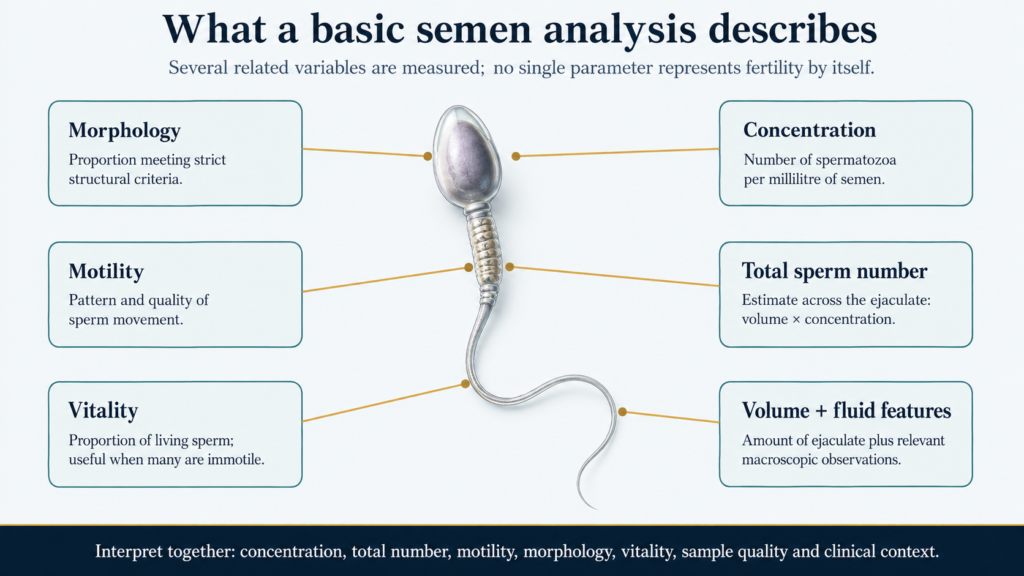
• Identify the main measurements included in a basic semen analysis.
• Understand the difference between a statistical reference value and a fertility diagnosis.
• Describe the journey of a semen sample through the laboratory.
• Differentiate the major features of the fifth and sixth editions.
• Recognise when repeat testing and professional interpretation may be necessary.
| KEY POINT Quick answer : The World Health Organization (WHO) fifth and sixth edition manuals provide standardised methods for collecting, examining, processing and reporting human semen. The fifth edition was issued in 2010; the sixth edition was issued in 2021 and remains the current WHO laboratory manual. The newer edition updates methods, reference distributions and quality guidance, while emphasising that one semen value cannot divide all men into fertile and infertile groups. A semen analysis is informative, but it cannot confirm fertility or infertility on its own. [1-4] |
Introduction
Semen examination is commonly included in the initial investigation of a couple who have difficulty achieving pregnancy. It may also be used when assessing male reproductive health, planning assisted reproductive technology (ART), monitoring selected treatments or exposures, evaluating donors, and confirming the effect of male contraception.
A semen sample contains spermatozoa – commonly called sperm – suspended in fluid produced by the testes, epididymides and accessory glands. Examining the sample can provide information about sperm production, the number of sperm present, their movement, their visible form and whether they are alive.
The result is only useful when the laboratory method is reliable. Collection errors, delays, unsuitable temperature, inadequate mixing, counting technique, staining quality and observer training can all alter the reported findings. The WHO manuals therefore focus heavily on standardisation, quality control and comparability between laboratories. [1,2,6]
The manual is a laboratory reference document. It is not a law, a complete male-infertility guideline or an automatic treatment algorithm. National regulations, accreditation requirements, validated laboratory standard operating procedures and clinical guidelines must still be followed.
What is WHO semen examination guidance?
The WHO Laboratory Manual for the Examination and Processing of Human Semen describes procedures for receiving, examining, processing and reporting semen samples. Its purpose is to help laboratories produce results that are technically sound and reasonably comparable across operators and centres. [1,2]
The fifth edition, published in 2010, introduced widely used lower reference limits derived from men whose partners achieved pregnancy within 12 months. The sixth edition, published in 2021, retained the core principles but revised several procedures, expanded the reference dataset and placed stronger emphasis on quality systems and contextual interpretation. [3-6]
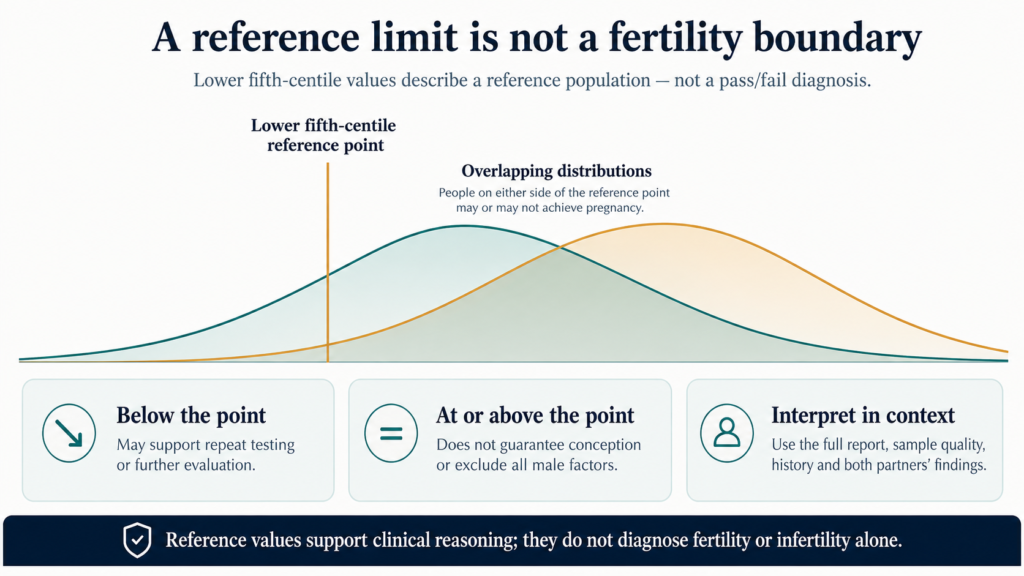
| INTERPRETATION Important distinction : WHO reference values are statistical descriptions of a selected reference population. They are not universal treatment thresholds, and they should not be presented as a simple fertile-versus-infertile boundary. |
Essential terms to know
| Term | Beginner meaning |
| Semen analysis | Laboratory examination of an ejaculated semen sample, including both the seminal fluid and spermatozoa. |
| Semen volume | The measured amount of ejaculate, usually reported in millilitres. |
| Sperm concentration | The number of spermatozoa in each millilitre of semen. |
| Total sperm number | The estimated number of spermatozoa in the whole ejaculate; it combines concentration with volume. |
| Motility | How sperm move. Progressive sperm move forwards, non-progressive sperm move without useful progression, and immotile sperm do not move. |
| Morphology | The proportion of assessed sperm that meet strict visible structural criteria. |
| Vitality | The proportion of living sperm; this is especially useful when many sperm are immotile. |
| Lower fifth centile | A point near the lower end of results in the WHO reference population. Approximately 5% of that population had results below it. |
How semen examination works
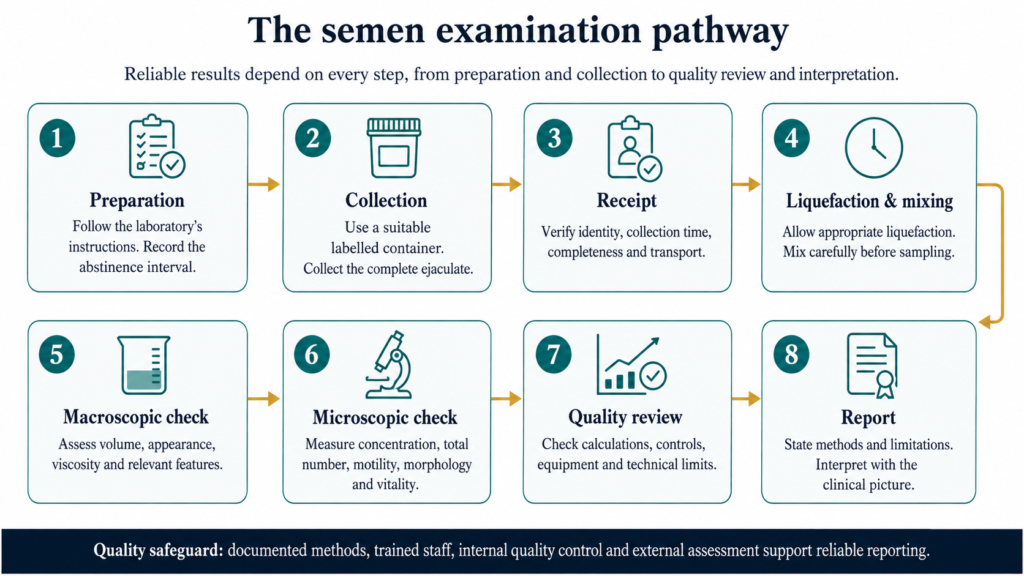
1. Preparation. The laboratory provides instructions about collection, the requested period of ejaculatory abstinence and what information must be recorded. WHO methods commonly use an abstinence interval of 2-7 days for diagnostic samples, although the laboratory protocol should always be followed. [1]
2. Collection. The sample is usually collected by masturbation into a clean, suitable container. The complete ejaculate should be collected where possible because different fractions may contain different concentrations of sperm and glandular secretions.
3. Transport and receipt. Staff verify identity, collection time, abstinence interval, completeness, transport conditions and any reported difficulty. Delays or unsuitable temperatures may affect motility.
4. Liquefaction and mixing. Fresh semen usually changes from a coagulated material to a more fluid state. After appropriate liquefaction, careful mixing is required so that the tested portion represents the whole sample.
5. Macroscopic examination. The laboratory records volume and relevant observations such as appearance, viscosity, liquefaction and, when indicated, pH.
6. Microscopic examination. Defined counting and observation procedures are used to assess sperm concentration, total number, motility, morphology and vitality, together with relevant non-sperm cells or other findings.
7. Quality review. Calculations, replicate agreement, controls, equipment performance, staff competency and technical limitations are reviewed before the report is released.
8. Reporting and interpretation. The report should state what was measured and any important limitations. Clinical interpretation then combines the full semen profile with the medical history, examination and the fertility assessment of both partners.
Main components and influencing factors
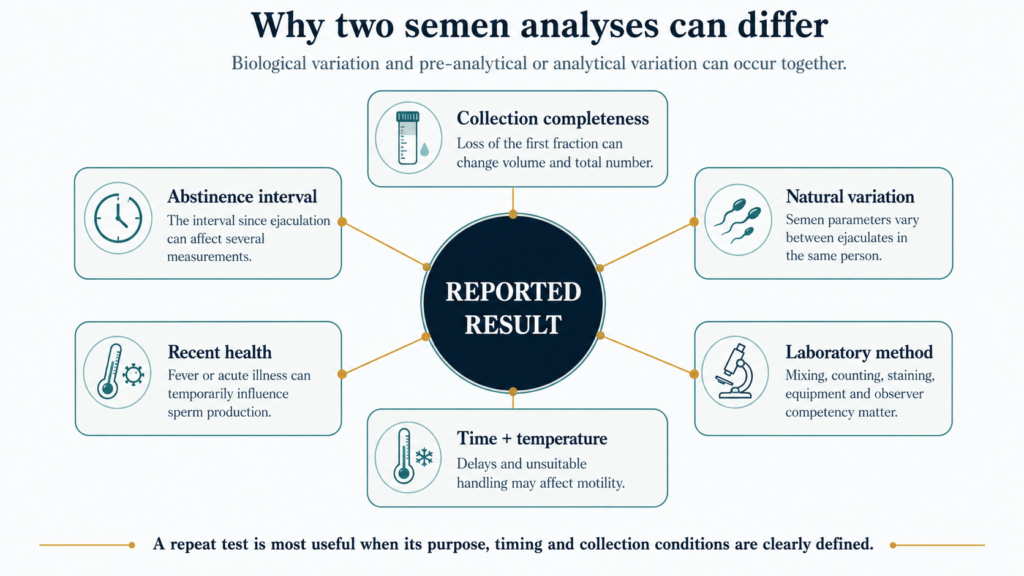
A semen result is a measurement of one sample under defined conditions, not a permanent personal score. Several groups of factors may affect what is observed:
• Patient and biological factors: natural variation between ejaculates, recent fever or illness, medications, hormonal exposure, testicular conditions, ejaculation frequency and other health factors.
• Collection factors: incomplete collection, an abstinence interval outside the requested range, unsuitable lubricants or containers, and failure to document sample loss.
• Transport and timing factors: delayed delivery, excessive temperature change or delayed motility assessment.
• Laboratory factors: inadequate mixing, incorrect dilution, counting too few sperm, inconsistent motility grading, poor morphology preparation, uncalibrated equipment or insufficient competency assessment.
• Clinical factors: the duration of infertility, sexual and reproductive history, age, ovulation, oocyte quality, tubal and uterine factors, previous pregnancies and earlier treatment outcomes.
• Governance factors: the laboratory’s quality-management system, external quality assessment, accreditation, local regulations and reporting standards.
What changed from the fifth to the sixth edition?
The numerical changes between editions are modest. The larger change is the clearer emphasis on methods, quality and interpretation across a continuum rather than a pass-or-fail label.
| Semen variable | 5th edition (2010) | 6th edition (2021) |
| Semen volume | 1.5 mL | 1.4 mL |
| Sperm concentration | 15 million/mL | 16 million/mL |
| Total sperm number | 39 million/ejaculate | 39 million/ejaculate |
| Total motility | 40% | 42% |
| Progressive motility | 32% | 30% |
| Vitality | 58% live | 54% live |
| Morphologically normal forms | 4% | 4% |
Table 1. Selected lower fifth-centile values. These are reference-distribution points, not absolute fertility or treatment cut-offs. [3,4]
Broader developments in the sixth edition
• Expanded reference data: The 2021 values use a larger dataset from more countries and continents than the dataset supporting the fifth edition. [4]
• Motility categories: The sixth edition reintroduces a four-category distinction: rapid progressive, slow progressive, non-progressive and immotile sperm. Progressive categories may also be combined for reporting. [6]
• Revised basic methods: Step-by-step instructions and calculations were updated to improve robustness, including approaches for very low sperm numbers. [1,6]
• Basic, extended and advanced examinations: The manual separates routine assessment from tests that answer more specific clinical or research questions. [1,7]
• Quality systems: There is stronger attention to internal quality control, external quality assessment, staff competency and reproducibility. [1,6]
• Extended tests: Methods such as sperm DNA fragmentation and computer-assisted sperm analysis are described, but their inclusion does not mean that every patient requires them. [7,8]
| Beginner interpretation Do not focus only on whether a number moved slightly between editions. The most important lesson is that standardised methods, distribution-based interpretation and clinical context matter more than treating one number as a verdict. |
Why the guidance matters in ART and embryology
• Comparable results: Standardised collection, counting and reporting improve comparability between operators, laboratories and time points.
• Male fertility investigation: The examination may identify patterns such as reduced sperm number, reduced motility, atypical morphology, absent sperm or a possible ejaculatory or reproductive-tract problem.
• ART planning: Semen findings can contribute to discussions about further investigation, sperm preparation, intrauterine insemination, in vitro fertilisation or intracytoplasmic sperm injection. They do not make the decision alone.
• Responsible counselling: Clear language reduces the risk of telling a patient that they are definitely fertile or infertile from one laboratory value.
• Laboratory governance: Documented methods, traceability, competency assessment and quality monitoring protect patients and support reliable professional practice.
What does the result mean?
What it may indicate
A value below a lower reference point may indicate that the measured variable is lower than that observed in most members of the WHO reference population. Depending on the degree and pattern of the findings, it may support repeat examination, review of collection conditions, a detailed medical and reproductive history, physical examination or selected hormonal, genetic or imaging investigations.
What it does not prove
A result below a reference value does not prove that natural conception is impossible. A result above all reference values does not guarantee pregnancy or demonstrate that every aspect of sperm function is normal. Basic semen analysis does not directly measure every event required for sperm transport, interaction with the oocyte, fertilisation, embryo development, implantation or live birth. [9]
Why it should not be interpreted in isolation
A qualified professional considers the complete semen profile, the degree of any deviation, sample completeness, technical notes, previous results, symptoms, medical history, physical findings, duration of infertility and the fertility evaluation of the other partner. Men with one or more abnormal semen parameters should receive appropriate clinical evaluation rather than only a laboratory label. [9]
| PRACTICE NOTE : Repeat testing Because semen variables show biological variation, a repeat analysis may be appropriate when the initial result is abnormal, unexpected or technically compromised. The 2025 WHO infertility guideline suggests a minimum interval of 11 weeks when repeating semen analysis for infertility assessment; ESHRE guidance commonly uses about three months. The recommendation and timing should be adapted to the clinical question and local protocol. [10,11] |
Common misconceptions: myth versus reality
| MYTH – “A normal WHO result proves fertility.” | REALITY – Values within the reference distribution are reassuring laboratory findings, but they do not guarantee conception. Fertility depends on both partners and on biological functions not fully captured by basic semen analysis. |
| MYTH – “A result below the reference point means sterility.” | REALITY – A lower value may reduce the probability of conception or prompt further assessment, but it does not prove that pregnancy is impossible. |
| MYTH – “The sixth edition changed every normal value.” | REALITY – Some lower fifth-centile values changed slightly and others remained the same. The more important developments concern methods, quality systems and interpretation. |
| MYTH – “One semen sample gives a permanent answer.” | REALITY – Semen variables can differ between ejaculates. Collection quality, recent illness, timing and laboratory conditions may also alter a single result. |
| MYTH – “Four per cent normal morphology means the other 96% are useless.” | REALITY – Strict morphology records the proportion meeting every defined appearance criterion. It does not prove that every sperm outside that group is incapable of fertilisation. |
| MYTH – “The WHO manual tells the doctor which treatment to use.” | REALITY – The manual standards laboratory work. Treatment decisions require clinical assessment, both partners’ findings, patient preferences and applicable professional guidance. |
Simple practical example
| CASE Fictional educational case: Arun provides a complete sample after following the laboratory instructions. His report shows a volume of 2.1 mL, concentration of 18 million/mL, total sperm number of approximately 38 million, progressive motility of 28%, total motility of 44% and normal morphology of 4%. Under the sixth edition, some values are at or above the lower fifth-centile points while progressive motility and total sperm number are slightly below. This is not a simple “fertile” or “infertile” verdict. A clinician would review the entire pattern, sample quality, history, duration of infertility and the other partner’s assessment before deciding whether repeat testing or further evaluation is appropriate. |
Frequently asked questions
1. Is the sixth edition the current WHO manual?
Yes. The sixth edition was published in 2021 and is the current WHO Laboratory Manual for the Examination and Processing of Human Semen. Older reports may still refer to fifth-edition values or terminology, so the edition and method used should be clear. [1]
2. Which edition should a fertility laboratory follow?
Laboratories should use the current WHO manual together with national regulation, accreditation standards, validated standard operating procedures, manufacturer instructions and local professional requirements. The WHO manual does not override applicable law or institutional governance.
3. Are the WHO figures “normal values”?
It is more accurate to call them reference-distribution values or lower fifth-centile points. They were derived from a selected population of men whose partners conceived within a defined time. They do not perfectly separate people who can and cannot achieve pregnancy. [3,4]
4. Why can two semen analyses be different?
Natural biological variation is common. The abstinence interval, completeness of collection, recent illness, transport conditions, time to examination, mixing, counting method and observer technique may also affect the result.
5. Why is total sperm number different from concentration?
Concentration is the number of sperm in one millilitre. Total sperm number estimates the number in the whole ejaculate, so it depends on both concentration and semen volume.
6. Does a standard semen analysis test sperm DNA?
No. Basic semen analysis evaluates conventional semen and sperm variables. Sperm DNA fragmentation is a separate extended test. It may be useful for selected clinical questions, but routine testing for every patient is not established. [7,8]
7. Does a low result automatically mean IVF or ICSI is required?
No. Management depends on the type and severity of the finding, repeat results, the likely cause, age, other-partner factors, duration of infertility and previous treatment. One value should not select an ART procedure by itself.
8. Who should interpret an abnormal report?
Interpretation should involve an appropriately qualified fertility specialist, reproductive urologist, andrologist or other relevant healthcare professional. A trained clinical embryologist or andrology laboratory professional can explain the laboratory method, quality considerations and terminology within their professional scope.
Key takeaways
• The WHO semen manual standardises laboratory examination; it does not independently diagnose fertility.
• The sixth edition was published in 2021 and replaced the fifth edition from 2010.
• The numerical lower fifth-centile values changed only modestly between editions.
• The sixth edition places stronger emphasis on detailed methods, quality systems and contextual interpretation.
• A value below a reference point does not prove sterility, and values above all reference points do not guarantee pregnancy.
• Collection information, technical quality, clinical history and both partners’ fertility factors must be considered together.
• Professional interpretation is especially important when findings are markedly abnormal, absent, inconsistent or likely to influence a major treatment decision.
| RESPONSIBLE USE Educational disclaimer: This article is intended for general education and professional learning. It does not replace consultation with a qualified fertility specialist, reproductive urologist, clinical embryologist or other healthcare professional. Semen reports should not be used for self-diagnosis, assumptions about permanent fertility or individual treatment decisions. Findings must be interpreted alongside clinical history, examination, repeat testing when appropriate and the fertility assessment of both partners. |
References
1. World Health Organization. WHO laboratory manual for the examination and processing of human semen. 6th ed. Geneva: WHO; 2021. ISBN 978-92-4-003078-7.
2. World Health Organization. WHO laboratory manual for the examination and processing of human semen. 5th ed. Geneva: WHO; 2010. ISBN 978-92-4-154778-9.
3. Cooper TG, Noonan E, von Eckardstein S, et al. World Health Organization reference values for human semen characteristics. Human Reproduction Update. 2010;16(3):231-245. doi:10.1093/humupd/dmp048.
4. Campbell MJ, Lotti F, Baldi E, et al. Distribution of semen examination results 2020 – a follow up of data collated for the WHO semen analysis manual 2010. Andrology. 2021;9(3):817-822. doi:10.1111/andr.12983.
5. Wang C, Mbizvo M, Festin MP, Björndahl L, Toskin I, et al. Evolution of the WHO “semen” processing manual from the first (1980) to the sixth edition (2021). Fertility and Sterility. 2022;117(2):237-245. doi:10.1016/j.fertnstert.2021.11.037.
6. Björndahl L, Kirkman Brown J; WHO manual editorial board members. The sixth edition of the WHO Laboratory Manual: ensuring quality and standardization in basic examination of human ejaculates. Fertility and Sterility. 2022;117(2):246-251. doi:10.1016/j.fertnstert.2021.12.012.
7. Baldi E, Gallagher MT, Krasnyak S, Kirkman-Brown J; WHO manual editorial board members. Extended semen examinations in the sixth edition of the WHO Laboratory Manual. Fertility and Sterility. 2022;117(2):252-257. doi:10.1016/j.fertnstert.2021.11.034.
8. Boitrelle F, Shah R, Saleh R, et al. The sixth edition of the WHO manual for human semen analysis: a critical review and SWOT analysis. Life. 2021;11(12):1368. doi:10.3390/life11121368.
9. American Urological Association; American Society for Reproductive Medicine. Diagnosis and Treatment of Infertility in Men: AUA/ASRM Guideline. Published 2020; amended 2024.
10. World Health Organization. Guideline for the prevention, diagnosis and treatment of infertility. Geneva: WHO; 2025.
11. European Society of Human Reproduction and Embryology. Evidence-based guideline: Unexplained infertility. ESHRE; 2023.
12. Zegers-Hochschild F, Adamson GD, Dyer S, et al. The International Glossary on Infertility and Fertility Care, 2017. Human Reproduction. 2017;32(9):1786-1801. doi:10.1093/humrep/dex234.
Official source links
• WHO sixth edition publication page
• WHO infertility guideline, 2025