From the first injection to the pregnancy test, IVF can feel like a series of unfamiliar appointments, medicines, numbers and laboratory updates. This guide explains the journey in plain language—what is happening in your body, what is happening in the embryology laboratory, and what you may experience at each stage.
| 1 Stimulate | 2 Collect | 3 Fertilise | 4 Culture | 5 Transfer / Freeze |
| CATEGORY– Patient Education | READING TIME ~10–12 minutes | AUTHOR – Manoj Kumar K, Embryologist |
| PUBLISHED – 29 September 2026 | LAST REVIEWED – 30 September 2026 | PUBLISHER – Inside Embryo by Aurion |
Educational article · Evidence-based patient information · References include HFEA, NHS & ASRM · Individual treatment protocols may vary
| The simplest way to think about IVFIVF is a process in which the ovaries are stimulated to develop several eggs, eggs are collected, fertilisation takes place in a laboratory, embryos are observed as they develop, and a suitable embryo may be transferred into the uterus. Other suitable embryos may be frozen for future use. Not every patient follows every step in exactly the same way. |
Estimated reading time: 10–12 minutes
If you are about to start IVF, one of the most reassuring things you can have is a map of what comes next. An IVF “cycle” is not one procedure. It is a sequence of coordinated steps involving you, the fertility doctor, nurses and the embryology laboratory. Some stages happen over days, others take only minutes, and the plan may change depending on how your body responds.
A full IVF cycle commonly takes about 3–6 weeks, although preparation before treatment, genetic testing, embryo freezing or a planned frozen embryo transfer can make the overall journey longer. [1][2]
| Important before you readThis is a general overview, not a treatment protocol. Medication type and dose, monitoring schedules, the choice between IVF and ICSI, whether embryos are transferred fresh or frozen, and how many embryos are transferred should be individualised by your fertility team. |
In this guide, we will follow the journey from the first assessment to the pregnancy test, while also explaining what is happening behind the laboratory doors.
Table of Contents
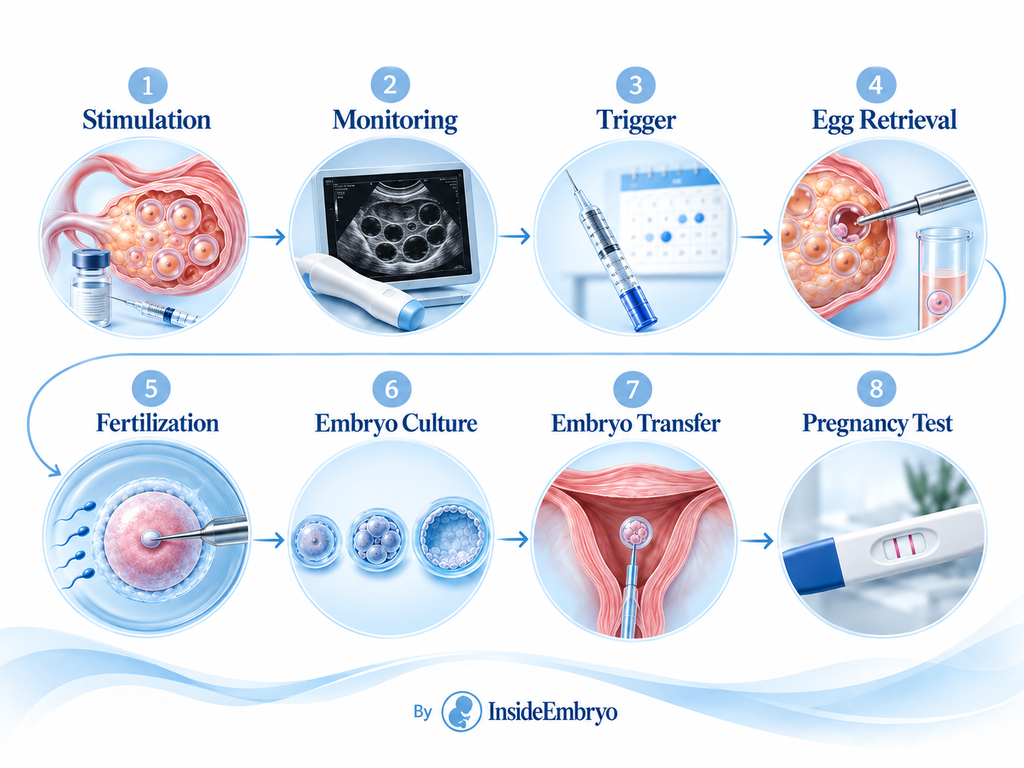
The IVF Cycle at a Glance
| Stage | What happens | What you may notice | Typical timing* |
| Planning & baseline | History, tests, consent and treatment plan | Appointments, questions, medication teaching | Before cycle starts |
| Ovarian stimulation | Daily fertility medicines help several follicles grow | Bloating, fullness, injection-site discomfort | Often ~8–14 days |
| Monitoring | Ultrasound ± blood tests guide medication changes | Repeated clinic visits | During stimulation |
| Trigger | Final-maturation medicine is given at a precise time | Timing matters | Usually ~1.5 days before retrieval |
| oocytes retrieval | Follicular fluid is collected and sent to the lab | Sedation; cramping or spotting afterward | Procedure day |
| Fertilisation | oocytes are inseminated by conventional IVF or ICSI when indicated | Lab update, often next day | Day 0–1 |
| Embryo culture | Embryos are observed as they develop | Waiting for scheduled lab updates | Usually 2–6 days after fertilisation |
| Transfer or freezing | A suitable embryo may be transferred; others may be frozen | Transfer is usually brief; freeze-all is common in some plans | Fresh transfer or later frozen cycle |
| Pregnancy test | A blood or urine test is done on the clinic-specified date | The waiting period can be emotionally difficult | Date varies by clinic/protocol |
*Timings are approximate. Your clinic’s instructions take priority.
What Exactly Is IVF?
IVF stands for in vitro fertilisation. “In vitro” refers to fertilisation taking place outside the body in a laboratory. Eggs are collected from the ovaries and brought to the embryology laboratory, where sperm and oocytes are brought together. If fertilisation occurs, the resulting embryos are cultured for several days. A suitable embryo may then be transferred to the uterus, while other suitable embryos can be cryopreserved for later use. [1]
IVF may be recommended for many different reasons, including tubal disease, male-factor infertility, ovulation problems, endometriosis, unexplained infertility, previous unsuccessful treatments, fertility preservation pathways, or the use of donor oocytes or sperm. The reason for treatment influences how the cycle is designed.
See This Topic on Instagram
Explore our related Instagram post for a quick visual overview.
Step 1 — Consultation, Testing and Cycle Planning
Before injections begin, the fertility team needs to understand the medical picture and decide whether IVF is the right treatment. This may include reviewing previous pregnancies and treatments, menstrual history, medical conditions and medications, ovarian reserve testing, ultrasound findings and semen analysis. Clinics may also require infection screening and formal consent before treatment begins. [2]
This is also the stage where your team should explain:
- why IVF is being recommended in your situation;
- which stimulation protocol is planned and why;
- whether conventional IVF or ICSI is expected to be used;
- whether the intention is a fresh transfer, a freeze-all cycle or a decision made later;
- what happens to any embryos that are not transferred;
- what extra tests or “add-ons,” if any, are being discussed and what evidence supports them.
| Patient question to ask“What decisions are already fixed, and which decisions might change depending on my response or the embryo development?” |
Step 2 — Ovarian Stimulation: Growing More Than One Follicle
In a natural menstrual cycle, the body usually selects one dominant follicle to mature. During IVF, fertility medicines are used to encourage several follicles to grow at the same time. The goal is not simply to produce the highest possible number of eggs; it is to achieve a safe, useful response for that individual patient.
The medicines are commonly given as injections at home. Depending on the protocol, another medicine is used to prevent ovulation from happening too early. Stimulation is monitored closely because people respond differently to the same medication dose.
What might you feel?
- mild bloating or pelvic heaviness as the ovaries enlarge;
- bruising or stinging at injection sites;
- fatigue, headaches, mood changes or breast tenderness in some patients;
- a growing number of appointments as the cycle approaches egg retrieval.
| RememberA friend’s follicle count, medication dose or oocytes number is not a target for your cycle. IVF dosing is individualised, and “more” is not automatically “better.” |
Step 3 — Monitoring: Watching Follicles Grow
During stimulation, the clinic uses ultrasound scans—and in many blood tests—to judge how the follicles are developing and whether medication changes are needed. Follicles are fluid-filled structures in the ovary; the oocyte itself is microscopic and cannot be seen on the ultrasound scan.
Monitoring helps the team decide when enough follicles appear ready for the final maturation step. It also helps identify patients who may be responding too strongly or too weakly, so the plan can be adjusted for safety.
Step 4 — The Trigger: Timing Final oocyte Maturation
When the follicles are considered ready, you will be instructed to take a “trigger” medicine. This helps the oocytes complete final maturation before collection. The timing is precise because oocytes retrieval is scheduled in relation to the trigger. Follow the clinic’s exact time and instructions rather than changing it yourself.
| Practical tip: On trigger day, set more than one reminder and confirm the exact medication, dose and time in writing. If you think the trigger was taken late, early or incorrectly, contact the clinic immediately rather than guessing what to do next. |
Step 5 — oocytes Retrieval: From the Ovary to the Embryology Laboratory
oocytes retrieval—also called oocyte retrieval or egg collection—is usually performed with sedation or anaesthesia. Using ultrasound guidance, the doctor passes a needle through the vaginal wall into the ovarian follicles and aspirates the follicular fluid. The procedure itself is relatively short; the NHS describes egg collection as taking around 20 minutes, although time in the clinic is longer because of preparation and recovery. [2]
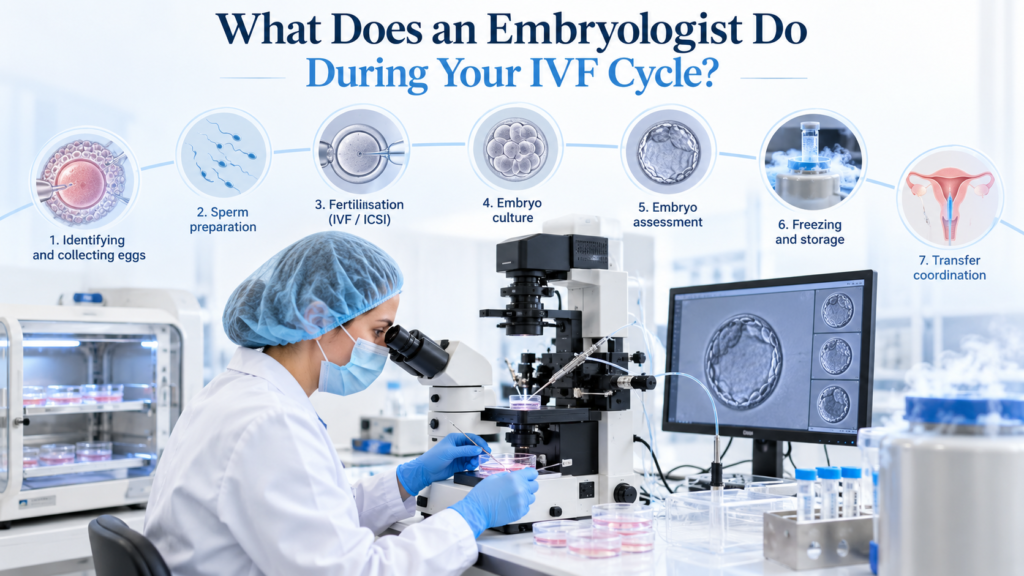
The follicular fluid is passed immediately to the embryology team. Under a microscope, the embryologist searches the fluid and identifies the oocytes (eggs). This is one of the first moments when the clinical and laboratory sides of IVF directly meet.
After retrieval, it is common to have some cramping, bloating, tiredness or light spotting. Your clinic should give you written instructions about medicines, activity, food and drink, and symptoms that require medical advice.
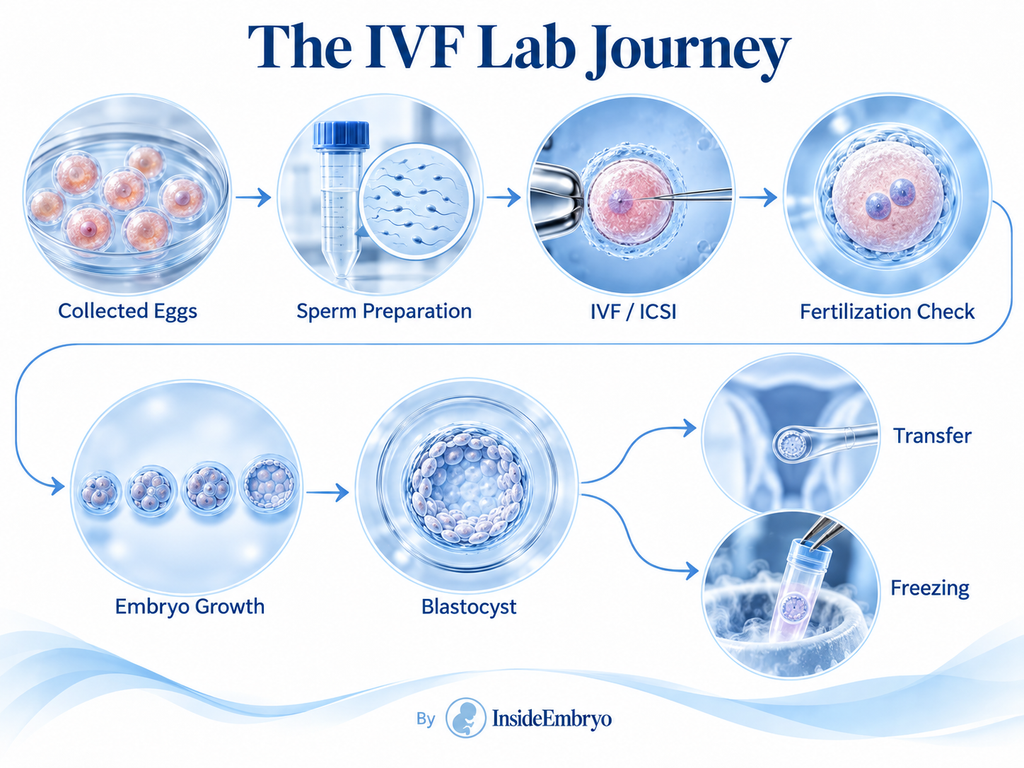
Inside the Embryology Lab — What Happens After oocyte Collection?
| The laboratory part of IVF is a sequence, not a single result : Retrieved oocytes → mature oocytes → normally fertilised oocytes → developing embryos → embryos suitable for transfer or freezing. It is normal for the number to decrease at each biological step. A reduction in numbers does not automatically mean that something went wrong. |
1. The oocytes are identified and assessed
After the oocytes are found, they are kept in carefully controlled culture conditions. Depending on the fertilisation method, the embryologist may assess whether the eggs have reached the mature stage needed for ICSI.
2. Sperm is prepared
A semen sample may be provided on the day of retrieval, or frozen/donor/surgically retrieved sperm may be used depending on the treatment plan. The laboratory prepares the sample to obtain sperm appropriate for fertilisation.
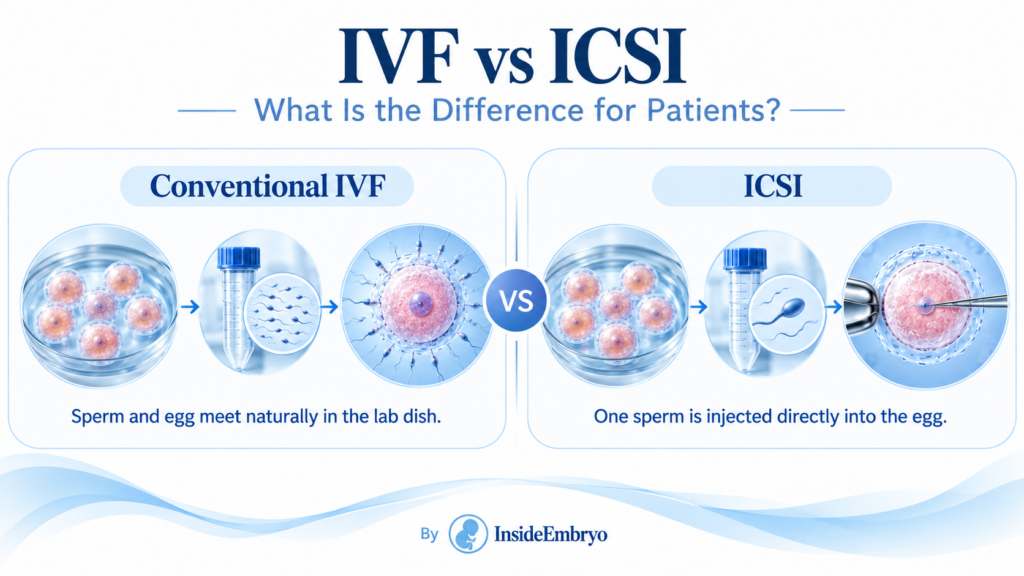
3. Fertilisation: conventional IVF or ICSI
With conventional IVF, prepared sperm and oocytes are placed together in the laboratory and fertilisation is allowed to occur. With ICSI (intracytoplasmic sperm injection), an embryologist injects a single sperm into a mature egg. ICSI is commonly used when there are significant sperm-related factors or other clinical indications; it is not simply a “stronger” version of IVF for every patient. [1]
4. Fertilisation is checked
The laboratory checks for signs of normal fertilisation at a defined time after insemination or ICSI. Clinics differ in how and when results are communicated, so ask when you should expect a call, message or portal update.
5. Embryos are cultured for several days
If fertilisation occurs, embryos continue to develop in incubators under controlled conditions. HFEA describes embryo development before transfer as commonly lasting between two and six days. [1] Some embryos stop developing; others continue to the stage suitable for transfer or freezing. Embryologists assess development according to the laboratory’s validated grading system.
| A useful way to understand embryo gradingEmbryo grading is a description of how an embryo looks and develops at a particular time. It helps laboratory and clinical teams make decisions, but a grade is not a guarantee of implantation, pregnancy or a healthy baby. |
Step 6 — Fresh Transfer, Freeze-All, or Frozen Transfer?
Not every IVF retrieval is followed by an embryo transfer in the same cycle. Your team may recommend one of several pathways:
- Fresh embryo transfer: an embryo is transferred a few days after egg retrieval, if the clinical situation is suitable.
- Freeze-all: suitable embryos are frozen and transfer is planned in a later cycle. This may be chosen for medical, laboratory or treatment-planning reasons.
- Embryo freezing after transfer: one suitable embryo may be transferred and other suitable embryos frozen for future use.
- Genetic testing pathway: when preimplantation genetic testing is planned, embryos are usually biopsied and frozen while results are awaited.
HFEA advises that transferring a single suitable embryo is generally best practice because transferring more than one embryo increases the chance of twins or higher-order multiple pregnancy, which carries additional health risks. [1] The number of embryos to transfer should be discussed individually with the fertility team and follow local guidance.
Step 7 — Embryo Transfer: A Small Procedure With a Big Emotional Weight
Embryo transfer usually involves passing a thin catheter through the cervix and placing the embryo into the uterus. Anaesthesia is not routinely required for most transfers. The procedure is often physically brief, even though emotionally it may feel like the most important moment of the cycle. [1]
After transfer, follow your clinic’s medication plan—often including progesterone support—and do the pregnancy test on the date they provide. Testing too early can create confusing or misleading results.
| Myth vs factMYTH: You must stay in bed after embryo transfer so the embryo does not “fall out.” FACT: Evidence reviewed by ASRM does not support bed rest after embryo transfer; immediate ambulation is acceptable. [3] |
Step 8 — The Waiting Period and Pregnancy Test
The days between transfer and the pregnancy test are often called the “two-week wait,” although the actual interval depends on the type and timing of transfer. Your clinic will tell you exactly when to test. The NHS notes that the pregnancy test date is set by the clinic and stresses testing on the instructed date for an accurate result. [2]
Try not to read too much into individual symptoms. Progesterone and other medications can cause breast tenderness, bloating, cramps, fatigue and other sensations that can overlap with early-pregnancy symptoms. The pregnancy test—not symptoms—is what answers the question.
IVF Is a Pathway, Not a Straight Line
A cycle can change direction. The dose may be adjusted. Retrieval may yield fewer or more oocytes than expected. Fertilisation may be lower than hoped. A fresh transfer may become a freeze-all cycle. An embryo planned for transfer may not continue developing. Sometimes the safest choice is to pause or cancel a step.
These changes can be disappointing, but they are not necessarily evidence of poor care. IVF decisions are repeatedly updated using new information from scans, hormones, the procedure and the laboratory. A good fertility team should explain why the plan changed and what that means for the next step.
Why Do the Numbers Reduce From oocytes to Embryos?
Patients are often surprised by “attrition”—the natural reduction in numbers across the laboratory journey. For example, the number of follicles seen on ultrasound is not necessarily the number of oocytes retrieved; not every retrieved egg is mature; not every mature egg fertilises normally; and not every fertilised egg develops into an embryo suitable for transfer or freezing.
That is why a single headline number—“How many oocytes did I get?”—does not describe the whole cycle. Your clinic should help you interpret each stage in context rather than comparing it with another person’s results.
What Can You Control During an IVF Cycle?
You cannot control every biological outcome, but you can make the process safer and easier to navigate by focusing on the parts that are in your hands:
- Take medications exactly as instructed and ask before changing a dose or timing.
- Keep monitoring appointments and tell the team about new symptoms or medicines.
- Know whom to contact after hours and what counts as an urgent symptom.
- Ask how laboratory updates will be communicated so you are not waiting without a plan.
- Keep a written treatment calendar or medication checklist.
- Protect your emotional bandwidth: decide who you want updates from and who you want to update.
- Avoid adding unproven supplements, tests or procedures without discussing evidence and safety with your fertility team.
When Should You Contact the Clinic Urgently?
Most people complete IVF without a serious complication, but fertility medicines and procedures do have risks. HFEA specifically highlights ovarian hyperstimulation syndrome (OHSS), multiple pregnancy and ectopic pregnancy among important risks to understand. [1]
| Seek urgent advice according to your clinic’s instructions if you develop concerning symptomsExamples include severe or rapidly worsening abdominal pain or swelling, difficulty breathing, fainting, heavy bleeding, persistent vomiting, markedly reduced urination, chest pain, or other symptoms your clinic has told you require urgent review. If symptoms are severe or you cannot reach the fertility team, seek emergency medical care. |
Your own clinic’s safety sheet should always be the first reference because recommendations vary with the medications and procedures you received.
5 Common IVF Myths — and the Facts
| Myth | Fact |
| “More oocytes always means a better cycle.” | Egg number is only one part of the picture. Safety, maturity, fertilisation and embryo development also matter. |
| “ICSI guarantees fertilisation.” | ICSI helps sperm enter the egg, but it cannot guarantee normal fertilisation or embryo development. |
| “A high-grade embryo is guaranteed to implant.” | Embryo grading is useful, but it cannot guarantee implantation or pregnancy. |
| “You must stay in bed after embryo transfer.” | ASRM guidance finds no benefit from bed rest after transfer. [3] |
| “If the first IVF cycle fails, IVF will never work.” | One cycle provides information as well as a result. Future decisions depend on age, diagnosis, ovarian response, sperm factors, embryo development and previous outcomes. |
Frequently Asked Questions
How long does one IVF cycle take?
For many patients, the active IVF cycle takes around 3–6 weeks. The total journey can be longer if preparation, additional testing, embryo freezing, genetic testing or a separate frozen embryo transfer is included. [1][2]
Does every follicle contain an egg?
No. Follicles are seen on ultrasound, but the egg inside is microscopic. Some follicles may not yield an egg at retrieval, and retrieved oocytes can be at different stages of maturity.
Is egg retrieval painful?
Egg retrieval is generally performed with sedation or anaesthesia. Cramping, bloating, fatigue and light spotting can occur afterward. Your clinic should explain its anaesthesia and pain-relief plan before the procedure.
What is the difference between IVF and ICSI?
In conventional IVF, oocytes and prepared sperm are placed together and fertilisation is allowed to occur. In ICSI, an embryologist injects a single sperm into a mature egg. The choice depends on the clinical and laboratory situation. [1]
Will all fertilised oocytes become blastocysts?
No. Some embryos stop developing as part of normal biological attrition. The laboratory follows development and identifies embryos suitable for transfer or freezing according to its validated criteria.
Is embryo transfer painful?
Most transfers are brief and do not require anaesthesia. Some patients feel pressure or mild cramping, particularly if a full bladder is requested for ultrasound guidance.
Can I walk after embryo transfer?
Yes, unless your own doctor has given you a different instruction for a specific medical reason. ASRM guidance does not recommend bed rest after embryo transfer. [3]
When should I take a pregnancy test?
Use the date given by your fertility clinic. Testing early can be misleading, especially when fertility medications have been used. [2]
Does IVF guarantee pregnancy?
No. IVF can improve the chance of pregnancy for many people, but success varies with age, diagnosis, egg and sperm factors, embryo characteristics, uterine factors and other individual circumstances. No ethical clinic can guarantee a pregnancy or live birth.
10 Useful Questions to Ask Your IVF Team
- What is the goal of my stimulation protocol, and what response are you expecting?
- How often will I be monitored, and how will dose changes be communicated?
- Exactly when and how should I take the trigger?
- What type of sedation or anaesthesia is used for egg retrieval?
- Will we use conventional IVF, ICSI, or decide after the semen/egg assessment?
- When will I receive fertilisation and embryo-development updates?
- What grading system does your laboratory use, and how should I interpret it?
- What factors would make you recommend a fresh transfer versus freeze-all?
- How many embryos do you recommend transferring in my situation, and why?
- What symptoms after stimulation, retrieval or transfer should make me call urgently?
Beginner Glossary
| Glossary Term | Short Definition |
|---|---|
| IVF (In Vitro Fertilisation) | A fertility treatment in which eggs are collected and fertilised with sperm in a laboratory. |
| Ovarian Stimulation | Use of fertility medications to encourage several ovarian follicles to grow during an IVF cycle. |
| Follicle | A fluid-filled structure in the ovary that may contain a developing oocyte. |
| Oocyte | The scientific term for the female egg cell collected during egg retrieval. |
| Trigger Injection | A carefully timed medication used to support final oocyte maturation before egg collection. |
| Egg Retrieval | A procedure in which oocytes are collected from ovarian follicles, usually using ultrasound guidance. |
| Semen Analysis | A laboratory assessment of sperm concentration, motility, morphology and other semen characteristics. |
| Sperm Preparation | Laboratory processing used to select an appropriate population of sperm for fertilisation. |
| Fertilisation | The biological process in which sperm and oocyte interact to begin formation of a new embryo. |
| ICSI | Intracytoplasmic sperm injection; a technique in which one sperm is injected directly into a mature oocyte. |
| Embryo Culture | The period during which fertilised oocytes and embryos are maintained and monitored in controlled laboratory conditions. |
| Embryo Grading | Laboratory assessment used to describe an embryo’s developmental and morphological features. |
| Blastocyst | A later preimplantation embryo stage usually reached around day 5 or 6 of development. |
| Embryo Transfer | Placement of an embryo into the uterus using a thin catheter. |
| Cryopreservation | Freezing and storage of eggs, sperm or embryos at very low temperatures for possible future use. |
The Take-Home Message
An IVF cycle is best understood as a chain of small, carefully timed steps—not one big procedure. The ovaries are stimulated, follicles are monitored, oocytes are collected, fertilisation takes place in the laboratory, embryos are cultured, and a suitable embryo may be transferred or frozen for later use. At each stage, the plan can change according to safety and biology.
Knowing the pathway will not remove every uncertainty, but it can make each call, scan and laboratory update easier to understand. Ask your team what is happening now, what they are looking for next, and what decisions may change depending on the result. That is how an unfamiliar IVF cycle becomes a journey you can follow one step at a time.
| InsideEmbryo note: Behind every embryo update is a sequence of laboratory observations and decisions. Our goal is to explain those steps clearly so patients can understand the science without turning normal biological uncertainty into fear. |
About the Author
| Manoj Kumar K — Embryologist, InsideEmbryoInsideEmbryo creates patient-friendly and learning-focused content about embryology, IVF and assisted reproductive technology. The aim is to make complex laboratory and treatment concepts easier to understand while keeping the limits of online education clear. |
Medical Disclaimer
| For education, not individual medical adviceThis article is for general educational purposes only. It does not replace consultation, diagnosis or treatment from a qualified fertility specialist or healthcare professional. IVF protocols, medication doses, laboratory methods, embryo-transfer decisions and follow-up plans vary between patients and clinics. Always follow the instructions provided by your own fertility team. If you have urgent or severe symptoms, seek prompt medical care. |
References & Further Reading
These sources were used as the factual backbone for the patient-facing overview. They are listed for transparency and further reading; local protocols may differ.
1. Human Fertilisation and Embryology Authority (HFEA). In vitro fertilisation (IVF). https://www.hfea.gov.uk/treatments/explore-all-treatments/in-vitro-fertilisation-ivf/
2. NHS. IVF. https://www.nhs.uk/tests-and-treatments/ivf/
3. American Society for Reproductive Medicine (ASRM). Performing the embryo transfer: a guideline. https://www.asrm.org/practice-guidance/practice-committee-documents/performing-the-embryo-transfer-a-guideline-2017/
Editorial note: The HFEA and NHS sources describe IVF as a multi-stage treatment, generally taking around 3–6 weeks for a cycle, while ASRM guidance supports normal ambulation rather than bed rest after embryo transfer. This article intentionally avoids promising a specific egg number, embryo number or success rate because those are individual and age-dependent.