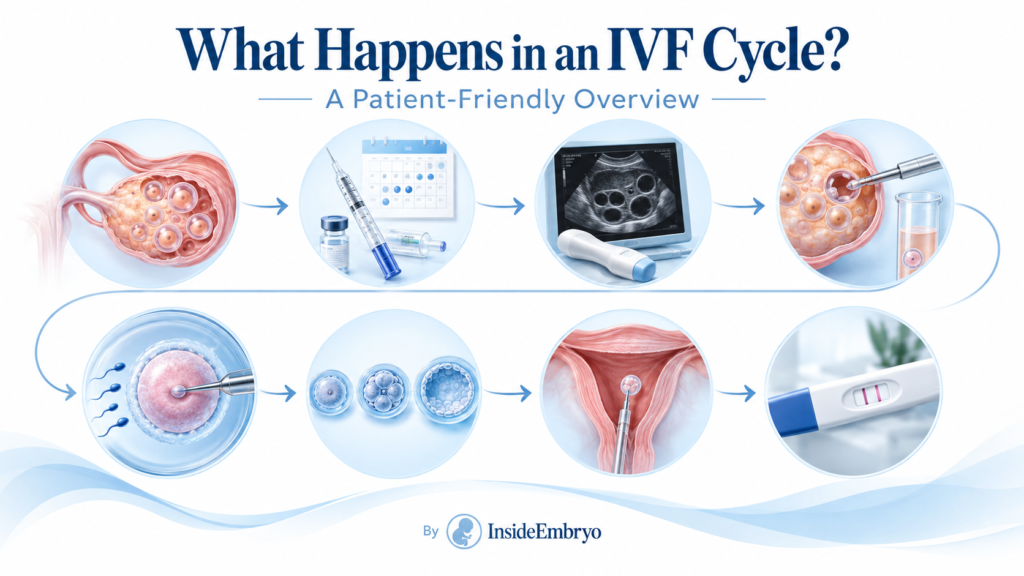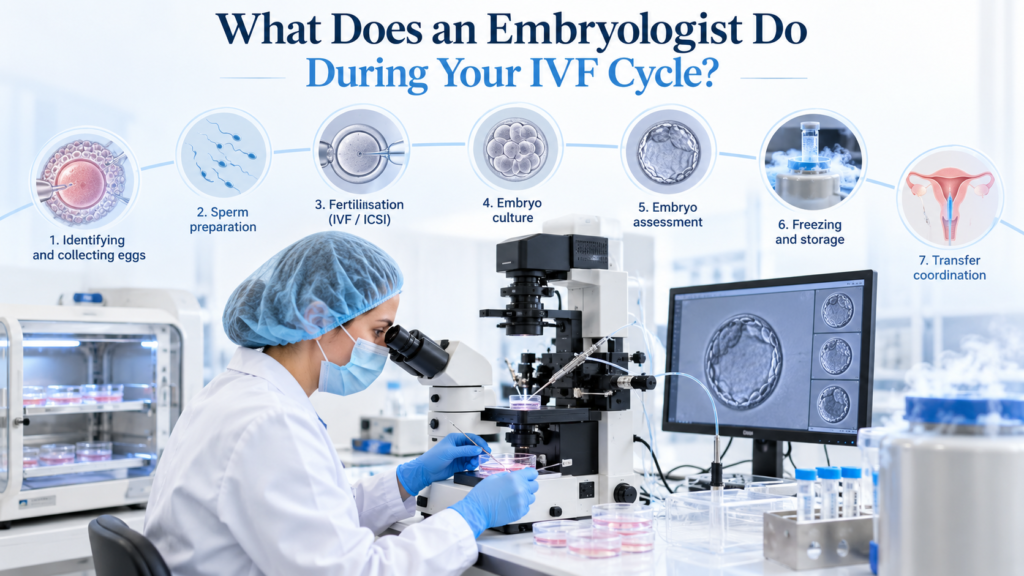
Same IVF journey. Different fertilisation method.
A clear guide to what happens in the laboratory, why one method may be chosen over the other, and what the choice can — and cannot — tell you about your chance of success.
| CATEGORY– Patient Education | READING TIME ~10-12 minutes | AUTHOR– Manoj Kumar K, Embryologist |
| PUBLISHED – 29 September 2026 | ARTICLE TYPE – Patient Guide | PUBLISHER– Inside Embryo by Aurion |
| Educational and medical disclaimer This article is for general education. It does not decide which fertilisation method is right for an individual patient and does not replace advice from your fertility specialist or embryology team. Treatment choices depend on semen findings, oocyte number and maturity, previous fertilisation history, planned genetic testing, use of frozen oocytes, laboratory practice, and other clinical factors. |
Introduction
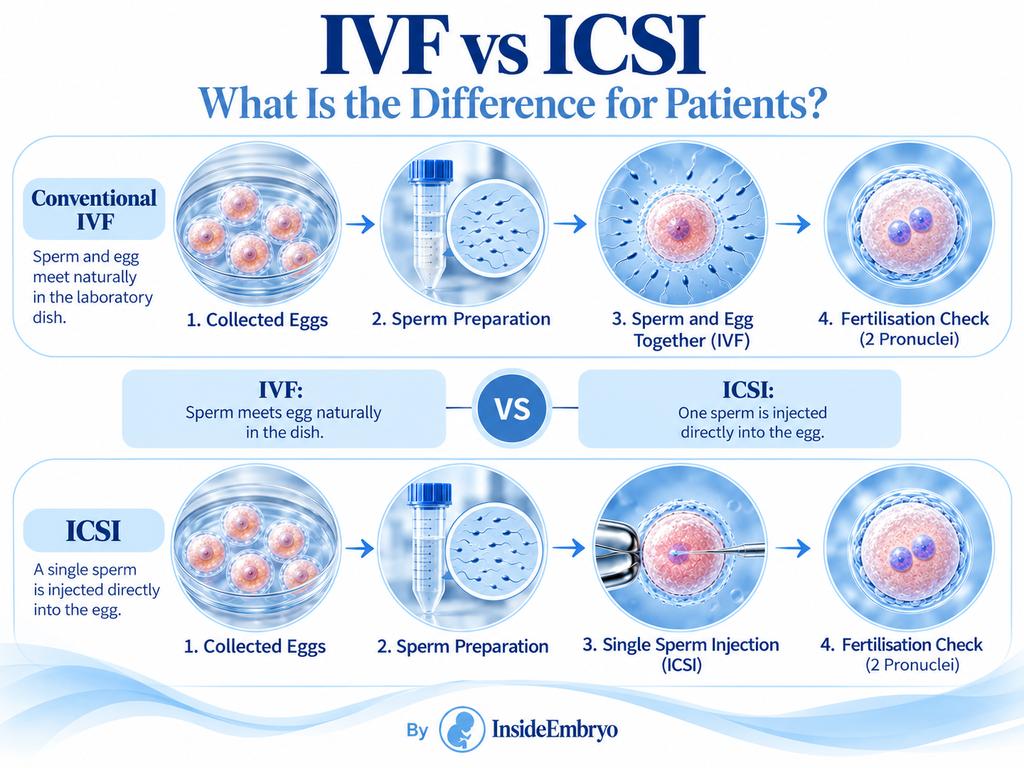
If you are starting IVF, you may hear two terms very early in the process: conventional IVF and ICSI. They are often spoken about as if they are two completely different fertility treatments. In reality, the overall treatment cycle is largely the same. The main difference is how the sperm and oocyte are brought together in the laboratory.
In conventional IVF, prepared sperm are placed around each oocyte and fertilisation is allowed to occur through the sperm’s own interaction with the oocyte. In intracytoplasmic sperm injection (ICSI), an embryologist selects a single sperm and injects it directly into a mature oocyte using micromanipulation equipment. ICSI is especially useful when there is a significant sperm-related fertility problem or a history of failed or very low fertilisation with conventional IVF. It is not automatically “better” for every patient.
This guide explains the difference in simple language, what happens in the laboratory, when ICSI may be recommended, and why the best choice is based on the reason for treatment rather than the idea that the more technical option must always be superior.
What You Will Learn
- What conventional IVF and ICSI actually mean.
- The one key laboratory step that separates IVF from ICSI.
- Why ICSI is commonly used for significant male-factor infertility and selected other situations.
- Why ICSI does not guarantee fertilisation, embryo development, implantation, pregnancy or live birth.
- Why routine ICSI is not recommended for every IVF cycle when semen parameters are normal and there is no previous fertilisation problem.
- Useful questions you can ask your fertility specialist or embryologist before oocyte collection.
Key Takeaways
| ICSI is a fertilisation technique performed as part of an IVF cycle — not a separate replacement for IVF.In conventional IVF, sperm are placed with the oocytes; in ICSI, one sperm is injected directly into a mature oocyte.ICSI is well established for severe sperm-related problems, surgically retrieved sperm, frozen–thawed oocytes, and previous very poor or failed fertilisation in selected cases.For patients without male-factor infertility or previous fertilisation failure, current guidance does not support using ICSI routinely simply because it is more technically advanced.ICSI can help overcome some barriers to fertilisation, but it cannot correct oocyte quality, embryo chromosome problems, implantation factors, or every cause of infertility. |
Table of Contents
1. The Simplest Difference Between IVF and ICSI
The difference is the method used to help fertilisation happen in the laboratory.
| Comparison Point | Conventional IVF | ICSI |
| How sperm meets the oocyte | Many prepared sperm are placed around each oocyte. A sperm must interact with and enter the oocyte. | One selected sperm is injected directly into a mature oocyte. |
| Main purpose | Allows fertilisation to occur with less micromanipulation when sperm function is considered adequate. | Helps bypass important sperm-related barriers to fertilisation in selected situations. |
A useful way to think about it: the IVF cycle gets the oocytes and sperm to the laboratory; the IVF-versus-ICSI decision describes how fertilisation is attempted once the oocytes are available.
2. What Happens in Conventional IVF?
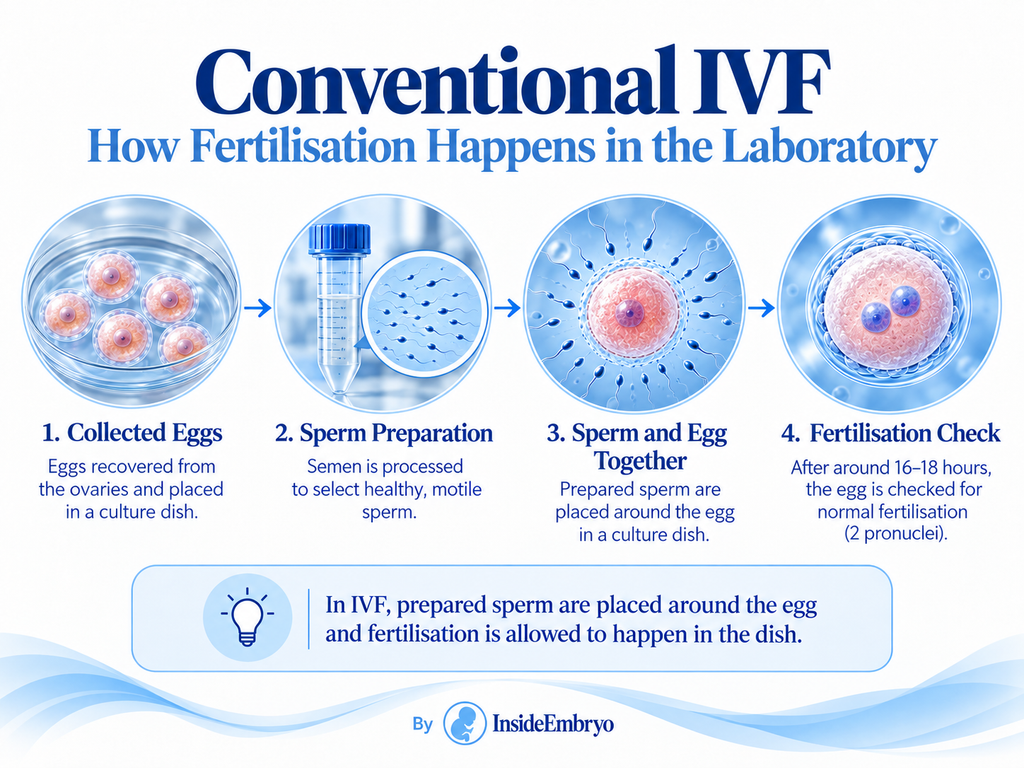
After oocyte collection, the embryology team identifies the oocytes and prepares the sperm sample. In conventional IVF, a measured concentration of prepared, progressively motile sperm is placed in the culture dish with each oocyte. The sperm must then complete the normal steps needed to bind to the oocyte and penetrate its outer layers.
oocytes are collected. The oocytes are recovered from follicular fluid during the oocyte-retrieval procedure and are kept in carefully controlled laboratory conditions.
Sperm is prepared. The semen sample is processed so that an appropriate population of motile sperm is available for insemination.
oocytes and sperm are placed together. Prepared sperm are added around the oocytes in culture medium. The sperm are not injected into the oocyte.
The laboratory waits for fertilisation. The oocytes remain in controlled culture conditions while sperm–oocyte interaction occurs.
Fertilisation is checked. The embryology team assesses the oocytes at the appropriate time for signs of normal fertilisation, commonly including two pronuclei.
Conventional IVF still involves sophisticated laboratory control. “Conventional” does not mean basic or outdated; it means fertilisation is attempted without injecting a sperm through the oocyte membrane.
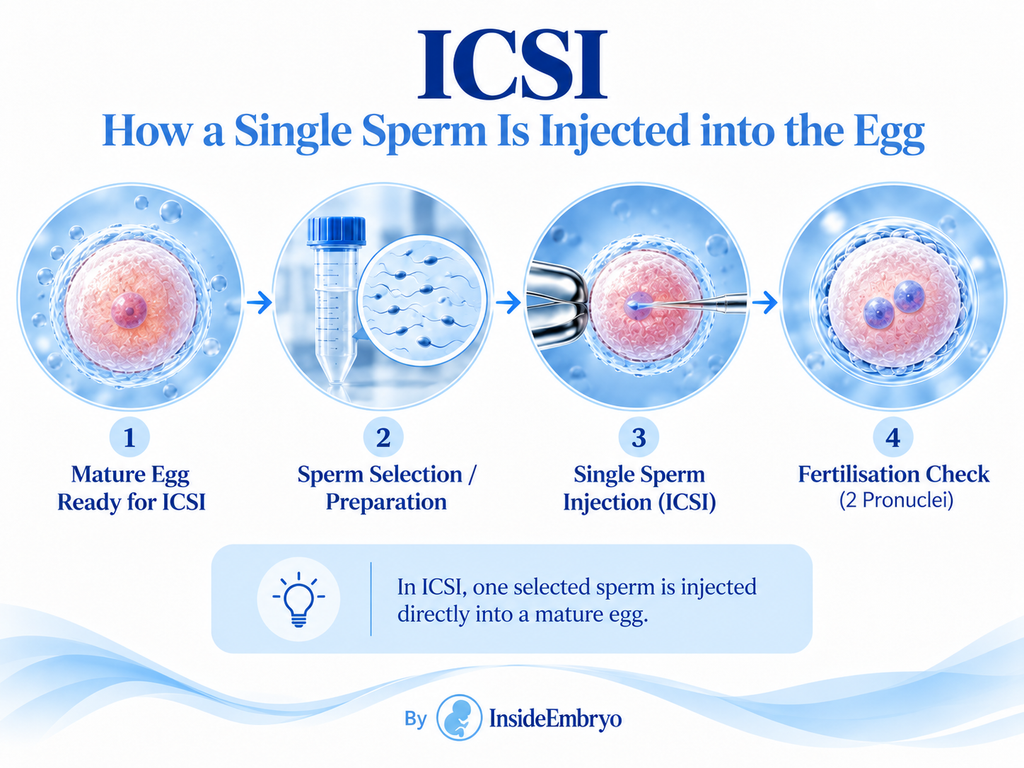
3. What Happens in ICSI?
ICSI uses micromanipulation. Before injection, the cells surrounding the oocyte are removed so the embryologist can assess whether the oocyte is mature. Only mature oocytes are normally suitable for ICSI. A single sperm is selected, immobilised, drawn into a very fine injection pipette, and introduced directly into the cytoplasm of the oocyte while the oocyte is stabilised with a holding pipette.
oocyte maturity is assessed. The surrounding cumulus cells are removed and the embryologist identifies mature oocytes suitable for injection.
A sperm is selected. A sperm is chosen under the microscope according to the laboratory’s routine criteria.
The oocyte is stabilised. A holding pipette gently keeps the oocyte in position.
One sperm is injected. A fine injection pipette passes through the oocyte membrane and deposits the sperm inside the oocyte.
The injected oocytes return to culture. After ICSI, the oocytes are placed back into controlled incubator conditions until fertilisation assessment.
ICSI bypasses several steps the sperm would normally need to perform before entering the oocyte. However, injection does not force the oocyte to fertilise normally. The oocyte still has to respond biologically to the sperm, complete fertilisation, and support later embryo development.
4. IVF vs ICSI: Side-by-Side Comparison
| Feature | Conventional IVF | ICSI |
| Overall treatment cycle | Ovarian stimulation, oocyte collection, embryo culture and transfer/freezing follow the usual IVF pathway. | The same overall IVF pathway; the difference is the fertilisation step. |
| Fertilisation method | Prepared sperm are placed around the oocytes. | One sperm is injected into each suitable mature oocyte. |
| Sperm requirement | Requires enough functional sperm for conventional insemination as judged by the laboratory. | Can be used even when sperm number, motility or availability is very limited. |
| oocyte preparation | Cumulus cells can remain around the oocytes during insemination. | Cumulus cells are removed so maturity can be assessed before injection. |
| Embryologist micromanipulation | No sperm injection into the oocyte. | Requires a micromanipulation workstation and trained embryologist. |
| Common clinical use | Often suitable when semen parameters and previous fertilisation history do not indicate ICSI. | Commonly considered for significant male factor, surgically retrieved sperm, previous poor/failed fertilisation, and certain other defined indications. |
| Does it guarantee fertilisation? | No. | No. |
| Does it guarantee a better embryo or pregnancy? | No. | No. |
5. When Might ICSI Be Recommended?
The exact decision varies between clinics and patients, but ICSI is most clearly established when there is a reason to believe conventional sperm–oocyte interaction may not work reliably. Current guidance supports considering or offering ICSI in situations such as the following:
- Significant abnormalities in semen parameters, such as very low sperm concentration, poor motility, or severe sperm-quality problems, depending on severity and the full clinical picture.
- Sperm obtained by surgical retrieval from the testis or epididymis.
- A previous conventional IVF cycle with complete fertilisation failure or a very low fertilisation rate.
- Use of previously frozen and thawed oocytes, where ICSI is widely used as the established fertilisation method after warming.
- Some forms of preimplantation genetic testing, particularly PGT-M, where minimising contamination from additional sperm or cumulus cells can be important for the genetic test.
Importantly, the indication is not simply “because ICSI is more advanced.” The decision should be linked to a specific clinical or laboratory reason.
See This Topic on Instagram
Explore our related Instagram post for a quick visual overview.
6. When May Conventional IVF Be Appropriate?
Conventional IVF may be appropriate when semen parameters are considered suitable for standard insemination and there is no history suggesting a major fertilisation problem. The treatment team also considers the number and maturity of oocytes, prior cycle results, the purpose of treatment, and the laboratory’s validated procedures.
In 2026 guidance, NICE advises against using ICSI for non-male-factor fertility problems when semen parameters are normal. Similarly, the American Society for Reproductive Medicine states that routine ICSI for all oocytes in patients without male-factor infertility or previous fertilisation failure does not improve live-birth rates. This is why many clinics increasingly focus on appropriate indication rather than automatically using ICSI for every cycle.
7. Does ICSI Improve Success Rates?
This question needs an important distinction: fertilisation is not the same outcome as pregnancy or live birth.
Fertilisation rate: ICSI can improve the chance of fertilisation when sperm-related factors make conventional fertilisation difficult, and it can reduce the risk of another fertilisation failure in selected patients with a previous poor outcome.
Embryo development: Once fertilisation has occurred, later development depends on oocyte biology, sperm biology, chromosome status, culture conditions and other factors. ICSI does not guarantee that every fertilised oocyte will become a usable blastocyst.
Pregnancy and live birth: When there is no male-factor indication or prior fertilisation problem, using ICSI routinely has not been shown to improve live-birth outcomes compared with conventional IVF. HFEA therefore does not publish separate ICSI success statistics, noting that overall success is influenced by many patient and treatment factors.
8. What ICSI Can and Cannot Solve
| ICSI can help with… | ICSI cannot guarantee or correct… |
| Bypassing difficulty with sperm reaching or entering the oocyte. | Normal fertilisation in every injected oocyte. |
| Using very small numbers of sperm in selected male-factor cases. | Poor oocyte quality or age-related oocyte changes. |
| Using surgically retrieved sperm. | Chromosome abnormalities in oocytes, sperm or embryos. |
| Reducing the risk of repeat poor/failed fertilisation in selected patients. | Blastocyst development, implantation, pregnancy or live birth. |
| Fertilisation after warming cryopreserved oocytes. | All causes of infertility or recurrent treatment failure. |
9. What Happens After Fertilisation?
After conventional IVF or ICSI, the next stages are broadly the same. The embryology team checks for fertilisation, then cultured embryos are monitored as they divide and develop. Depending on the treatment plan, embryos may be cultured for several days, assessed for transfer, biopsied for an indicated genetic test, or cryopreserved for later use.
- Fertilisation check: the laboratory looks for expected signs of normal fertilisation at the appropriate time.
- Early cleavage: fertilised oocytes that continue developing begin dividing into multiple cells.
- Compaction and morula: cells become more tightly connected as development progresses.
- Blastocyst stage: some embryos form a fluid-filled blastocyst with distinct cell populations.
- Transfer or freezing: suitable embryos may be selected according to the patient’s treatment plan and clinic policy.
This is why the fertilisation method is only one part of the IVF journey. A cycle can have good fertilisation yet still face challenges later, while another cycle can have fewer fertilised oocytes but still produce an embryo capable of resulting in a live birth.
10. Myth Versus Fact
| Myth | Fact |
| “ICSI is a completely different treatment from IVF.” | ICSI is a fertilization technique used within an IVF treatment cycle. |
| “ICSI means every egg will fertilize.” | No. ICSI bypasses some sperm-related barriers, but normal fertilization is still a biological process and can fail. |
| “ICSI is always more successful than conventional IVF.” | Not for every patient. Routine ICSI has not been shown to improve live-birth outcomes in many non-male-factor situations. |
| “Only the sperm matters when deciding on ICSI.” | Semen findings are important, but previous fertilization history, frozen eggs, sperm retrieval method, and the overall treatment plan can also influence the decision. |
| “An embryo created by ICSI develops differently afterward.” | After normal fertilization, embryos created by IVF and ICSI are generally cultured and assessed through the same laboratory pathway. |
11. Questions Patients Can Ask Their Clinic
- Why are you recommending conventional IVF or ICSI in my specific case?
- Is the recommendation based on the semen analysis, previous fertilization, frozen eggs or sperm, surgical sperm retrieval, or another reason?
- How many of my retrieved eggs are expected to be mature enough for the planned fertilization method?
- What is the risk of low or failed fertilization in my situation?
- Would using ICSI change my expected pregnancy or live-birth chance, or mainly reduce a fertilization-related risk?
- Are there additional charges for ICSI?
- If we have used conventional IVF before, what happened with fertilization in that cycle?
A good explanation should connect the recommendation to your specific treatment history and laboratory situation, rather than simply describing ICSI as the “better” or “safer” choice for everyone.
12. Frequently Asked Questions
Is ICSI a different treatment from IVF?
Not really. ICSI is usually performed within an IVF cycle. Ovarian stimulation, oocyte collection, embryo culture and transfer/freezing are still part of the IVF pathway. ICSI changes the fertilisation step.
Does ICSI use only one sperm?
One sperm is injected into each suitable mature oocyte. The semen sample still contains many sperm; the embryologist selects individual sperm for injection.
Can immature oocytes be injected with ICSI?
Routine ICSI is performed on mature oocytes. oocytes that are immature at the time of assessment are not equivalent to mature oocytes and may not be suitable for standard injection.
Can ICSI prevent all fertilisation failure?
No. ICSI greatly helps in many male-factor situations, but fertilisation can still fail because injection does not replace the biological events required inside the oocyte.
Is ICSI needed for unexplained infertility?
Not automatically. Current guidance does not support routine ICSI for non-male-factor infertility when semen parameters are normal, although previous poor or failed fertilisation may change the recommendation.
Is ICSI always used with PGT?
Not always for every type of PGT. ICSI is often used in specific genetic-testing contexts, particularly PGT-M, to reduce the risk of contamination. For PGT-A alone, evidence does not show that ICSI improves live-birth or euploidy outcomes when there is no male-factor indication.
Does ICSI produce stronger or higher-quality embryos?
ICSI is a way to attempt fertilisation. It does not inherently make an embryo genetically normal, stronger, or more likely to implant.
Which method is safer?
Both are established laboratory approaches. The most appropriate method depends on the clinical indication, laboratory expertise and individual treatment plan. Your clinic should explain the expected benefits, limitations and any procedure-specific considerations.
Why does my clinic use ICSI more often than another clinic?
Practice patterns differ between laboratories, regions and patient populations. The important question is whether the method is being used for a clear indication in your situation.
13. Beginner Glossary
IVF (in vitro fertilisation): A fertility treatment in which oocytes are collected and fertilisation is attempted outside the body, followed by embryo culture and clinical use as appropriate.
ICSI (intracytoplasmic sperm injection): A laboratory fertilisation technique in which one sperm is injected directly into the cytoplasm of a mature oocyte.
Oocyte: The scientific term for an oocyte cell.
Mature oocyte: An oocyte that has reached the stage normally considered suitable for fertilisation, including ICSI.
Semen parameters: Laboratory measures such as sperm concentration, motility and morphology used as part of male fertility assessment.
Male-factor infertility: Infertility in which sperm production, number, movement, shape, delivery or function contributes to difficulty achieving pregnancy.
Fertilisation: The biological process in which the oocyte and sperm combine and the fertilised oocyte begins early development.
Pronuclei: Temporary nuclear structures visible after fertilisation; two pronuclei are a commonly assessed sign of normal fertilisation.
Embryo: The developing organism after fertilisation during the early stages before implantation and later development.
Blastocyst: A more advanced preimplantation embryo stage that typically develops after several days of culture.
PGT-M: Preimplantation genetic testing for a specific single-gene or monogenic condition.
PGT-A: Preimplantation genetic testing for aneuploidy, which assesses embryo chromosome copy number.
The key message for patients
| IVF and ICSI are not competing treatments. They are two ways of managing the fertilization step within IVF. ICSI is highly valuable when there is a clear reason to bypass sperm-related fertilization barriers, but it is not automatically necessary — or automatically more successful — for every IVF patient. The best choice is the method that fits the biology and treatment history of your individual cycle. |
14. References
1. National Institute for Health and Care Excellence (NICE). Fertility problems: assessment and treatment. NG257. Intracytoplasmic sperm injection recommendations. Published 31 March 2026. Source
2. American Society for Reproductive Medicine (ASRM). Intracytoplasmic sperm injection for nonmale factor indications: a Committee opinion. Fertility and Sterility. 2026;126:49–56. Source
3. Human Fertilisation and Embryology Authority (HFEA). Intracytoplasmic sperm injection (ICSI): patient information. Source
4. Human Fertilisation and Embryology Authority (HFEA). In vitro fertilisation (IVF): patient information. Source
5. ESHRE Good Practice in the IVF Lab Working Group. ESHRE recommendations on Good Practice in the IVF laboratory. Human Reproduction. 2026;41(8):1245–1269. Source
Related reading on InsideEmbryo
What Happens in an IVF Cycle? A Patient-Friendly Overview
IVF Journey — understand where you are in the treatment pathway
Final Educational Disclaimer
| For education only. Inside Embryo by Aurion provides general scientific and patient education and does not replace patient-specific assessment, medical advice, informed consent, embryology-laboratory judgement, or local clinical guidance. The choice between conventional IVF and ICSI should be made with the treating fertility team after considering the full clinical history, semen findings, oocyte factors, previous fertilisation results, laboratory practice and treatment goals. No fertilisation method can guarantee fertilisation, embryo development, implantation, pregnancy or live birth. |
Author: Manoj Kumar K | Publisher: Inside Embryo by Aurion | insideembryo.com