
A beginner-friendly guide to how layout, air quality, workflow, equipment, cryosafety and quality systems work together in an IVF laboratory.
| Learning level | Beginner | Major category | Embryology and IVF Laboratory Science |
| Subcategory | IVF Laboratory Science and Procedures | Estimated reading time | Approximately 11 minutes |
| Author | Manoj Kumar K | Publisher | Inside Embryo by Aurion |
| Publication date | 10 August 2026 | Last reviewed date | 10 August 2026 |
| Educational and medical disclaimerThis article is for education and general scientific understanding. It is not patient-specific medical advice, a laboratory construction specification or a substitute for local regulatory, engineering, accreditation or clinical guidance. IVF outcomes depend on many biological, clinical and laboratory factors; no laboratory design can guarantee fertilisation, embryo development, pregnancy or live birth. |
Introduction
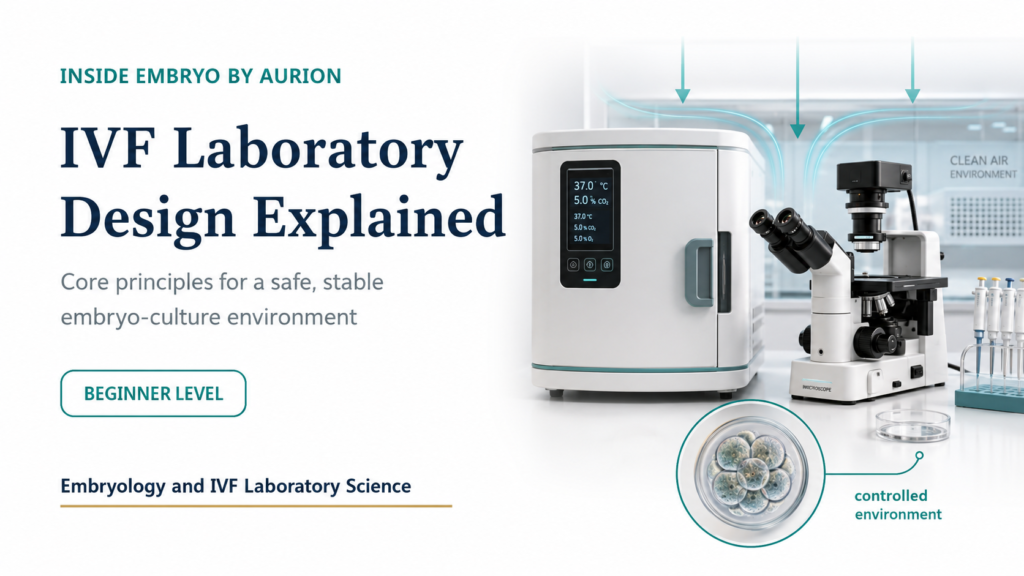
IVF laboratory design is the deliberate planning of the physical space, environmental controls, utilities, equipment and work systems used to handle sperm, oocytes and embryos outside the body. In assisted reproductive technology (ART), these cells may spend minutes to several days in laboratory-controlled conditions, so the room and the systems around it are part of the culture environment rather than a neutral backdrop. Current good-practice guidance therefore links laboratory layout with clean air, stable temperature and gases, safe movement of specimens, equipment monitoring, traceability, staff ergonomics and emergency preparedness.[1,2] Good design aims to reduce avoidable variation and human error while supporting reliable laboratory practice. It does not make every embryo develop normally and it cannot guarantee pregnancy or live birth. This article explains the core ideas for beginners, with a global perspective; national regulations, building codes and accreditation requirements must always be checked before a real laboratory is designed or renovated.
What You Will Learn
- What IVF laboratory design means and why it is part of embryo-culture quality.
- Where laboratory design fits into the IVF pathway from oocyte retrieval to transfer or cryostorage.
- The main design domains: workflow, air, environment, utilities, equipment, cryosafety and quality systems.
- A practical eight-step sequence for planning and commissioning a laboratory.
- What a design or environmental assessment can and cannot demonstrate.
- How to recognise common misconceptions and when specialist interpretation is needed.
| Key takeaways• IVF laboratory design is a biological, engineering, safety and quality system – not simply a floor plan. • The design should minimise unnecessary specimen movement and time outside controlled conditions. • Air control should address particles and chemical contaminants such as VOCs, with monitoring and source control. • Cryostorage requires distinct ventilation, monitoring, alarm and emergency-safety planning. • Validation, alarms, backup systems and a quality-management programme remain essential after the laboratory opens. • Good design can reduce avoidable risk and variation, but it cannot guarantee embryo development, pregnancy or live birth. |
Table of Contents
Meaning and basic definition
An in vitro fertilisation (IVF) laboratory is a specialised clinical laboratory where gametes – sperm and oocytes – and embryos are received, identified, prepared, observed, cultured, micromanipulated, cryopreserved or prepared for transfer. International terminology places these activities within ART and medically assisted reproduction, but the exact services offered vary between centres.[9]
IVF laboratory design is broader than architecture. It combines the floor plan with heating, ventilation and air-conditioning (HVAC), air filtration, medical gases, electrical resilience, workstations, incubators, cryostorage, cleaning arrangements, access control, monitoring, documentation and staff workflow. ESHRE’s 2026 good-practice recommendations emphasise a design that supports optimal workflow and minimises the time reproductive cells spend outside controlled environmental conditions.[1]
Why IVF laboratory design matters
Gametes and preimplantation embryos are handled in small volumes of culture medium. Temperature, pH, gas conditions and contaminant exposure can change when dishes are moved or incubators are opened. Good design cannot remove biological variation, but it can reduce avoidable environmental variation.[4-6]
Design also affects people and resilience. Crowding, awkward microscope positions, interruptions or long specimen routes can increase distraction, while power, gas, incubator or alarm failures can threaten critical processes. Ergonomics, sensible equipment placement, backup systems and emergency planning are therefore part of laboratory quality and safety.[1,2,8]
Where it fits within ART and IVF care
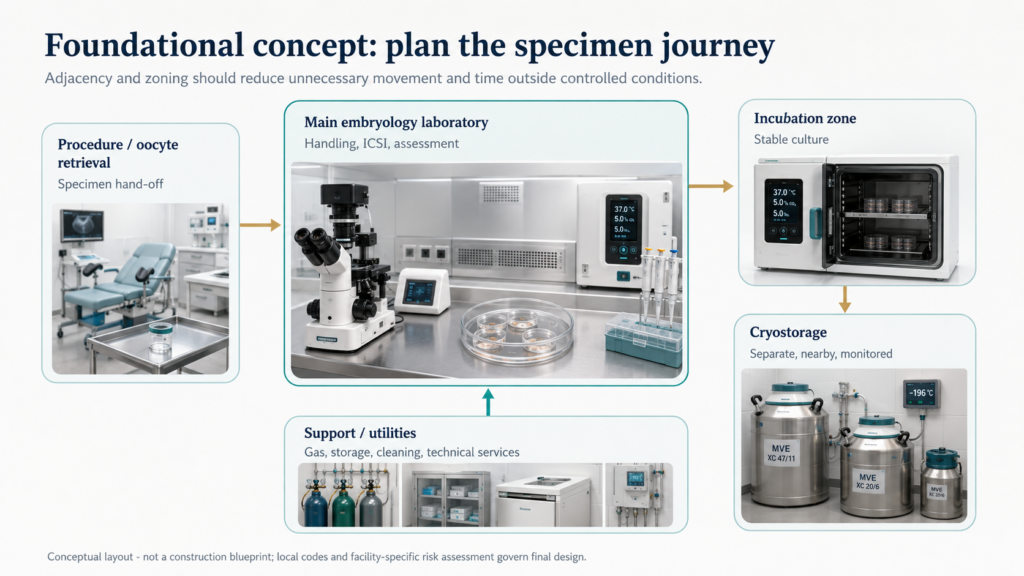
Laboratory design sits underneath the entire laboratory phase of an IVF cycle. After oocyte retrieval, follicular fluid and oocytes are transferred to the embryology team; sperm may be prepared in an andrology area; insemination or intracytoplasmic sperm injection (ICSI) is performed; fertilisation is checked; embryos are cultured and assessed; and selected embryos may be prepared for transfer, biopsy or cryopreservation. The laboratory must allow these steps to occur with clear identification, controlled conditions and as little unnecessary movement as practicable.[1,2]
For that reason, adjacency matters. ESHRE recommends that the IVF laboratory should ideally be close to the procedure room, while cryostorage is preferably separate from the main working area but nearby. Technical facilities, general storage and activities involving toxic or fixative chemicals should be physically separated from embryo-handling areas.[1]
Principal components of an IVF laboratory design
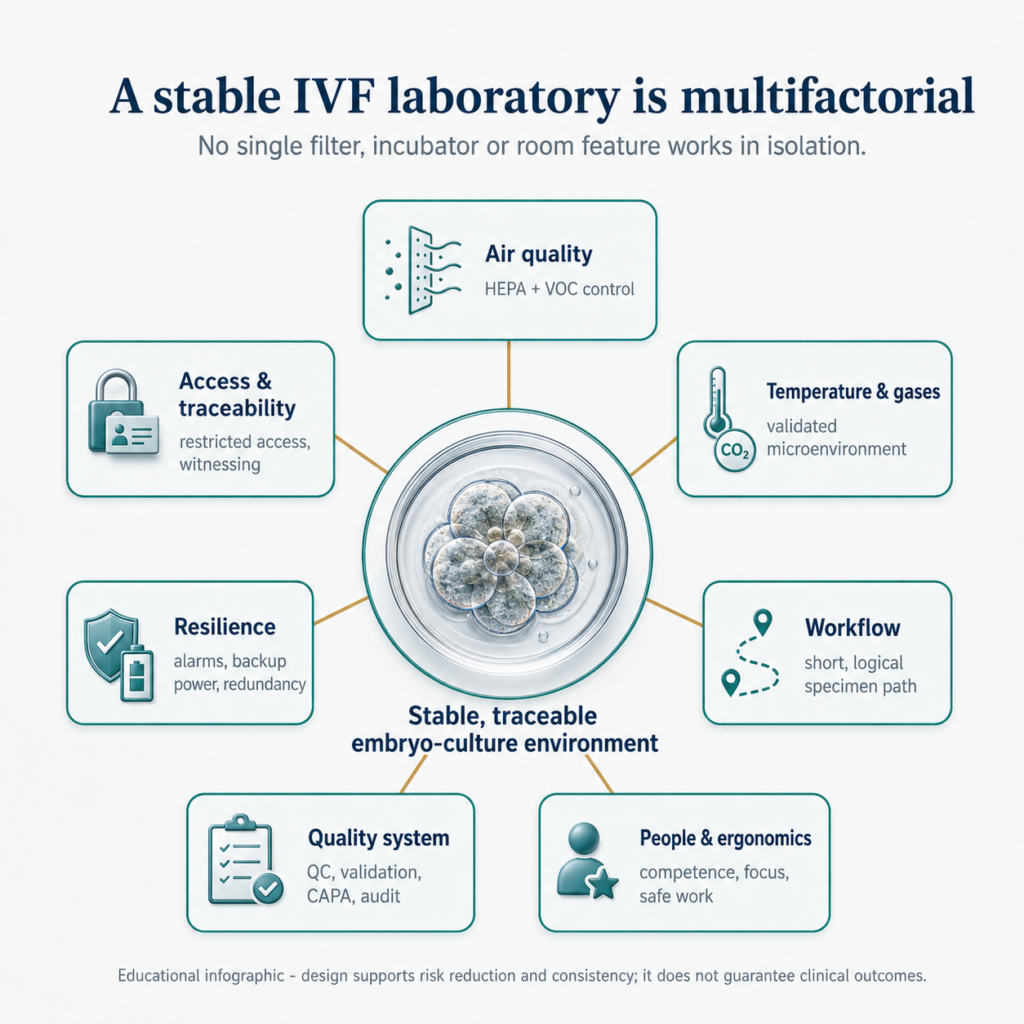
A beginner-friendly model has four layers: the specimen pathway; the environmental layer of air, temperature, humidity, gases, lighting and vibration; the infrastructure layer of power, medical gases, alarms and data; and the human-quality layer of access, witnessing, ergonomics, cleaning, validation and monitoring.[1,2,10]
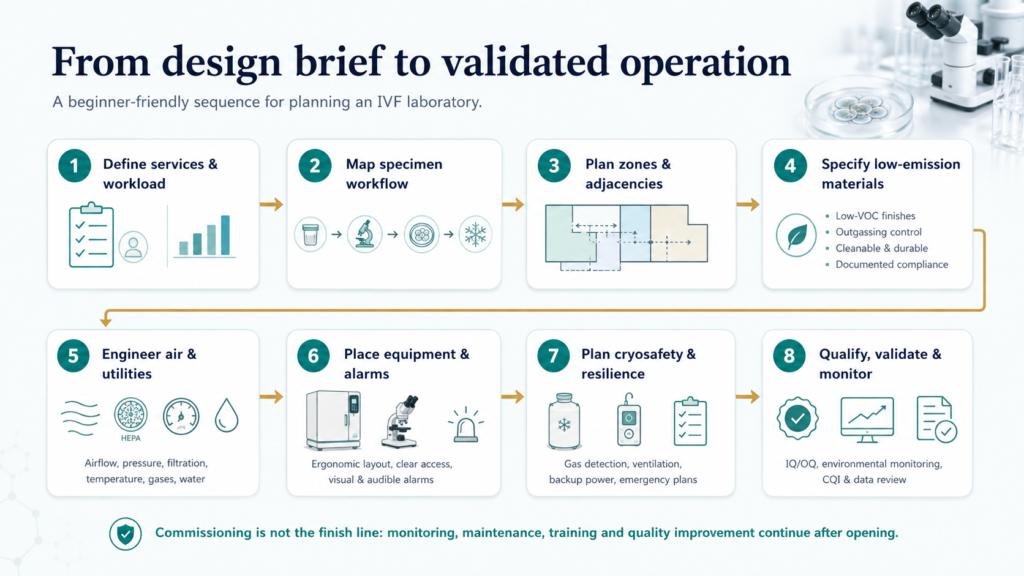
Air control commonly combines high-efficiency particulate air (HEPA) filtration with volatile organic compound (VOC) control, pressure management and monitoring. The exact HVAC solution depends on engineering design, the building and local requirements; HEPA filtration alone does not remove every chemical contaminant.[1,4,6]
Low-emission construction materials and adequate off-gassing after renovation help limit avoidable VOC sources. Cryostorage needs separate attention because liquid nitrogen can displace oxygen; ventilation, low-oxygen alarms, access control, tank monitoring and emergency procedures are therefore important.[1,4,7]
Table 1. Core IVF laboratory design domains
| Design domain | Why it matters | Beginner example |
| Workflow and zoning | Reduces unnecessary movement and conflicting activities | Procedure hand-off close to embryo work area |
| Air and materials | Controls particles and chemical contaminants | HEPA plus VOC control; low-emission finishes |
| Culture environment | Supports stable conditions during handling and incubation | Validated heated surfaces and incubators |
| Utilities and resilience | Keeps critical systems available | Backup power, gas contingency and alarm escalation |
| Cryostorage safety | Protects stored material and staff | Ventilation, oxygen alarm and tank monitoring |
| People and quality system | Makes safe practice repeatable | Restricted access, witnessing, QC and CAPA |
Step-by-step: how an IVF laboratory is planned
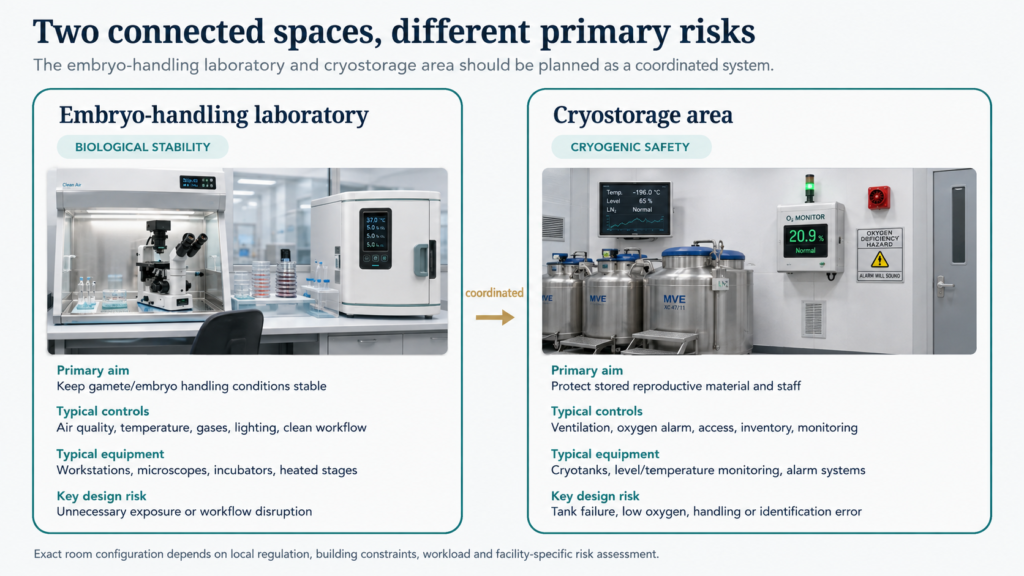
- Define services and workload. List the procedures, expected cycle volume, staffing and storage needs so equipment and space match actual activity.[1,2,10]
- Map the specimen journey. Follow oocytes, sperm and embryos through each hand-off and identify unnecessary travel or time outside controlled conditions.[1]
- Plan zones and adjacencies. Keep connected activities close, separate incompatible work and restrict access to critical areas while meeting local codes.[1,2]
- Specify suitable materials. Use cleanable, low-emission finishes and allow sufficient off-gassing after construction or renovation.[1,4]
- Engineer air and utilities. Design HVAC, particulate/VOC control, pressure relationships, gases, power and data as one coordinated system.[1,4,6]
- Place equipment and alarms. Provide workable ergonomics, adequate incubator capacity, independent checks and monitoring of critical equipment.[1]
- Plan cryosafety and resilience. Include ventilation, oxygen alarms, monitored cryostorage, backup power, gas contingencies and an emergency response pathway.[7,8]
- Qualify, validate and monitor. Demonstrate that rooms, equipment and processes perform as intended, then continue QC, calibration, maintenance, trending, competency assessment and CAPA.[1,2]
Factors that may influence the final design
There is no universal floor plan. Workload, IVF/ICSI/biopsy services, cryobanking, building geometry, outdoor pollution, climate, staffing, utilities, regulation and future expansion can all change the solution.[1,4,10]
The general need for a stable culture environment is well accepted, but the effect of one architectural feature on pregnancy or live birth is difficult to isolate because patient biology and multiple laboratory variables act together. Design should therefore be understood as risk control rather than a single outcome predictor.[1,4,6]
What a laboratory design assessment can tell us
A design review can assess whether specimen flow is logical, incompatible activities are separated, staff have workable space and critical environmental, utility, alarm and backup systems are planned. It can also identify foreseeable risks such as excessive traffic, unsafe cryostorage arrangements or single points of failure.[1,2,7]
After opening, quality and environmental data can show whether the laboratory remains within its validated limits. That is a system-performance assessment, not a patient diagnostic test.
What it cannot tell us
A floor plan or environmental reading cannot diagnose infertility, determine an embryo’s genetic competence or guarantee fertilisation, implantation, pregnancy or live birth. Outcomes remain influenced by patient, gamete, embryo, clinical and laboratory factors.[9,11]
Association means variables occur together; prediction estimates likelihood; diagnosis identifies a clinical condition using appropriate criteria; and a guarantee implies certainty. Laboratory design may be associated with better control and may support performance, but it is not a diagnosis or guarantee.
Table 2. What a design review can show – and what it cannot
| A design / system review can help show | It cannot demonstrate |
| Whether workflow, zoning and access controls are logically planned | The cause of an individual patient’s infertility |
| Whether critical utilities, alarms and backup systems are specified | An embryo’s genetic or developmental competence |
| Whether environmental controls and monitoring are defined | A certain implantation, pregnancy or live-birth outcome |
| Whether foreseeable laboratory risks have mitigation measures | That one laboratory design is universally best |
Myth versus fact
| Myth: ‘A clean room is sterile.’Fact: Clean-room controls reduce contamination; sterility is not assumed. Cleaning, access control and monitoring remain necessary.[1,4] |
| Myth: ‘HEPA filtration solves every air problem.’Fact: HEPA targets particles; VOC source control and chemical filtration may also be needed.[1,4,6] |
| Myth: ‘The best incubator compensates for poor workflow.’Fact: Handling time, heated work, gas control, maintenance and staff practice also matter.[1,5] |
| Myth: ‘Modern design guarantees pregnancy.’Fact: Design supports consistency and risk reduction; clinical outcomes are multifactorial.[1,6] |
| Myth: ‘Cryotanks belong in the main lab.’Fact: ESHRE recommends separate, nearby cryostorage with appropriate safety controls.[1] |
| Myth: ‘One blueprint suits every centre.’Fact: Local regulation, workload, building constraints and risk assessment determine the final layout. |
Practical interpretation for learners
During a laboratory tour, follow the specimen pathway. Ask where temperature can change, where identification could fail, how contaminants are controlled, what is continuously monitored and what happens if power, gas, an incubator or an alarm fails.
Think in layers rather than devices. Good practice combines stable equipment, short specimen routes, appropriate gases, heated handling, controlled air, restricted access, trained staff and a quality system. The safest design makes the stable and traceable action easy to perform.[1,2,5]
When specialist interpretation or consultation is needed
A new build, major renovation, HVAC change, cryostorage expansion, medical-gas installation or alarm redesign needs multidisciplinary specialist input. The team commonly includes laboratory leadership, embryologists, quality staff, facilities/HVAC engineers and local safety, regulatory or accreditation expertise.[1,2,10]
Specialist review is also appropriate when environmental trends change, alarms become unreliable, cryostorage risks increase or laboratory performance shifts after construction or equipment changes. Investigation should consider the whole system rather than attributing an outcome to one measurement.
Summary
IVF laboratory design connects specimen flow with controlled air, stable culture conditions, suitable materials, reliable utilities, equipment monitoring, cryosafety, traceability, ergonomics and emergency resilience. Current guidance emphasises minimising unnecessary time outside controlled conditions, controlling particulate and VOC exposure, monitoring critical systems and separating cryostorage from the main work area.[1]
Its purpose is to manage avoidable risk and variation. Even excellent design cannot diagnose infertility, prove embryo competence or promise pregnancy or live birth.
Frequently Asked Questions
Why does an IVF laboratory need special air control?
Gametes and embryos are handled in culture systems that may be affected by environmental contaminants. Guidance therefore combines particulate/VOC control, source control, monitoring and suitable materials; the goal is control, not sterility.[1,4,6]
What is positive pressure?
The laboratory is kept at a slightly higher pressure than adjacent areas so air tends to move outward when a door opens. The exact pressure strategy must be engineered for the facility.[1,2]
Why are low-VOC materials important?
Paints, adhesives, sealants, furniture and cleaning products can release volatile organic compounds. Low-emission materials, filtration and off-gassing reduce avoidable chemical loading.[1,4]
Why is cryostorage usually separate?
Liquid nitrogen can displace oxygen, so cryostorage has specific ventilation, oxygen-alarm, access and monitoring needs. Separation helps manage those hazards while remaining close to laboratory workflow.[1,7]
Does better laboratory design guarantee better IVF outcomes?
No. Design supports safer and more consistent practice, but outcomes depend on patient, gamete, embryo, clinical and laboratory factors. It is risk control, not a guarantee.[1,6]
Can an existing room become an IVF laboratory?
Sometimes, but floor area alone is insufficient. HVAC, materials, power, gases, cryosafety, access, workflow, structural limits and local regulation all need professional assessment and commissioning.[1,2,10]
What should a trainee notice during a laboratory tour?
Follow specimen movement, incubator access, heated work areas, gases, backup power, cryostorage, alarms, access and witnessing. Ask how each critical condition is monitored and how deviations are managed.
Beginner Glossary
Assisted reproductive technology (ART): Treatments involving in-vitro handling of oocytes, sperm or embryos for reproduction.
In vitro fertilisation (IVF): Fertilisation of oocytes outside the body followed by embryo culture and clinical use as appropriate.
Gamete: A reproductive cell: an oocyte or spermatozoon.
Embryo: The developing organism after fertilisation; early stages may be cultured in the IVF laboratory.
Incubator: Equipment that maintains defined culture conditions for gametes or embryos.
HVAC: Heating, ventilation and air-conditioning system controlling room air and environmental conditions.
HEPA filter: High-efficiency particulate air filter for removing very small airborne particles.
VOC: Volatile organic compound; a chemical that can evaporate into room air.
Positive pressure: A pressure relationship encouraging air to flow from the controlled room towards adjacent space.
Cryostorage: Storage of reproductive material at cryogenic temperatures, commonly using liquid nitrogen.
Validation: Documented evidence that a system or process performs as intended.
Quality control (QC): Routine checks that critical conditions remain within defined limits.
CAPA: Corrective and preventive action used to address a problem and reduce recurrence.
Traceability: Ability to follow specimen identity, location and history through laboratory steps.
References
1. ESHRE Good Practice in the IVF Lab Working Group; Arroyo G, Barrie A, Coticchio G, Ebner T, Kirkman-Brown J, et al. ESHRE recommendations on Good Practice in the IVF laboratory. Hum Reprod. 2026;41(8):1245-1269. doi:10.1093/humrep/deag096. Source
2. Practice Committees of the American Society for Reproductive Medicine and the Society for Reproductive Biologists and Technologists. Comprehensive guidance for human embryology, andrology, and endocrinology laboratories: management and operations: a committee opinion. Fertil Steril. 2022;117(6):1183-1202. doi:10.1016/j.fertnstert.2022.02.016. Source
3. Practice Committee of the American Society for Reproductive Medicine, Practice Committee of the Society for Assisted Reproductive Technology, and Practice Committee of the Society of Reproductive Biologists and Technologists. Minimum standards for practices offering assisted reproductive technologies: a committee opinion. Fertil Steril. 2021;115(3):578-582. doi:10.1016/j.fertnstert.2020.12.036. Source
4. Mortimer D, Cohen J, Mortimer ST, Fawzy M, McCulloh DH, Morbeck DE, et al. Cairo consensus on the IVF laboratory environment and air quality: report of an expert meeting. Reprod Biomed Online. 2018;36(6):658-674. doi:10.1016/j.rbmo.2018.02.005. Source
5. Cairo Consensus Group. ‘There is only one thing that is truly important in an IVF laboratory: everything’ Cairo Consensus Guidelines on IVF Culture Conditions. Reprod Biomed Online. 2020;40(1):33-60. doi:10.1016/j.rbmo.2019.10.003. Source
6. Sciorio R, Rapalini E, Esteves SC. Air quality in the clinical embryology laboratory: a mini-review. Ther Adv Reprod Health. 2021;15:2633494121990684. doi:10.1177/2633494121990684. Source
7. Practice Committees of the American Society for Reproductive Medicine, Society for Reproductive Biologists and Technologists, and Society for Assisted Reproductive Technology. Cryostorage of reproductive tissues in the in vitro fertilization laboratory: a committee opinion. Fertil Steril. 2020;114(3):486-491. doi:10.1016/j.fertnstert.2020.06.019. Source
8. Practice Committees of the American Society for Reproductive Medicine, the Society for Assisted Reproductive Technology, and the Society of Reproductive Biologists and Technologists. Development of an emergency plan for in vitro fertilization programs: a committee opinion. Fertil Steril. 2021;115(4):870-873. doi:10.1016/j.fertnstert.2021.01.009. Source
9. Zegers-Hochschild F, Dyer S, Adamson GD, Baker V, Barnhart K, Bhattacharya S, et al. The International Glossary on Infertility and Fertility Care, 2025. Fertil Steril. 2026;126(1):127-149. doi:10.1016/j.fertnstert.2026.02.022. Source
10. Lagunov A, Crowe M, Swain JE. Establishing and Equipping a New IVF Laboratory. In: Montag MHM, Morbeck DE, editors. Principles of IVF Laboratory Practice: Laboratory Set-Up, Training and Daily Operation. Cambridge: Cambridge University Press; 2023. p. 1-8. doi:10.1017/9781009030601.002. Source
11. World Health Organization. Guideline for the prevention, diagnosis and treatment of infertility. Geneva: World Health Organization; 2025. ISBN 978-92-4-011577-4. Source
Final Educational Disclaimer
| For education onlyInside Embryo by Aurion provides scientific education and does not replace patient-specific assessment, clinical judgement, laboratory validation, engineering design, accreditation requirements or national and local law. Laboratory practices must be interpreted by appropriately qualified professionals within the context of the facility and the patient. No information in this article should be read as a promise of fertilisation, embryo development, implantation, pregnancy or live birth. |
Author: Manoj Kumar K | Publisher: Inside Embryo by Aurion | insideembryo.com