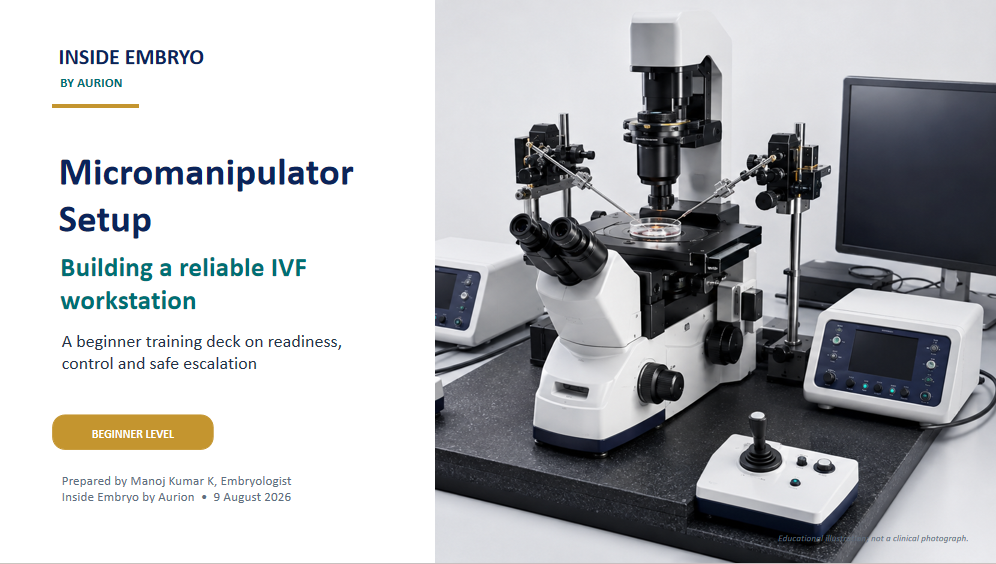
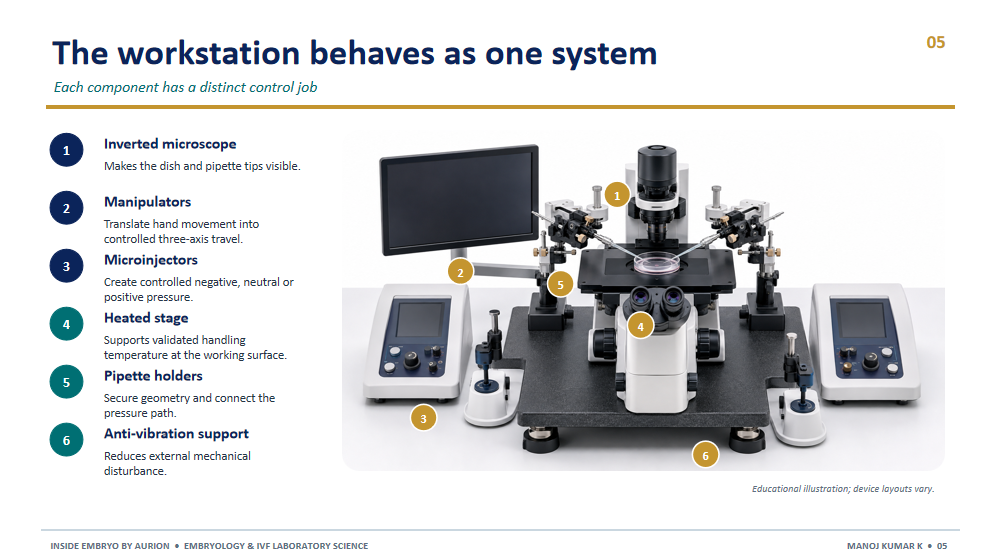
This beginner PowerPoint turns micromanipulator setup into a structured visual teaching sequence. Rather than teaching device-specific numerical settings, the presentation focuses on the reasoning required to recognise a technically ready workstation: clear vision, controlled movement, predictable pressure, environmental stability and complete documentation. It introduces workstation anatomy, holding and working sides, alignment, acellular pressure testing, the eight-step readiness pathway, stop-use signals, troubleshooting concepts and the distinction between technical readiness and clinical outcome.
| Resource Information | Details |
|---|---|
| Topic | Micromanipulator Setup |
| Resource | PowerPoint Training Deck |
| Level | Beginner |
| Scientific Area | Embryology and IVF Laboratory Science |
| Speciality | Micromanipulation and Embryo Biopsy |
| Slides | 19 |
| Presentation Ratio | 16:9 |
| Learning Style | Visual teaching, classroom discussion and revision |
| Suitable For | Embryology trainees, students, laboratory educators and IVF professionals |
| Author | Manoj Kumar K, Embryologist |
| Publisher | Inside Embryo by Aurion |
| Website | insideembryo.com |
| Access | Free |
| Format | PPTX |
What You Will Learn
- Identify the optical path, manipulators, microinjectors, heated stage and micropipettes.
- Explain the four major setup interfaces: vision, motion, pressure and environment.
- Differentiate the stabilising role of the holding side from the procedure-specific working side.
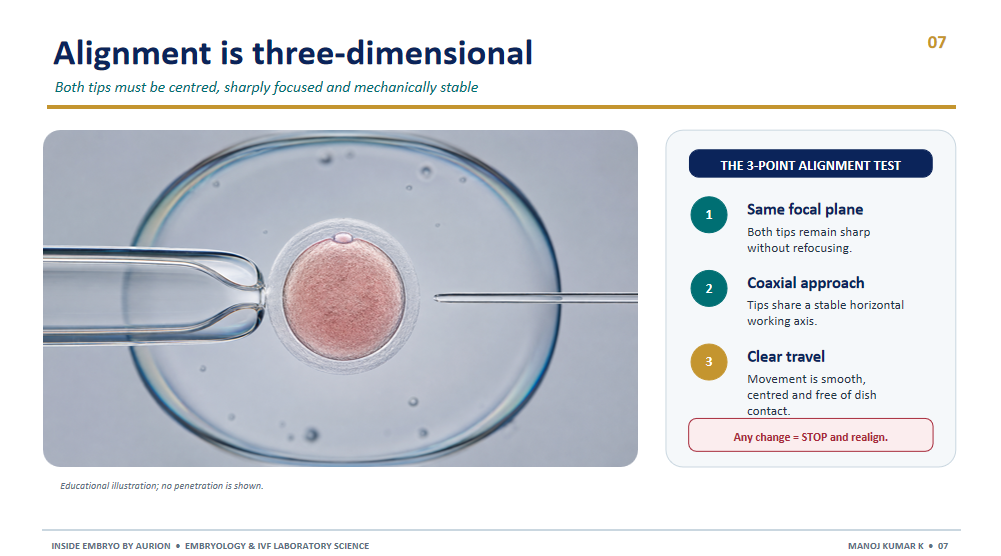
- Understand basic three-dimensional pipette alignment and focal-plane principles.
- Follow an eight-stage supervised pre-use readiness sequence from review through release or escalation.
- Recognise drift, pressure abnormalities, damaged pipettes, environmental instability and documentation uncertainty as reasons to stop and reassess.
Educational use only. This presentation supports scientific learning, supervised training and academic discussion. It is not an executable clinical protocol and does not authorise unsupervised manipulation of human gametes or embryos.
Users must follow current institutional SOPs, manufacturer IFUs, equipment qualification and validation requirements, competency programmes, professional guidance and applicable regulations. Numerical settings, tool geometry, release ranges and troubleshooting procedures must be defined locally rather than copied from a teaching presentation.
© Inside Embryo by Aurion. Personal educational use is permitted. Republishing, reselling, modifying or distributing the presentation without permission is prohibited.