Meet the scientist working behind the laboratory door.
A patient-friendly guide to how embryologists care for eggs, sperm and embryos from egg collection through fertilisation, embryo culture, transfer, freezing and future frozen-embryo treatment.
| CATEGORY – Patient Education | READING TIME ~12-14 minutes | AUTHOR – Manoj Kumar K, Embryologist |
| PUBLISHED – 30 September 2026 | ARTICLE TYPE – Patient Guide | PUBLISHER – Inside Embryo by Aurion |
During IVF, you usually spend most of your time with doctors, nurses, sonographers and coordinators. Yet some of the most important steps in the cycle happen in a laboratory you may never enter. The scientist working there is the embryologist.
An embryologist is trained to handle reproductive cells and embryos under carefully controlled laboratory conditions. Their work may include finding eggs after retrieval, preparing or working with sperm, performing conventional IVF or ICSI, checking fertilisation, monitoring embryo development, preparing embryos for transfer, freezing and warming eggs or embryos, and maintaining accurate identification and quality-control records throughout the process.
The exact responsibilities vary between clinics, countries and staff roles. IVF is a team treatment: the embryologist does not independently decide your medication plan or make every clinical decision. Instead, the laboratory team works closely with fertility doctors, nurses and other professionals so that your treatment plan can be carried out safely and accurately.
| In one sentenceAn embryologist is the laboratory scientist who looks after eggs, sperm and embryos during IVF, performs key laboratory procedures, records development, and helps ensure that every sample is correctly identified and handled in a controlled environment. |
In this article
- What an embryologist is and where they fit into your IVF team
- What happens in the laboratory before egg collection
- How embryologists find and care for eggs after retrieval
- What happens to the sperm sample
- How fertilisation is attempted with conventional IVF or ICSI
- What the embryologist checks on Day 1 and during embryo culture
- How embryo transfer, freezing, warming and PGT biopsy may involve the embryology team
- The hidden work: witnessing, traceability, quality control and documentation
- What embryologists can tell from an embryo – and what they cannot
- Common myths, questions to ask, FAQs, glossary and references
Table of Contents
Who is an embryologist?
Embryologist are the unsung hero who are always looking to into the sperms, oocytes and embryos.
An embryologist is a laboratory scientist trained in assisted reproductive technology (ART). In an IVF laboratory, embryologists work with human eggs (oocytes), sperm, fertilised eggs and embryos. Professional guidance describes embryology laboratories as providing services such as oocyte identification, fertilisation, embryo culture, transfer support, cryopreservation and, in some centres, embryo biopsy for preimplantation genetic testing (PGT).
Because the work involves living cells that are highly sensitive to temperature, pH, gas conditions, timing and handling, embryology is not simply “looking at embryos under a microscope.” It combines technical skill, reproductive biology, precise documentation, quality systems, teamwork and careful judgement within the clinic’s validated procedures.
| Important to knowYou may not meet the embryologist who handled your eggs or embryos. Some clinics provide direct calls from the laboratory; others communicate results through doctors or nurses. Limited face-to-face contact does not mean the embryology team is less involved. |
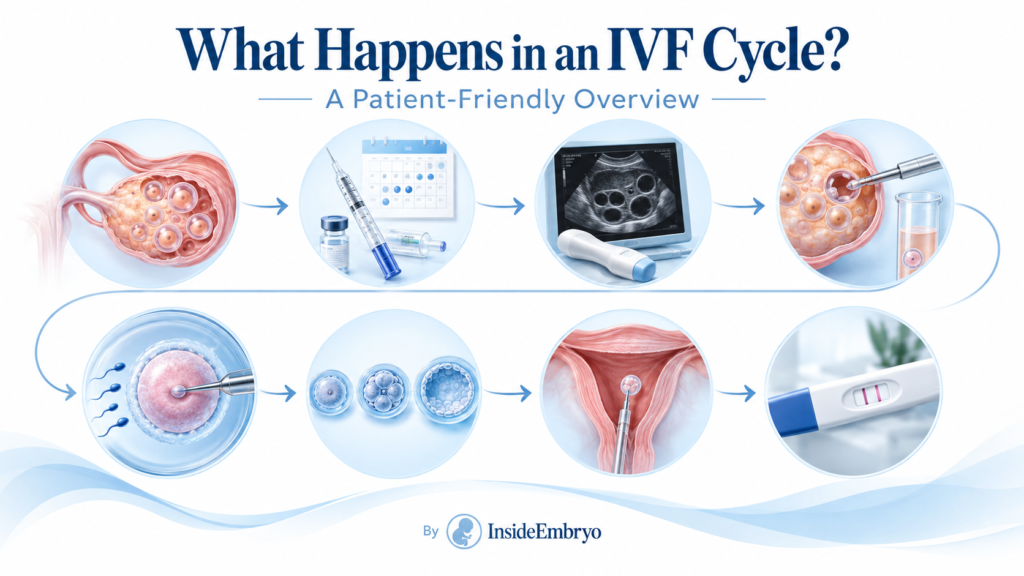
Where does the embryologist fit into your IVF journey?
| IVF stage | What you may experience | What the embryology team may be doing |
| Before egg collection | Stimulation, scans and trigger medication | Preparing the laboratory, checking equipment and culture conditions, confirming the treatment plan and identification systems. |
| Egg collection | Egg retrieval procedure | Receiving follicular fluid, locating oocytes, washing/identifying them and placing them into culture. |
| Sperm preparation | Fresh, frozen, donor or surgically retrieved sperm may be used | Preparing the treatment sample or working with the andrology team so suitable sperm are available for fertilisation. |
| Fertilisation | Conventional IVF or ICSI is performed as planned | Inseminating eggs or performing ICSI on suitable mature eggs according to the treatment plan. |
| Day 1 | You may receive a fertilisation update | Checking eggs for expected signs of fertilisation and documenting the result. |
| Embryo culture | Embryos develop over the next several days | Maintaining culture conditions, observing development at planned times and recording embryo morphology/stage. |
| Transfer / biopsy / freezing | An embryo may be transferred, biopsied or frozen | Preparing the selected embryo, supporting transfer, performing biopsy when indicated, or vitrifying suitable embryos. |
| Frozen embryo transfer | A stored embryo is used in a later cycle | Warming the embryo, checking survival and development, and preparing it for transfer. |
1. Before egg collection: preparing the laboratory
Your embryologist’s work begins before the egg-retrieval needle enters the first follicle. IVF laboratories are designed to provide a stable environment for eggs and embryos, and the team follows quality-control procedures throughout the day.
Depending on the laboratory, preparation may include:
- Checking incubator temperature, gas conditions, alarms and other critical equipment.
- Preparing or confirming the culture dishes, media, consumables and labels needed for the day.
- Reviewing the planned laboratory treatment – for example conventional IVF, ICSI, freezing or PGT biopsy.
- Confirming patient identification and traceability steps before biological material is handled.
- Coordinating the timing of egg collections, fertilisation procedures, embryo assessments, transfers and frozen-embryo warming.
Many of these tasks are invisible to patients, but they are essential. The goal is to reduce avoidable variation and provide a controlled environment before eggs, sperm or embryos enter the laboratory workflow.
2. During egg collection: finding the eggs
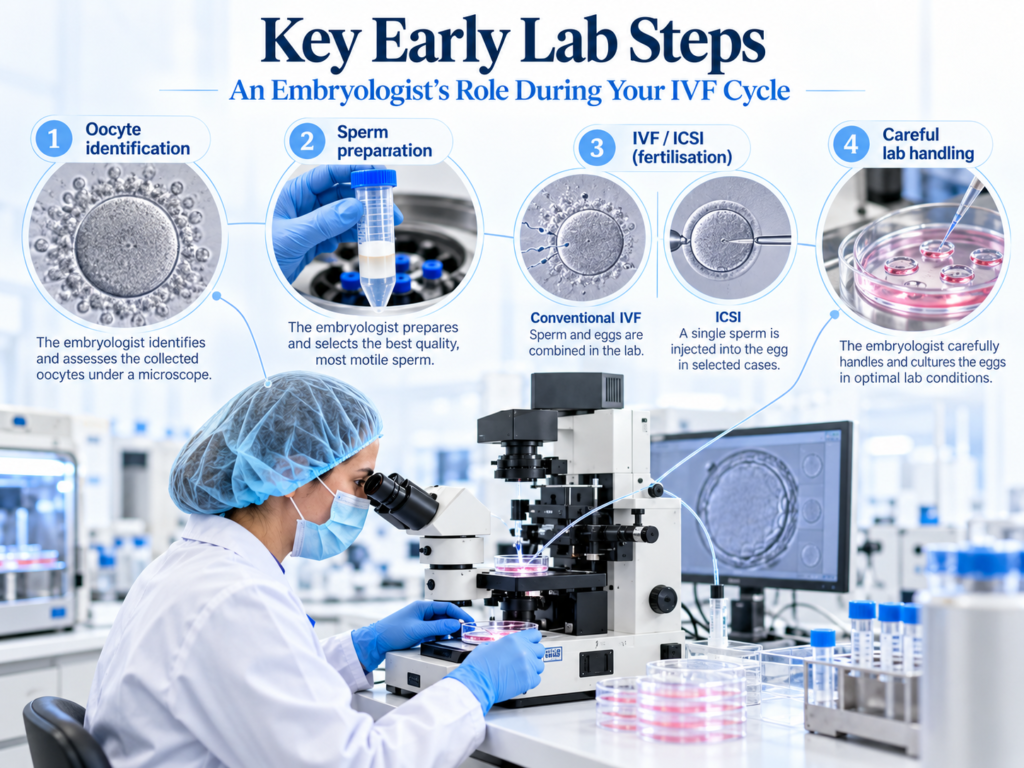
During egg retrieval, the fertility doctor aspirates fluid from the ovarian follicles. That follicular fluid is passed to the laboratory, where an embryologist examines it under a microscope to look for the oocyte-cumulus complex – the egg surrounded by supporting cells.
- The embryologist identifies oocytes in the follicular fluid.
- The oocytes are gently handled and placed into appropriate culture conditions.
- The number of eggs found is documented and communicated according to the clinic’s process.
- The eggs are kept in controlled conditions while the laboratory prepares for the planned fertilisation method.
| A common misunderstandingThe number of follicles seen on ultrasound is not the same as the number of eggs collected. Not every follicle contains a recoverable egg, and not every collected egg will be mature or capable of fertilisation. |
3. What happens to the sperm sample?
On or around the day of egg collection, a sperm sample may be produced, thawed from storage, provided by a donor source, or obtained surgically in selected male-factor cases. Depending on how a clinic divides laboratory roles, sperm preparation may be performed by an embryologist, an andrologist, or another appropriately trained laboratory professional.
For treatment, the sample is processed so that an appropriate population of sperm is available for conventional IVF or ICSI. The exact method depends on the sample and the laboratory’s validated procedures.
It is important to separate treatment preparation from diagnosis. A diagnostic semen analysis is a separate assessment. The treatment-day laboratory team uses the sample according to the IVF plan and communicates any unexpected findings to the clinical team.
See This Topic on Instagram
Explore our related Instagram post for a quick visual overview.
4. Fertilisation: conventional IVF or ICSI
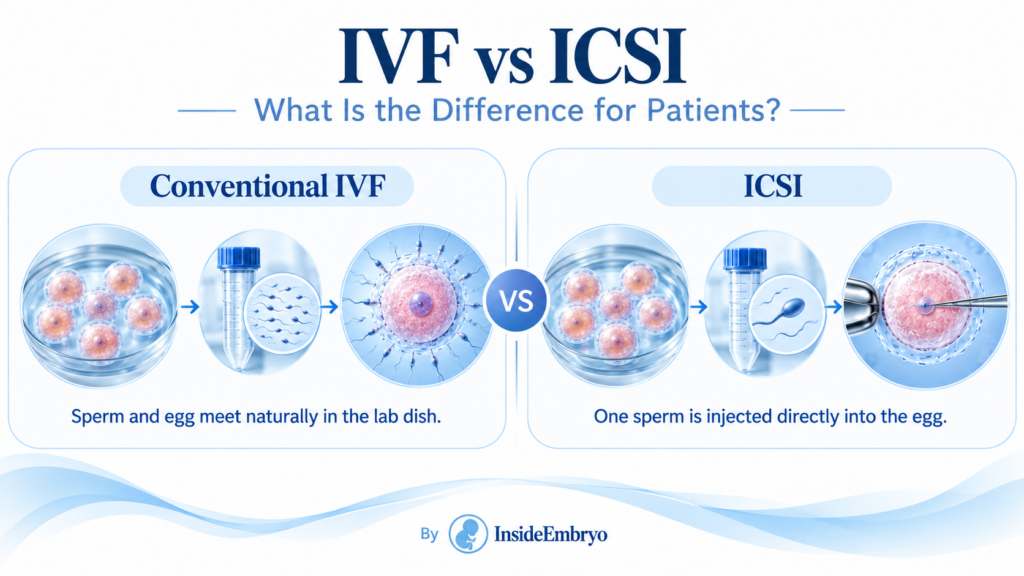
Once the eggs and sperm are ready, the laboratory attempts fertilisation using the method planned for your cycle. The two most common approaches are conventional IVF and intracytoplasmic sperm injection (ICSI).
| Method | What the embryologist does | What it means for the egg |
| Conventional IVF | Places an appropriate preparation of sperm with the eggs in controlled culture conditions. | Sperm must complete the steps needed to interact with and enter the egg without direct injection. |
| ICSI | Removes surrounding cells to assess egg maturity, selects a sperm using routine laboratory criteria, and injects one sperm into each suitable mature egg. | ICSI bypasses several sperm-entry steps, but normal fertilisation still depends on the biology of the egg and sperm. |
The embryologist performs the laboratory technique, but the choice between conventional IVF and ICSI should be linked to the treatment indication and clinic plan. It is not simply a matter of choosing the “more advanced” option.
| Related reading – For a full patient-friendly comparison, see: “IVF vs ICSI: What Is the Difference for Patients?” on Inside Embryo. |
5. Day 1: checking whether fertilisation occurred
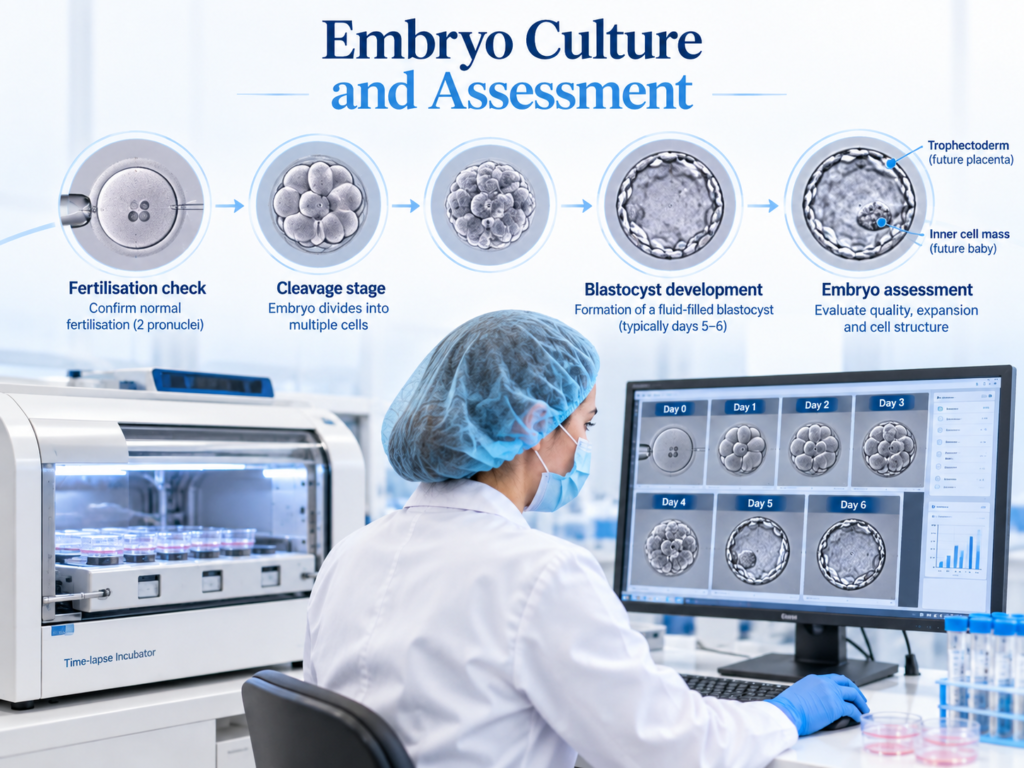
After fertilisation has been attempted, the embryology team checks the eggs at the laboratory’s scheduled time for signs of fertilisation. A commonly expected finding is two pronuclei (2PN), representing the visible nuclear structures from the egg and sperm before they combine.
The embryologist may document eggs as normally fertilised, unfertilised, abnormally fertilised, or not clearly assessable according to the laboratory’s criteria. Your clinic may then call or message you with a fertilisation update.
| Important perspectiveFertilisation is an early milestone, not a final outcome. A normally fertilised egg still has to continue dividing and developing over the next several days. Not every fertilised egg becomes a blastocyst, and not every blastocyst results in pregnancy. |
6. Embryo culture: watching development without trying to “force” it
After fertilisation, embryos are cultured in carefully controlled incubators. Over the next several days, embryologists assess development at planned time points while trying to minimise unnecessary disturbance.
Depending on the day and the clinic’s system, the embryologist may record features such as:
- Cell number and symmetry during early cleavage stages.
- The degree of fragmentation or other morphological features.
- Compaction as cells form a morula.
- Blastocyst expansion and the appearance of the inner cell mass and trophectoderm.
- Whether an embryo has reached the laboratory’s criteria for transfer, biopsy or cryopreservation.
Some laboratories use time-lapse incubators that capture images without routinely removing embryos for observation. Other laboratories use conventional incubators with scheduled assessments. Both approaches still require trained interpretation and validated laboratory practice.
Embryo grading is a descriptive system. It helps the team communicate development and prioritise embryos, but it cannot reveal everything about embryo biology and cannot guarantee implantation, pregnancy or live birth.
What can an embryologist tell from an embryo – and what can they not tell?
| An embryologist can assess… | An embryologist cannot know with certainty… |
| Developmental stage and visible morphology at a specific time. | Whether an embryo will definitely implant. |
| Whether fertilisation appears normal by laboratory criteria. | Whether every apparently normal embryo is chromosomally normal. |
| Whether an embryo meets the clinic’s criteria for transfer, biopsy or freezing. | Whether a pregnancy or live birth will occur. |
| How embryos compare within the same cycle using the laboratory’s grading system. | A baby’s future health or all genetic information from appearance alone. |
| Whether a warmed embryo survived and resumed expected development. | The final outcome of the transfer before pregnancy testing and follow-up. |
7. If PGT is planned: embryo biopsy
Preimplantation genetic testing (PGT) is not part of every IVF cycle. When it is clinically indicated and chosen after appropriate counselling, a trained embryologist may perform an embryo biopsy, commonly at the blastocyst stage.
A small number of cells from the trophectoderm – the outer cell layer that contributes mainly to placental tissues – may be removed and sent to a genetics laboratory. The embryo is usually cryopreserved while testing is completed. The embryologist must maintain clear identification between the embryo and the biopsy sample throughout the process.
| PGT does not “improve” an embryoA biopsy and genetic test provide information for a specific clinical purpose. They do not make an embryo stronger, repair genetic abnormalities or guarantee a successful pregnancy. |
8. Embryo transfer day: preparing the embryo for the clinical team
If an embryo transfer is planned, the embryologist confirms the embryo to be used according to the treatment plan, patient consent, laboratory criteria and clinic policy. The embryo is assessed and prepared for transfer.
In many clinics, the fertility doctor performs the uterine catheter placement while the embryologist loads the embryo into a fine transfer catheter and coordinates the laboratory side of the procedure. Exact responsibilities vary by clinic and local practice.
After the transfer, the laboratory may check the catheter to confirm that the embryo is no longer inside it. The embryologist then completes the relevant documentation and updates the laboratory record.
| What if there is no fresh transfer?Not every IVF cycle includes a fresh embryo transfer. Suitable embryos may be frozen for a later cycle because of the treatment plan, safety considerations, genetic testing, endometrial timing or other clinical reasons. |
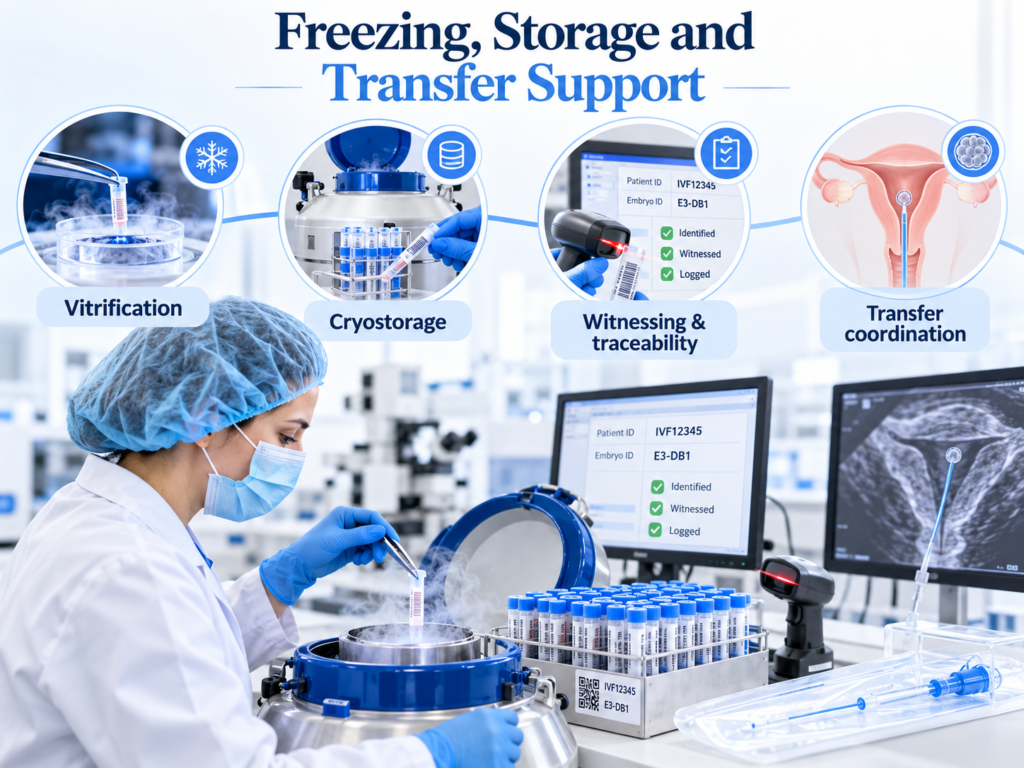
9. Freezing embryos – and warming them later
Suitable embryos that are not being transferred may be cryopreserved if this is part of your consent and treatment plan. Most modern IVF laboratories use vitrification, a rapid cryopreservation method designed to minimise ice-crystal formation.
The embryologist’s responsibilities may include confirming embryo identity, documenting the embryo and stage, performing the vitrification procedure, labelling the storage device, recording its storage location and maintaining traceability within the cryostorage system.
For a frozen embryo transfer, an embryologist warms the selected embryo before transfer and assesses whether it has survived the warming process and is showing expected post-warming features. The timing and assessment system vary by laboratory.
10. The hidden work: identification, witnessing and traceability
One of the most important parts of embryology is work that patients never see: making sure the correct eggs, sperm and embryos remain linked to the correct patient at every critical step.
Laboratories use defined identification and witnessing systems. Depending on the clinic, this may involve two qualified staff members, an electronic witnessing system, or a combination of methods. Labels, records and specimen identity are checked during important manipulations and handovers.
This traceability applies not only on egg collection day, but also during insemination or ICSI, fertilisation assessment, embryo culture, biopsy, transfer, freezing, warming and storage.
11. Quality control: protecting the laboratory environment
Embryos cannot be cared for well without a reliable laboratory environment. Embryologists therefore spend part of every working day on quality control and documentation in addition to hands-on procedures.
- Monitoring incubators, gas systems, refrigerators, freezers and cryostorage equipment.
- Reviewing temperature and alarm systems and responding to unexpected changes.
- Checking media, consumables and laboratory supplies before use.
- Maintaining cleaning, maintenance and equipment records.
- Documenting procedures, outcomes and deviations according to laboratory policy.
- Following emergency procedures and continuity plans for power, equipment or storage problems.
Good embryology is therefore both biological and organisational. The technical procedure is only one part of the work; the quality system around it is equally important.
12. Communication: when will you hear from the embryologist?
Communication practices differ widely. In some clinics, an embryologist calls patients directly after fertilisation checks or embryo assessments. In others, the update comes from a nurse, doctor or coordinator using information entered by the laboratory.
Updates may include the number of eggs collected, the number of mature eggs when relevant, fertilisation results, embryo-development information, the planned transfer day, freezing information or whether another decision is needed.
| A useful question to ask before egg collection – “When will I receive laboratory updates, who will contact me, and which days should I expect to hear about fertilisation and embryo development?” |
What does the embryologist decide – and what is decided by the wider team?
IVF works best when laboratory and clinical decisions are connected. No single person is responsible for every decision in the cycle.
| Embryology team contributes laboratory information about… | Clinical team and patient decisions may include… |
| Egg identification and maturity when assessed. | Medication protocol, dose changes and trigger timing. |
| Fertilisation findings and embryo-development observations. | Whether IVF is appropriate and the overall clinical treatment plan. |
| Embryo morphology, grading and laboratory suitability for transfer/freezing. | How many embryos should be transferred, considering clinical guidance and consent. |
| Technical feasibility of ICSI, biopsy, freezing or warming procedures. | Whether PGT, donor treatment or other clinical options are appropriate. |
| Laboratory records and cryostorage information. | Medical advice, pregnancy care and management of treatment complications. |
Myth vs fact
| Myth | Fact |
| The embryologist just watches embryos under a microscope. | Embryologists perform multiple laboratory procedures and also manage identification, documentation, cryopreservation, quality control and communication. |
| A top-grade embryo is guaranteed to become a baby. | Grading describes visible development. It cannot guarantee implantation, pregnancy or live birth. |
| During ICSI, the embryologist can pick a genetically perfect sperm by looking at it. | Routine sperm selection uses observable laboratory criteria. A standard microscope cannot reveal every genetic or DNA feature of a sperm cell. |
| The more often embryos are checked, the safer they are. | Laboratories aim to obtain the information they need while minimising unnecessary disturbance. Assessment schedules depend on the culture system. |
| The same embryologist must handle your case from start to finish. | IVF laboratories work as teams. Different trained embryologists may perform different steps with documented handovers and traceability. |
Questions patients can ask their IVF laboratory or clinic
- When will I receive my egg, fertilisation and embryo-development updates?
- Will an embryologist speak with me directly, or will results come through my doctor or nurse?
- Why are you recommending conventional IVF or ICSI for my cycle?
- How does your laboratory identify and witness eggs, sperm and embryos?
- On which days do you normally assess embryos, and how do you describe embryo grades?
- What criteria do you use for freezing embryos?
- If PGT is planned, how is the biopsy sample linked to my embryo?
- If I have frozen embryos, what should I expect on the warming and transfer day?
- Can I receive a written embryology report after my cycle?
Common questions – simple answers
Will I meet my embryologist?
Maybe. Some clinics introduce patients to the laboratory team or arrange embryologist calls, while others communicate through the clinical team. The structure varies by clinic.
Does an embryologist choose which embryo is transferred?
The embryologist usually provides laboratory information about embryo development and helps identify which embryo meets the clinic’s criteria for transfer. The final plan also depends on consent, clinical guidance, treatment history and the fertility team’s recommendations.
Can an embryologist tell if an embryo is genetically normal just by looking at it?
No. Embryo morphology can provide useful information about development, but appearance alone cannot determine chromosome status or rule out genetic conditions.
Can an embryologist improve poor egg quality?
No laboratory technique can reverse the biological quality of an egg. Embryologists can provide appropriate handling and culture conditions and use indicated fertilisation techniques, but they cannot make every egg mature, fertilise or develop normally.
Does ICSI mean the embryologist chooses the “best” sperm?
For ICSI, a sperm is selected using the laboratory’s routine observable criteria. This does not mean the embryologist can see all genetic or DNA qualities of that sperm, and ICSI does not guarantee normal fertilisation or embryo development.
Are my embryos watched continuously?
The laboratory environment is monitored continuously, but embryo assessment depends on the incubator system and clinic protocol. Time-lapse incubators can capture images at intervals; conventional incubators use planned observations. Embryos do not need a person staring at them continuously to be safely cultured.
Why did one embryo stop developing while another continued?
Early embryo development is biologically variable. Differences can reflect factors within the egg, sperm or embryo itself, including chromosome and cellular factors that cannot always be seen. Appropriate laboratory care can support development, but it cannot guarantee that every embryo will continue growing.
If no embryo reaches transfer or freezing, does that mean the laboratory did something wrong?
Not necessarily. A cycle can be performed appropriately and still result in no embryo suitable for transfer or freezing because human reproduction has natural biological attrition. If an unexpected laboratory event occurred, the clinic should explain it and document it according to its procedures.
A practical patient checklist
Before egg collection
- Ask when and how the clinic will report the number of eggs and fertilisation results.
- Confirm whether conventional IVF, ICSI or another planned laboratory procedure will be used and why.
- Make sure consent for embryo freezing, storage and any planned PGT is complete.
- Ask who to contact if you have questions about the embryology report.
During embryo culture
- Expect normal biological drop-off between collected eggs, mature eggs, fertilised eggs and developing embryos.
- Avoid comparing your embryo numbers or grades directly with another patient’s cycle.
- Ask what your clinic’s grading system means rather than treating a grade as a guarantee.
- Write down questions before update calls so you do not have to remember them during an emotional conversation.
After transfer or freezing
- Ask how many embryos were transferred and how many, if any, were cryopreserved.
- Request a copy of your embryology summary if the clinic provides one.
- For frozen embryos, understand that storage records and future warming plans remain part of laboratory care.
Key takeaways
- Embryologists are laboratory scientists who care for eggs, sperm and embryos during IVF.
- Their work starts before egg collection and continues through fertilisation, embryo culture, transfer, cryopreservation and later warming when needed.
- Embryologists also perform essential behind-the-scenes work involving patient identification, witnessing, documentation, quality control and equipment monitoring.
- Embryo grading is useful laboratory information, but no embryologist can guarantee implantation, pregnancy or live birth from appearance alone.
- IVF is a team process. Embryologists provide laboratory expertise while fertility doctors and other clinicians manage the medical aspects of treatment.
- Different clinics organise embryology roles differently, so asking how and when your laboratory communicates can make the process easier to understand.
- Your clinic’s patient-specific advice and consent process always take priority over general educational information.
Mini glossary
| Term | Patient-friendly meaning |
| Embryologist | A scientist trained to perform and document laboratory procedures involving eggs, sperm and embryos in assisted reproduction. |
| Oocyte | The scientific term for an egg cell. |
| Cumulus cells | Support cells that naturally surround the egg after retrieval. |
| Fertilisation | The biological process in which egg and sperm combine and early development begins. |
| Pronuclei (PN) | Temporary nuclear structures visible after fertilisation; two pronuclei are commonly assessed as a sign of normal fertilisation. |
| Embryo culture | Keeping fertilised eggs/embryos in controlled laboratory conditions while development is monitored. |
| Blastocyst | A later preimplantation embryo stage usually reached after several days of culture. |
| Embryo grading | A laboratory description of visible developmental and morphological features. |
| Vitrification | A rapid cryopreservation method used to freeze eggs or embryos. |
| Warming | The laboratory process used to recover vitrified eggs or embryos from cryostorage for use. |
| PGT | Preimplantation genetic testing performed for defined indications after appropriate counselling. |
| Witnessing / traceability | Systems used to maintain correct patient and specimen identity through laboratory procedures. |
Suggested related reading on Inside Embryo
- What Happens in an IVF Cycle? A Patient-Friendly Overview
- IVF vs ICSI: What Is the Difference for Patients?
About the author
Manoj Kumar K, Embryologist
Founder and author of Inside Embryo, an educational platform focused on fertility, assisted reproduction, human embryology and IVF laboratory science. The aim is to make complex reproductive science clear, structured and responsible for patients, learners and fertility professionals.
Medical disclaimer
| Educational information onlyThis article provides general education about the role of embryologists during IVF. It does not diagnose infertility, recommend a treatment method, interpret an individual embryo report, predict treatment outcome or replace advice from your fertility specialist, embryology laboratory or healthcare team. Laboratory methods, communication practices and staff responsibilities vary between clinics and countries. If you have questions about your own eggs, sperm, embryos, fertilisation results, storage or transfer plan, ask your treating clinic for patient-specific information. |
Read the full Inside Embryo Medical Disclaimer: insideembryo.com/medical-disclaimer/
References and resources
1. European Society of Human Reproduction and Embryology (ESHRE). Revised guidelines for good practice in IVF laboratories (2026). Open source
2. American Society for Reproductive Medicine (ASRM). Comprehensive guidance for human embryology, andrology, and endocrinology laboratories: management and operations. Committee opinion (2022). Open source
3. American Society for Reproductive Medicine (ASRM). Minimum standards for practices offering assisted reproductive technologies. Committee opinion (2021). Open source
4. Human Fertilisation and Embryology Authority (HFEA). In vitro fertilisation (IVF) – patient information. Open source
5. Human Fertilisation and Embryology Authority (HFEA). A-Z fertility glossary – Embryologist. Open source
6. Human Fertilisation and Embryology Authority (HFEA). World Embryologist Day: a day in the life of an embryologist. Open source