| Author | Manoj Kumar K |
| Publisher | Inside Embryo by Aurion | insideembryo.com |
| Major category / Date | Assisted Reproduction and Fertility Care | 10 August 2026 |
Direct Definition
| Embryo transfer (ET) is the assisted reproductive technology procedure in which one or more preimplantation embryos are placed into the uterus, usually through the cervix with a soft catheter, after in vitro fertilisation (IVF) or intracytoplasmic sperm injection (ICSI). It may involve a fresh embryo or a previously cryopreserved embryo after warming, and it is distinct from the later biological process of implantation. [1] |
Key Facts
- Embryo transfer is the step that places an embryo into the uterine cavity; it does not itself mean that implantation or pregnancy has occurred.
- Transfers may be fresh or performed after cryopreservation and warming in a frozen-thawed or vitrified-warmed embryo transfer cycle. [1]
- Transabdominal ultrasound guidance is widely recommended because it helps visualise catheter position during transfer; evidence-based guidance also favours a soft catheter and atraumatic technique. [4,7]
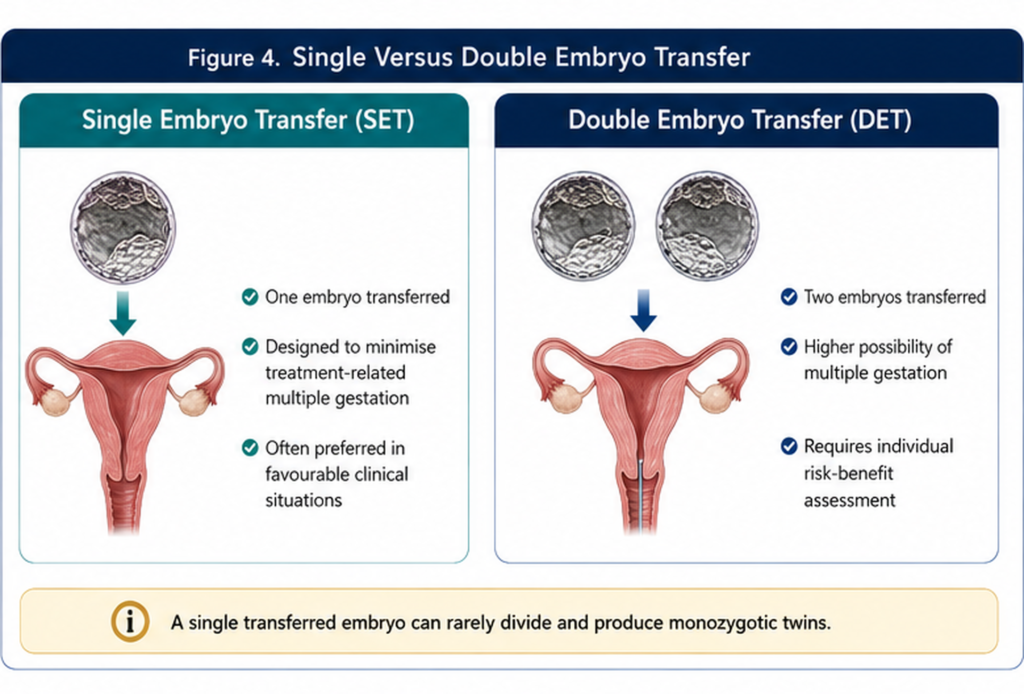
- The number of embryos transferred is a safety as well as efficacy decision. Elective single-embryo transfer is preferred in many clinical situations to reduce multiple gestation. [3,6]
- Embryo, endometrial, uterine, laboratory, patient and procedural factors all contribute to outcome; no single feature guarantees implantation, pregnancy or live birth.
- Prolonged bed rest after embryo transfer has not been shown to improve IVF outcome; ordinary mobilisation after the procedure is acceptable in evidence-based guidance. [4,7]
Table 1. Key scientific distinctions in embryo transfer
| Concept | Meaning | Why it matters |
| Transfer | Physical placement of embryo(s) into the reproductive tract, usually the uterus. | A clinical-laboratory procedure. |
| Implantation | Attachment and penetration of a zona-free blastocyst into endometrial tissue. [1] | A later biological event, not visible at the time of transfer. |
| Fresh transfer | Transfer of an embryo that has not previously been cryopreserved. [1] | Occurs in temporal continuity with the stimulation/retrieval cycle. |
| Frozen/warmed transfer | Transfer after embryo cryopreservation and warming. [1] | Requires synchronisation of embryo developmental stage with the endometrium. |
| SET / DET | Transfer of one embryo / two embryos. [1,3] | Number transferred affects multiple-pregnancy risk and counselling. |
Table of Contents
1. What Is Embryo Transfer?
Embryo transfer is the procedure that connects laboratory embryo culture with the uterine phase of assisted reproduction. The current International Glossary on Infertility and Fertility Care defines it as placing one or more preimplantation embryos, from day 1 to day 7 of development, into the uterus; transfer to a Fallopian tube is now rarely indicated. [1] In contemporary IVF practice, the term usually means transcervical intrauterine transfer.
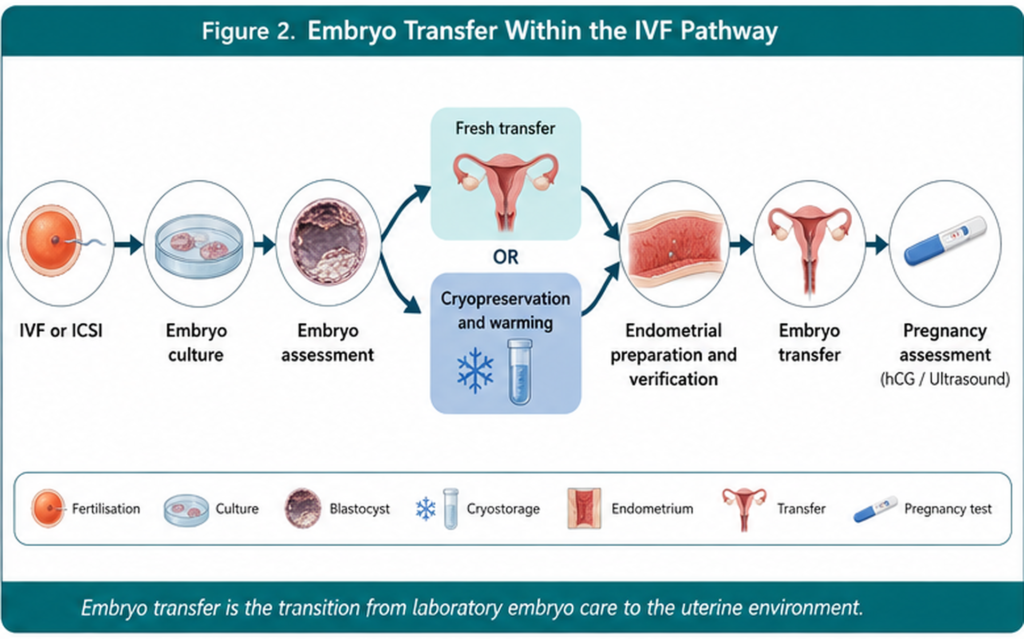
The embryo may have been produced by conventional IVF or ICSI, may be transferred during the same treatment cycle (fresh transfer), or may have been cryopreserved and later warmed for transfer. A transfer cycle is therefore not synonymous with an ovarian-stimulation cycle. Some patients undergo a transfer without a new oocyte retrieval, particularly when previously vitrified embryos are available. [1]
Embryo transfer is also a multidisciplinary handover point. The embryology team confirms embryo identity, developmental stage and laboratory readiness; the clinical team prepares the patient and performs the catheter-based procedure; and both teams use witnessing, documentation and communication systems to reduce preventable error.
2. Biological or Scientific Basis
Successful implantation requires temporal and biological coordination between a developmentally competent embryo and an endometrium capable of supporting implantation. At the blastocyst stage, the embryo consists principally of an inner cell mass and trophectoderm. After hatching from the zona pellucida, the blastocyst can appose, adhere to and then invade the endometrial surface. The glossary defines implantation as attachment and subsequent penetration of a zona-free blastocyst into the endometrium, beginning approximately 5-7 days after fertilisation. [1]
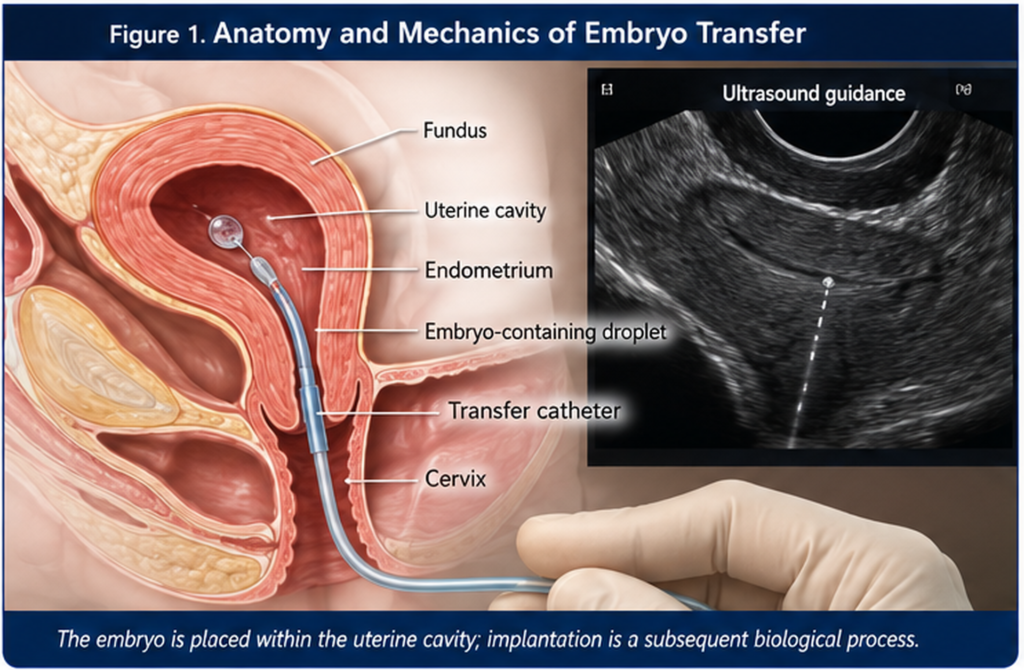
Embryo transfer does not mechanically implant the embryo. The catheter deposits the embryo in a small volume of medium into the uterine cavity; subsequent hatching and embryo-endometrial interaction are biological processes influenced by embryo competence and the uterine environment.
Timing differs by embryo stage and transfer protocol. Cleavage-stage embryos and blastocysts represent different developmental ages; in frozen embryo transfer, endometrial exposure to ovulation or progesterone is coordinated with embryo age. This synchronisation is clinically important, but no single measurement of the endometrium functions as a universal guarantee of receptivity or implantation.
3. Role in Assisted Reproduction and Fertility Care
Within an IVF or ICSI pathway, embryo transfer follows fertilisation and embryo culture and precedes pregnancy testing. The 2025 WHO infertility guideline places IVF within a progressive, evidence-based pathway of fertility care. [2] Embryo selection may use developmental stage and morphology and, in selected cases, information from preimplantation genetic testing; these data inform selection but do not create certainty of outcome.
Fresh transfer may be used when clinical circumstances are suitable; in other cycles, embryos are cryopreserved and transfer is deferred for clinical or laboratory reasons. The choice between fresh and frozen transfer is context dependent rather than a universal ranking of one method as superior for every patient.
A central safety decision is the number of embryos to transfer. Multiple embryo transfer can increase the probability of multiple gestation, which carries higher maternal, fetal and neonatal risks. ESHRE recommends counselling about these risks whenever transfer of more than one embryo is considered, and both ESHRE and ASRM promote single-embryo transfer in favourable situations to pursue a healthy singleton birth. [3,6]
4. Clinical or Laboratory Relevance
For the embryologist, transfer involves embryo verification, preparation of transfer medium, loading of the catheter according to laboratory protocol, protection of the embryo from avoidable temperature and pH disturbance, communication with the clinician, and examination of the catheter after the procedure when required to confirm that the embryo has not been retained.
For the clinician, the goals are correct patient and embryo identification, atraumatic passage through the cervix, controlled catheter positioning and embryo deposition without unnecessary manipulation. Transfer difficulty, cervical anatomy, uterine orientation, blood or mucus, catheter characteristics and operator technique may influence procedural quality. ASRM notes that pregnancy rates can vary between clinicians and supports standardisation of the procedure. [4,5]
5. How Embryo Transfer Is Evaluated or Identified
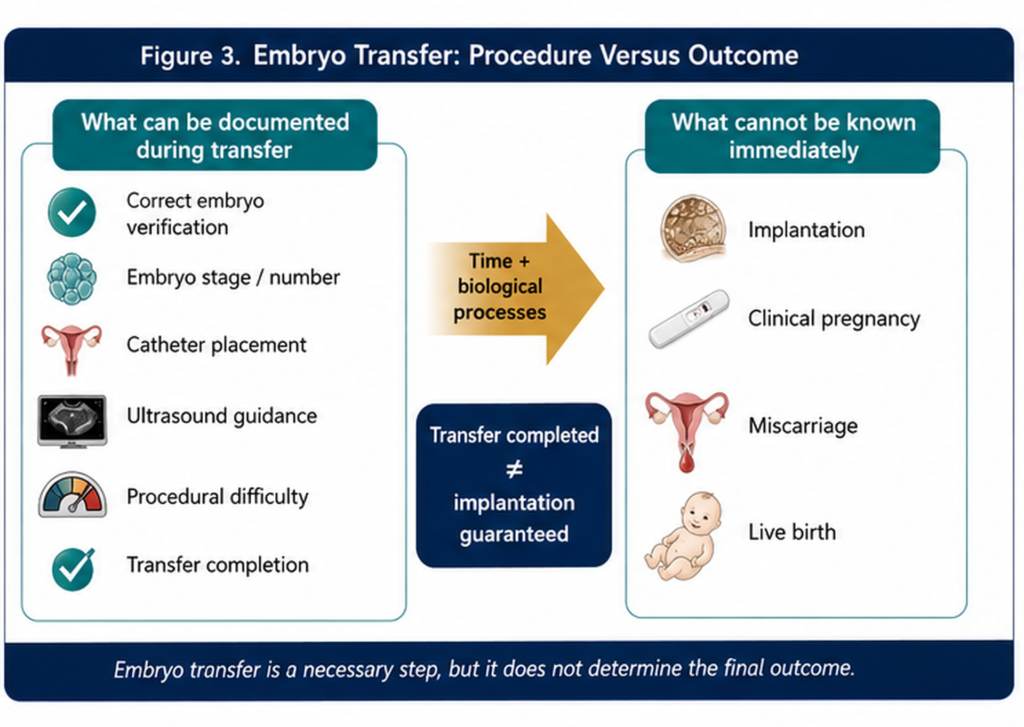
Embryo transfer is identified and documented as a clinical procedure rather than by one diagnostic test. The transfer record commonly includes patient and embryo identity checks, embryo stage and number, whether embryos were fresh or warmed, catheter type, ultrasound use, procedural difficulty, and any relevant observations such as blood, mucus or embryo retention. Local regulatory and quality-management requirements determine the exact documentation and witnessing process.
Transabdominal ultrasound is commonly used to guide catheter passage and deposition. NICE recommends ultrasound-guided embryo transfer because it improves pregnancy rates, and ASRM guidance also supports abdominal ultrasound guidance. [4,7] Evidence reviewed by ASRM supports use of a soft catheter and deposition in the upper or middle uterine cavity while avoiding contact with the fundus. [4]
After the procedure, there is no immediate bedside test that proves implantation. Subsequent biochemical pregnancy testing detects human chorionic gonadotrophin (hCG), while ultrasound later evaluates the location and development of a clinical pregnancy. These later outcomes should not be conflated with technical completion of the transfer itself.
Table 2. Interpreting information around embryo transfer
| Observation or measure | What it can contribute | What it cannot establish alone |
| Embryo morphology/stage | Supports embryo assessment and selection. | Does not guarantee implantation or euploidy. |
| Ultrasound-guided catheter position | Supports controlled, visualised deposition. [4,7] | Does not prove implantation will occur. |
| Endometrial assessment | Provides clinical context for transfer planning. | No single measurement proves receptivity in every patient. |
| Transfer difficulty | Describes the procedure and may identify technical issues. | Does not diagnose the biological cause of a failed cycle. |
| Positive hCG after transfer | Indicates biochemical evidence of pregnancy. | Does not by itself confirm pregnancy location or live birth. |
6. Interpretation
A completed embryo transfer means that the intended embryo or embryos were deposited according to the documented procedure; it does not mean that implantation has occurred. Interpretation progresses from technical completion of the transfer to later biochemical pregnancy, ultrasound-confirmed clinical pregnancy and, ultimately, live birth.
Outcome measures have different denominators and time points. Implantation per embryo transferred, pregnancy per transfer, and live birth per transfer or per initiated cycle are not interchangeable. Interpretation should specify the population, embryo stage, fresh or frozen context, number transferred and outcome definition.
Failed implantation after one transfer cannot reliably identify a single cause. Embryo competence, chromosomal status, endometrial biology, uterine pathology, technical transfer factors and chance all contribute. Repeated outcomes require clinical evaluation in context rather than attribution to one isolated parameter.
7. Factors That May Influence Embryo Transfer
Table 3. Factors that can influence embryo-transfer planning, procedure or outcome
| Domain | Examples and relevance |
| Patient and reproductive context | Age and oocyte source, previous ART history, uterine anatomy, relevant reproductive pathology and medical conditions can affect prognosis and transfer strategy. |
| Embryo factors | Developmental stage, morphology, cryosurvival, cohort characteristics and genetic information when clinically available contribute to embryo selection but remain probabilistic. |
| Endometrial and cycle factors | Cycle type, ovulation or progesterone timing, endometrial development and clinical protocol influence embryo-endometrial synchrony. |
| Transfer technique | Catheter type, ultrasound guidance, cervical passage, uterine orientation, deposition site, avoidance of fundal trauma and procedure difficulty affect technical quality. [4] |
| Laboratory handling | Identity control, catheter loading, exposure time, temperature, pH, medium handling and coordination between embryologist and clinician are part of quality-controlled practice. |
| Number of embryos | SET versus transfer of more than one embryo directly influences the probability of multiple gestation and must be considered with prognosis and patient safety. [3,6] |
8. Embryo Transfer and ART Outcomes
Embryo transfer is necessary for uterine implantation in IVF/ICSI treatment, but the procedure is only one component of the pathway to live birth. Evidence-based transfer technique can improve procedural consistency and, for some interventions, pregnancy rates. ASRM supports ultrasound guidance, soft catheters, appropriate central uterine deposition and immediate ambulation after transfer. [4] NICE similarly recommends ultrasound-guided transfer and advises that bed rest longer than 20 minutes does not improve IVF outcome. [7]
The number of embryos transferred has a major safety implication. Transferring more than one embryo can increase multiple pregnancy, which is associated with higher rates of maternal and neonatal complications than singleton pregnancy. ESHRE therefore frames elective single-embryo transfer as the preferable strategy in appropriate patients, while ASRM recommends age- and prognosis-based limits and strong consideration of single-embryo transfer in favourable circumstances. [3,6]
Outcome reporting should distinguish implantation, clinical pregnancy, miscarriage and live birth. A transfer can be technically uncomplicated yet not result in implantation; conversely, difficult technical features do not make failure inevitable. The most responsible interpretation is probabilistic and multifactorial.
9. Important Limitations
- Biological variability: embryos with similar morphology can have different developmental competence, and endometrial biology varies between and within individuals.
- Technical variability: transfer catheter, ultrasound conditions, cervical anatomy, uterine position and operator technique can differ between procedures and centres.
- Inter-observer and laboratory variability: morphology grading, definitions of difficult transfer and local procedural protocols are not perfectly uniform.
- Evidence limitations: many embryo-transfer studies use clinical pregnancy rather than live birth as the primary outcome, and older studies may reflect laboratory practices that differ from modern vitrification and culture systems. [4]
- Population differences: recommendations on embryo number and transfer strategy may differ with age, prognosis, donor oocytes, gestational carriers, medical comorbidity, law and national policy. [3,6]
- Prediction limits: no single transfer characteristic, embryo grade, endometrial measurement or laboratory observation can provide a universal prediction of pregnancy or live birth.
10. Common Misunderstandings
Misunderstanding: Embryo transfer is the same as implantation. Reality: Transfer places the embryo in the uterus; implantation is a later biological process involving attachment and invasion of the endometrium. [1]
Misunderstanding: A person must remain in bed for hours after transfer. Reality: Evidence-based guidance does not support prolonged bed rest as a method to improve outcome. [4,7]
Misunderstanding: Transferring two embryos always gives a better overall result. Reality: More embryos can increase multiple-gestation risk. The best strategy balances the chance of live birth with maternal and neonatal safety, often favouring single-embryo transfer in suitable patients. [3,6]
Misunderstanding: A high-grade embryo guarantees pregnancy. Reality: Morphology is useful for embryo assessment but does not capture every determinant of competence, implantation or live birth.
Misunderstanding: Normal walking, standing or using the toilet can make the embryo fall out. Reality: The embryo is deposited inside the uterine cavity; ordinary mobilisation after an uncomplicated transfer is not considered a mechanism by which the embryo simply falls out. Prolonged immobilisation is not beneficial. [4,7]
Misunderstanding: One failed transfer proves there is a uterine or embryo abnormality. Reality: Failure can occur for many reasons, including biological variation and chance. Interpretation requires the complete clinical and laboratory context.
11. Related Encyclopedia Terms
Blastocyst • Implantation • Endometrium • Vitrification • Warming • Fertilisation • ICSI • IVF • Euploidy • Aneuploidy • Morphology • Catheter • Cryopreservation • Pregnancy • Hatching
12. Quick Summary
- Embryo transfer is the placement of one or more preimplantation embryos into the uterus as part of ART. [1]
- Transfer and implantation are separate events: the procedure deposits the embryo, while implantation occurs later through embryo-endometrial interaction.
- Fresh and frozen/warmed transfers differ in cycle context, but both require appropriate embryo-endometrial timing.
- Ultrasound guidance and atraumatic, standardised technique are supported by major professional guidance. [4,5,7]
- Single-embryo transfer is an important strategy for reducing multiple pregnancy in suitable patients. [3,6]
- Prolonged bed rest after transfer does not improve IVF outcome. [4,7]
- No embryo grade, endometrial measurement or procedural feature alone can guarantee pregnancy or live birth; ART outcomes are multifactorial.
13. Frequently Asked Questions
What is embryo transfer in IVF?
It is the procedure in which one or more laboratory-created preimplantation embryos are placed into the uterus, usually through the cervix using a transfer catheter. [1]
What is the difference between fresh and frozen embryo transfer?
A fresh transfer uses an embryo not previously cryopreserved. A frozen-thawed or vitrified-warmed transfer uses an embryo that was cryopreserved and later warmed, with the transfer cycle timed to the endometrium. [1]
Does embryo transfer hurt?
Many transfers are brief and require no anaesthesia, but discomfort varies. Speculum placement, a full bladder used for ultrasound, cervical anatomy or a technically difficult transfer can affect the experience.
How many embryos should be transferred?
The decision depends on clinical context, prognosis, age or oocyte age, embryo characteristics, medical risks and applicable guidance or law. Major professional guidance favours single-embryo transfer in many favourable situations to reduce multiple pregnancy. [3,6]
Can an embryo fall out after transfer?
Ordinary movement does not cause the embryo simply to fall out of the uterus. Evidence does not support prolonged bed rest after transfer. [4,7]
When can success be known after embryo transfer?
Not immediately. Pregnancy is assessed later using hCG testing and, if positive, subsequent ultrasound. A positive biochemical test is an intermediate outcome and does not itself guarantee live birth.
Does ultrasound guidance matter during embryo transfer?
Yes. NICE recommends ultrasound-guided embryo transfer because it improves pregnancy rates, and ASRM evidence-based guidance supports abdominal ultrasound guidance. [4,7]
Does a perfect-looking embryo guarantee implantation?
No. Morphology is informative but incomplete. Embryo competence, chromosomal factors, endometrial biology, uterine conditions, transfer technique and other factors all contribute to outcome.
14. References
1. Zegers-Hochschild F, Dyer S, Adamson GD, Baker V, Barnhart K, Bhattacharya S, et al. The International Glossary on Infertility and Fertility Care, 2025. Hum Reprod. 2026;41(6):892-909. doi:10.1093/humrep/deag029.
2. World Health Organization. Guideline for the prevention, diagnosis and treatment of infertility. Geneva: World Health Organization; 2025.
3. ESHRE Guideline Group on the Number of Embryos to Transfer during IVF/ICSI. Evidence-based guideline: number of embryos to transfer during IVF/ICSI. Grimbergen: European Society of Human Reproduction and Embryology; 2023.
4. Practice Committee of the American Society for Reproductive Medicine. Performing the embryo transfer: a guideline. Fertil Steril. 2017;107(4):882-896.
5. Practice Committee of the American Society for Reproductive Medicine. ASRM standard embryo transfer protocol template: a committee opinion. Fertil Steril. 2017;107(4):897-900.
6. Practice Committee of the American Society for Reproductive Medicine; Practice Committee of the Society for Assisted Reproductive Technology. Guidance on the limits to the number of embryos to transfer: a committee opinion. Fertil Steril. 2021;116(3):651-654.
7. National Institute for Health and Care Excellence. Fertility problems: assessment and treatment. NICE guideline NG257. London: NICE; 2026.
8. De los Santos MJ, Apter S, Coticchio G, Debrock S, Lundin K, Plancha CE, et al. Revised guidelines for good practice in IVF laboratories (2015). Hum Reprod. 2016;31(4):685-686.
9. Phillips JA, Martins WP, Nastri CO, Raine-Fenning NJ. Difficult embryo transfers or blood on catheter and assisted reproductive outcomes: a systematic review and meta-analysis. Eur J Obstet Gynecol Reprod Biol. 2013;168(2):121-128.
Educational scope: This encyclopedia entry provides general scientific education and is not a substitute for individual medical assessment, diagnosis or treatment advice.