Beginner level | Assisted Reproduction | Clinical Assisted Reproduction
Author: Manoj Kumar K, Embryologist
Published: 20.07.2026 | Last reviewed:20.07.2026 | Reading time: 12 minutes
Introduction
Clinical assisted reproduction is the clinical side of assisted reproductive technology (ART): the organised care pathway used when people need medical help to attempt pregnancy. For beginners, the most important idea is that ART is not only a laboratory technique. It connects history-taking, diagnosis, counselling, consent, treatment planning, medication, monitoring, gamete handling, embryo culture, embryo transfer, cryopreservation, outcome review and emotional support. The laboratory is essential, but it works inside a wider clinical system. The World Health Organization (WHO) defines infertility as a disease of the male or female reproductive system marked by failure to achieve pregnancy after 12 months or more of regular unprotected sexual intercourse [1,2]. ART terminology is standardised internationally, but clinical rules, funding, consent requirements and laboratory regulations vary across countries [3].
Who this article is for
This beginner article is for students, trainee embryologists, healthcare learners, laboratory trainees and interested readers who want a clear first view of clinical assisted reproduction. It may also help patients understand basic language, but it is not personal medical advice.
Why clinical assisted reproduction matters
Infertility and subfertility affect people in every region of the world. WHO reports that around one in six people experience infertility during their lifetime, making access, safety, quality and affordability important public-health issues [1]. Clinical ART matters because it can offer structured options when natural conception is delayed or unlikely, but it must be presented responsibly. No treatment can guarantee pregnancy, and the right pathway depends on diagnosis, age, gametes, uterus, medical history, local law and patient preference.
Scope of this article
This article explains the beginner pathway: what clinical ART means, the main terms, the usual flow from assessment to follow-up, and how the clinical team connects with the embryology laboratory.
What this article does not cover
This is not a treatment recommendation, not a stimulation protocol, not a laboratory standard operating procedure and not a legal guide. It does not compare clinics, promise success rates or replace counselling by a qualified professional.
Learning objectives
- Define clinical assisted reproduction and ART in beginner language.
- Describe the broad pathway from assessment to treatment review.
- Recognise how the clinical team and embryology laboratory connect.
- Explain why safety, consent, ethics and quality systems matter.
Key takeaways
- Clinical assisted reproduction is a pathway, not a single procedure.
- IVF and ICSI are laboratory-linked treatments within that pathway.
- Patient assessment guides treatment selection.
- Embryologists support gamete and embryo handling, but clinical decisions require a wider team.
- Ethical communication avoids guarantees and respects local regulations.
Table of Contents
Essential terminology
| Term | Beginner meaning |
| Assisted reproductive technology (ART) | Treatments or procedures involving handling of oocytes, sperm or embryos outside the body. |
| Clinical assisted reproduction | The clinical pathway that assesses, plans, monitors and follows fertility treatment. |
| In vitro fertilisation (IVF) | Fertilisation of oocytes with sperm outside the body in a controlled laboratory setting. |
| Intracytoplasmic sperm injection (ICSI) | A micromanipulation method where one sperm is injected into an oocyte. |
| Embryo transfer | Placement of an embryo into the uterus under clinical care. |
| Cryopreservation | Storage of gametes or embryos at very low temperature for future use. |
Basic scientific foundation
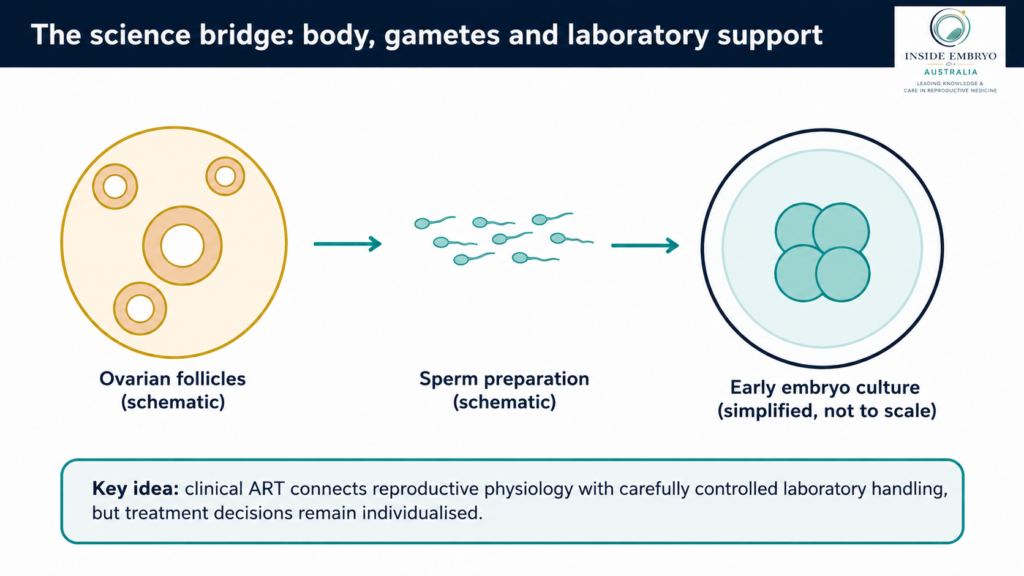
Human reproduction requires functional gametes, ovulation, sperm transport, fertilisation, embryo development, a receptive uterus and correct timing. Clinical ART may support one or more parts of this sequence. Ovarian stimulation may encourage development of multiple follicles; sperm preparation may select motile sperm for use; IVF and ICSI allow fertilisation to occur in the laboratory; embryo culture supports early development before transfer or cryopreservation. These steps are scientific and clinical, but outcomes remain biologically variable [3-5].
The clinical ART pathway step by step
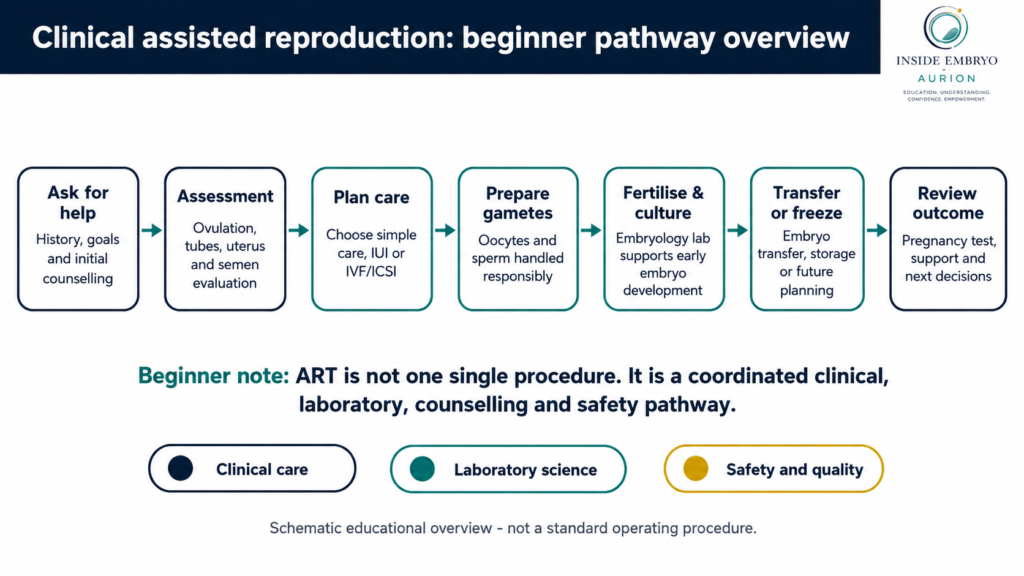
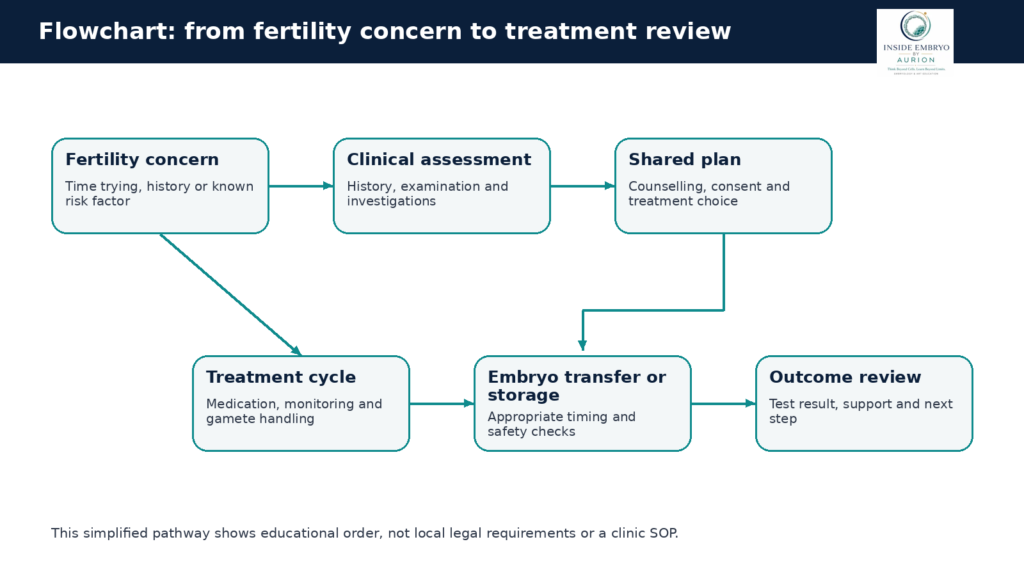
Fertility concern and consultation
Care usually begins when a person or couple seeks help for delayed conception, recurrent loss, known reproductive disease, need for donor gametes, fertility preservation or another medical situation. A careful history helps identify age, cycle pattern, previous pregnancies, medical conditions, surgeries, medications and reproductive goals.
Assessment and diagnosis
Assessment may include ovulation evaluation, ultrasound, ovarian reserve markers, semen analysis, tubal or uterine assessment and infection or genetic screening when indicated. The purpose is not to label people quickly, but to understand the main barriers and risks.
Shared treatment planning
A plan should be discussed in language the patient can understand. Options may include expectant management, lifestyle or medical care, ovulation induction, intrauterine insemination, IVF, ICSI, donor gametes, cryopreservation or referral for specialist counselling. WHO emphasises diagnosis, treatment pathways and psychosocial support as part of fertility care [2].
Treatment cycle preparation
If IVF or ICSI is selected, medication and monitoring are used to support follicle development. Monitoring aims to balance response with safety. The details vary by institution and patient, so this article does not provide medication schedules.
Gamete collection and laboratory handling
Oocytes are collected under clinical conditions. Semen is assessed and prepared in the andrology or embryology laboratory. Every sample and dish must be identified, documented and traceable. Laboratory quality systems are essential because the work involves irreplaceable reproductive cells [5].
Fertilisation and embryo culture
In IVF, oocytes and sperm are placed together in a controlled environment. In ICSI, one sperm is injected into an oocyte using micromanipulation. Embryos are then observed during early development. Culture conditions, equipment, records and staff competence are part of laboratory management [5].
Embryo transfer, cryopreservation or future planning
An embryo may be transferred in a fresh or frozen cycle depending on clinical and laboratory factors. Extra suitable embryos may be cryopreserved when permitted and consented. Guidance on embryo transfer aims to reduce avoidable multiple pregnancy while respecting individual circumstances and local policy [6,7].
Pregnancy test, counselling and review
A pregnancy test and clinical follow-up are part of the same care pathway. When treatment is not successful, review should include medical, laboratory and emotional aspects without blaming patients or staff.
Clinical and laboratory relevance
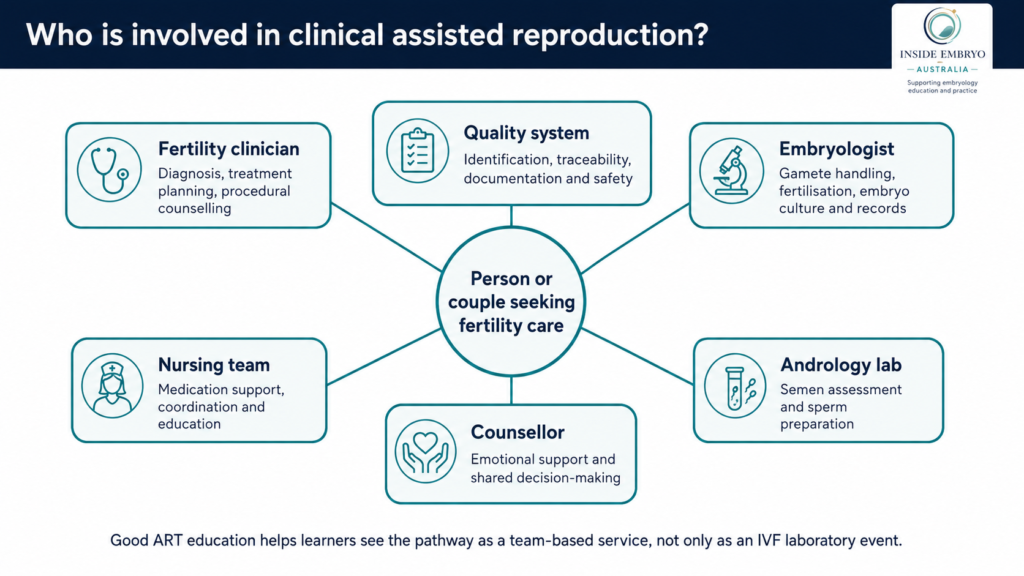
Clinical decisions and laboratory work influence each other. A clinician may choose IVF or ICSI based on diagnosis and gamete factors. The embryologist receives and handles gametes or embryos according to validated local procedures, documentation requirements and patient consent. The nurse often supports medication teaching and cycle coordination. Counselling and clear communication help people understand uncertainty, emotional stress and possible next steps. This integrated model is why clinical ART should be taught as a service pathway rather than as a single laboratory event.
Normal variation and individualisation
Beginners should avoid thinking that every ART cycle follows exactly the same route. Ovarian response varies. Semen parameters vary. Some cycles use donor gametes. Some use frozen embryo transfer. Some require fertility preservation. Some people stop, pause or change direction after counselling. Variation is not automatically abnormal; it may reflect biology, diagnosis, consent, safety or local regulation.
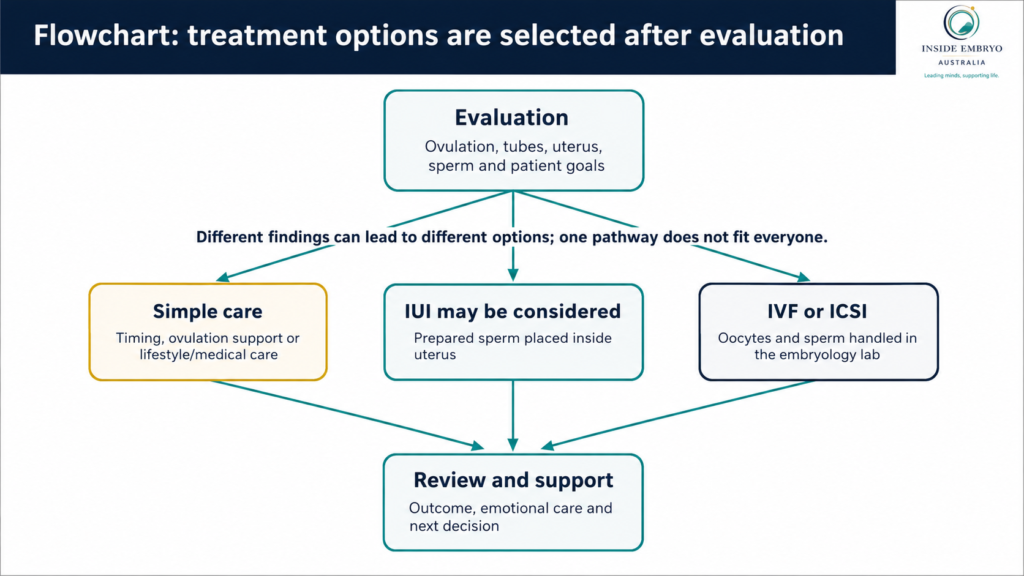
Flowchart showing how different evaluation findings can lead to different treatment options.
Common misconceptions
| Misconception | Responsible correction |
| ART means IVF only. | IVF is one ART pathway, but assisted reproduction includes several clinical and laboratory options. |
| Embryology alone determines success. | Embryology is important, but age, diagnosis, gametes, uterus, treatment plan and chance also matter. |
| More embryos always means a better outcome. | Transfer decisions must balance pregnancy chances with the risk of multiple pregnancy and current guidance [6,7]. |
| A normal test means no problem exists. | Tests are helpful but cannot explain every case of infertility. |
| A failed cycle means the pathway was wrong. | Cycles can fail despite appropriate care because reproduction remains biologically variable. |
Limitations and responsible communication
Educational content should not convert general knowledge into personal advice. Success rates differ by age, diagnosis, embryo number, gamete source, clinic population, country, law and reporting method. International reports describe ART activity globally, but their data should not be used as a promise for an individual person [8].
Safety, ethics, quality and regulation
Clinical ART involves consent, privacy, identity checks, infection control, traceability, staff competence, equipment maintenance, emergency planning and honest communication. ASRM guidance describes ART programs as involving both clinical treatments and laboratory procedures, and laboratory guidance highlights quality management, safety, document control and competence [4,5]. Laws and professional standards are jurisdiction-specific, so a global beginner article should not present one country’s rules as universal law.
Summary table
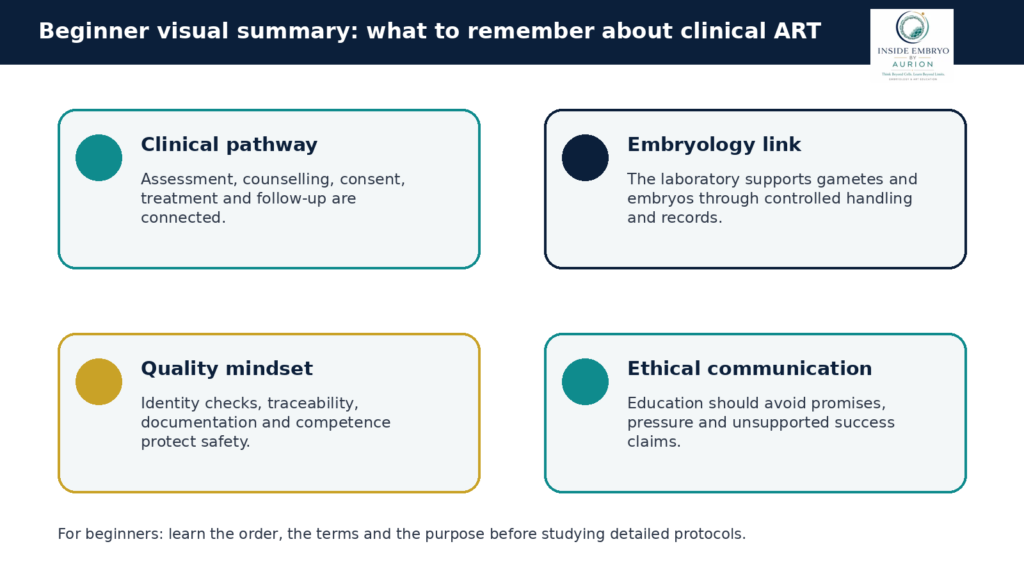
| Area | Beginner point |
| Clinical assessment | Identifies likely factors and guides safe planning. |
| Treatment choice | Depends on diagnosis, goals, consent and local regulation. |
| Embryology laboratory | Handles gametes and embryos with controlled systems and traceability. |
| Counselling | Supports understanding, expectations and emotional wellbeing. |
| Quality and ethics | Protect patient safety and responsible communication. |
Practical summary
- Start with the big picture before learning procedures.
- Use ART terms carefully and define them at first use.
- Separate diagnosis, treatment planning, laboratory work and follow-up.
- Remember that ART supports reproduction but does not guarantee pregnancy.
- Check local guidelines and laws when applying knowledge in practice.
FAQs
Is clinical assisted reproduction the same as IVF?
No. IVF is one major treatment within clinical assisted reproduction and ART.
What is the role of an embryologist?
An embryologist handles gametes and embryos, supports fertilisation and culture processes, documents observations and works within validated quality systems.
Does ART always involve embryo transfer?
Not always. Some cycles may involve cryopreservation, fertility preservation, cancellation or future planning.
Why are counselling and consent important?
They help people understand options, risks, uncertainty, storage decisions and alternatives.
Can this article guide my treatment choice?
No. It is educational only. Treatment decisions require qualified clinical assessment.
Are ART rules the same worldwide?
No. Definitions may be international, but legal, funding and consent requirements differ between countries.
Conclusion
Clinical assisted reproduction is best understood as a coordinated pathway connecting people, reproductive biology, clinical care, embryology, counselling, ethics and quality systems. For beginners, the safest foundation is to learn the language, the order of events and the limits of what ART can and cannot promise. Detailed protocols should be learned only through formal training, institutional procedures and current professional guidance.
Related Inside Embryo articles
- Introduction to IVF Laboratory Science
- Human Embryology: 8 Essential Stages from Fertilization to Organ Formation
- Introduction to Cryobiology
- Cellular Biology
- Andrology: Essential Concepts
References
[1] World Health Organization. Infertility. WHO fact sheet. Updated 2025. https://www.who.int/news-room/fact-sheets/detail/infertility
[2] World Health Organization. WHO issues first global guideline on infertility. 2025. https://www.who.int/news/item/28-11-2025-who-issues-first-global-guideline-on-infertility
[3] Zegers-Hochschild F, Adamson GD, Dyer S, et al. The International Glossary on Infertility and Fertility Care, 2017. Hum Reprod. 2017;32(9):1786-1801. doi:10.1093/humrep/dex234. https://doi.org/10.1093/humrep/dex234
[4] Practice Committee of the ASRM. Minimum standards for practices offering assisted reproductive technologies: a committee opinion. Fertil Steril. 2021;115(3):578-582. https://www.asrm.org/practice-guidance/practice-committee-documents/minimum-standards-for-practices-offering-assisted-reproductive-technologies-a-committee-opinion-2021/
[5] Practice Committee of the ASRM. Comprehensive guidance for human embryology, andrology, and endocrinology laboratories: management and operations. Fertil Steril. 2022;117(6):1183-1202. https://www.asrm.org/practice-guidance/practice-committee-documents/comprehensive-guidance-for-human-embryology-andrology-and-endocrinology-laboratories-management-and-operations-a-committee-opinion-2022/
[6] ESHRE Guideline Group on Embryo Transfer. ESHRE guideline: Number of embryos to transfer during IVF/ICSI. 2023. https://www.eshre.eu/-/media/sitecore-files/Guidelines/Embryo-transfer/1–ESHRE-ET-Guideline—Main-document.pdf
[7] Practice Committee of the ASRM and SART. Guidance on the limits to the number of embryos to transfer: a committee opinion. Fertil Steril. 2021;116(3):651-654. https://www.asrm.org/practice-guidance/practice-committee-documents/guidance-on-the-limits-to-the-number-of-embryos-to-transfer-a—committee-opinion-2021/
[8] Dyer S, Chambers GM, de Mouzon J, et al. International Committee for Monitoring Assisted Reproductive Technologies world report: ART 2019. Fertil Steril. 2025. doi:10.1016/j.fertnstert.2025.06.003. https://www.icmartivf.org/publications/
Author profile
Manoj Kumar K is an embryologist, scientific educator, and founder of Inside Embryo. His educational interests include reproductive biology, human embryology, andrology, assisted reproductive technology, cryobiology, IVF laboratory science, and scientific communication. Through Inside Embryo, he works to make evidence-based reproductive science clear, structured, and accessible to students, professionals, and interested learners.
Educational disclaimer
This resource is intended for scientific and educational purposes only. It does not replace professional medical advice, clinical judgement, formal laboratory training, validated institutional protocols, manufacturer instructions, legal advice, or applicable regulatory requirements. Clinical and laboratory procedures should be performed only by appropriately qualified personnel.