Manoj Kumar K, Embryologist
Inside Embryo | Scientific and Medical Education
Introduction
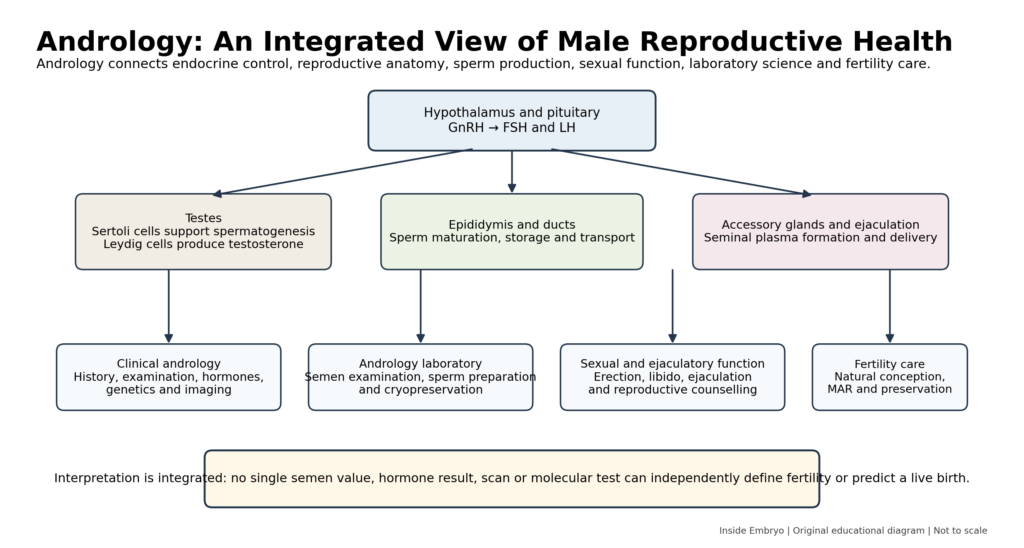
Andrology is the scientific and clinical field concerned with the male reproductive system, male fertility, reproductive endocrinology, sexual function and the laboratory assessment of semen and spermatozoa. It brings together anatomy, physiology, cell biology, genetics, urology, endocrinology, laboratory medicine and assisted reproductive technology.
Understanding andrology is important because male reproductive health is not limited to a sperm count. Fertility depends on hormonal signalling, testicular function, sperm production, maturation and transport, ejaculation, sexual function, general health and interaction with the reproductive biology of a partner. Male-factor findings may occur alone, alongside female-factor findings or within infertility that remains unexplained after standard evaluation.
This introductory article explains the major biological systems studied in andrology, the principles of semen examination, the significance and limitations of common findings, laboratory quality and current evidence. It is intended for mixed readers and does not diagnose an individual, recommend treatment or provide a clinical standard operating procedure. Related learning resources can be explored through the Inside Embryo Knowledge Hub.
Learning Objectives
- Define andrology and describe its major clinical and laboratory domains.
- Identify the principal organs and hormones involved in male reproduction.
- Explain the basic sequence of spermatogenesis and sperm maturation.
- Describe the purpose and limits of semen examination.
- Recognise broad categories of male reproductive dysfunction.
- Explain why results must be interpreted with clinical and technical context.
- Understand the quality, safety, ethical and legal principles relevant to andrology.
Key Takeaways
- Andrology covers male reproductive health, not semen analysis alone.
- Testicular sperm production depends on coordinated hypothalamic, pituitary and local hormonal signalling.
- Spermatozoa undergo development in the testis and further maturation in the epididymis.
- A semen examination evaluates an ejaculate and does not independently prove fertility or infertility.
- Reference distributions are aids to interpretation, not rigid biological boundaries.
- Abnormal findings may reflect pre-testicular, testicular, post-testicular or mixed factors.
- Repeated or targeted assessment may be required because semen characteristics vary.
- Laboratory reliability depends on identification, standardisation, competence and quality control.
- Emerging sperm tests and artificial-intelligence tools require clinical validation before routine use.
Table of Contents
Definition and Overview
The International Glossary on Infertility and Fertility Care defines andrology as medical practice dealing with the health of the male reproductive system.[1] The field includes reproductive development, hormones, fertility, contraception, sexual and ejaculatory disorders, genital-tract disease, semen analysis, sperm processing, cryopreservation and selected assisted-reproduction procedures.
Andrology is multidisciplinary. Clinicians assess anatomy, symptoms and medical causes; endocrine specialists evaluate hormonal disorders; genetic professionals contribute when inherited conditions are suspected; and laboratory scientists examine semen, prepare sperm and maintain quality systems.
Male reproductive findings may also have implications for general health. Disorders affecting testosterone production, testicular development or sperm formation may warrant broader evaluation, although an abnormal semen result does not automatically predict another disease.
Important Terminology
| Term | Clear meaning | Practical relevance |
| Andrology | The health and science of the male reproductive system. | Includes fertility, sexual function, hormones and laboratory assessment. |
| Spermatogenesis | Production of sperm cells within seminiferous tubules. | Depends on germ cells, Sertoli cells, hormones and the testicular environment. |
| Spermiogenesis | Remodelling of spermatids into spermatozoa. | Forms the condensed head, acrosome, midpiece and flagellum. |
| Spermatozoon | A mature male gamete cell. | Carries a haploid paternal chromosome set and specialised fertilisation machinery. |
| Semen | The ejaculate containing spermatozoa and secretions from reproductive glands. | Semen characteristics reflect several organs, not only the testes. |
| Azoospermia | Absence of spermatozoa in the ejaculate after appropriate examination. | Requires confirmation and investigation of production, obstruction or ejaculation. |
| Oligozoospermia | Sperm concentration below the applicable lower reference distribution. | Describes one semen finding; it is not a complete diagnosis. |
| Asthenozoospermia | Reduced sperm motility according to the method and reference used. | May affect sperm progression but requires contextual interpretation. |
| Teratozoospermia | A low proportion of sperm meeting defined morphological criteria. | Morphology alone does not define fertility or genetic normality. |
| Vitality | The proportion of live spermatozoa. | Helps distinguish immotile living sperm from dead sperm. |
| Cryopreservation | Storage of reproductive cells at very low temperature. | Used for fertility preservation, donor programmes and clinical planning. |
| MAR | Medically assisted reproduction. | Includes interventions supporting reproduction, including ART procedures. |
Classification of Male Reproductive Factors
| Category | Examples | Biological meaning |
| Pre-testicular | Hypothalamic or pituitary disorders; systemic endocrine disturbance | Hormonal stimulation of the testes is reduced or altered. |
| Testicular | Impaired spermatogenesis, genetic conditions, gonadotoxic exposure, testicular disease | The testes cannot produce sperm normally despite stimulation. |
| Post-testicular | Obstruction, ejaculatory dysfunction or transport disorder | Sperm production may occur, but delivery into the ejaculate is impaired. |
| Sexual or ejaculatory | Erectile, libido, emission or ejaculation disorders | Intercourse or semen delivery may be affected. |
| Accessory-gland or inflammatory | Prostate, seminal-vesicle or genital-tract conditions | May alter semen characteristics or cause symptoms. |
| Mixed or unexplained | More than one contributor, or no clear cause after standard assessment | Requires cautious communication and avoids unjustified certainty. |
Scientific and Biological Background
Male reproductive anatomy
The testes contain seminiferous tubules, where germ cells develop with Sertoli-cell support. Leydig cells between the tubules produce testosterone. The epididymis supports sperm maturation and storage; the vas deferens and ejaculatory ducts transport sperm; and accessory glands contribute most seminal fluid.
The scrotal position, testicular blood flow and pampiniform venous plexus contribute to temperature regulation. Anatomical or vascular disorders may affect function, but a structural finding should not automatically be assumed to cause infertility.
Endocrine regulation
Hypothalamic gonadotropin-releasing hormone (GnRH) stimulates pituitary follicle-stimulating hormone (FSH) and luteinising hormone (LH). LH stimulates Leydig-cell testosterone production. FSH acts mainly through Sertoli cells, while intratesticular testosterone and local factors support spermatogenesis. Inhibin B contributes feedback regulation.[2]
Testosterone supports reproductive tissues, sexual function and spermatogenesis, but a blood value does not directly measure sperm production. External testosterone may suppress pituitary gonadotropins and impair spermatogenesis; medication decisions require qualified care.
Spermatogenesis and sperm maturation
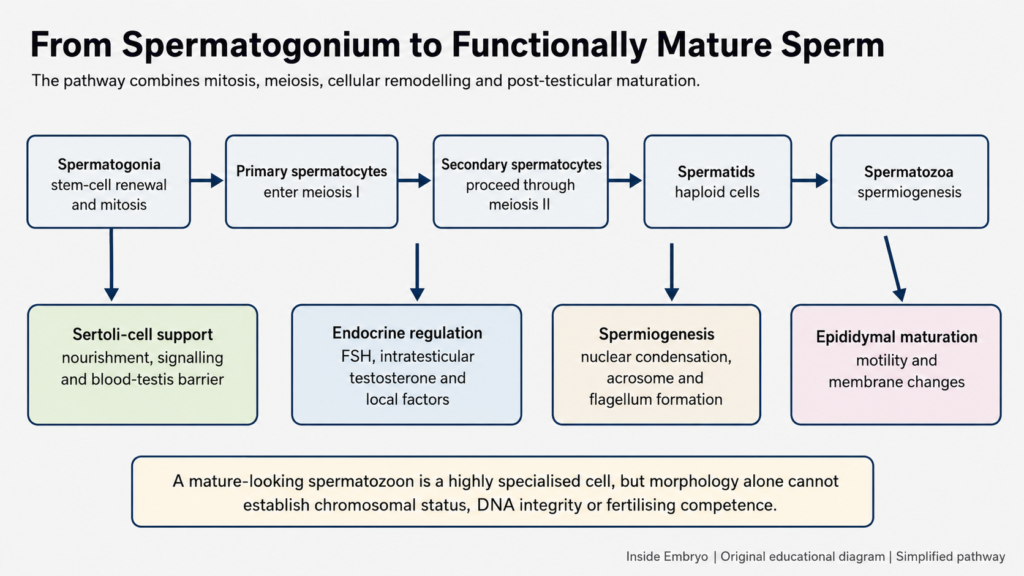
Spermatogenesis begins with spermatogonial stem and progenitor cells. Mitotic divisions maintain the germ-cell population and generate differentiating cells. Primary spermatocytes complete meiosis I, secondary spermatocytes proceed through meiosis II, and haploid spermatids form.
During spermiogenesis, spermatids are remodelled: the nucleus condenses, an acrosome and flagellum form, and excess cytoplasm is reduced. Epididymal transit then supports changes in motility, membrane organisation and fertilising capacity.
After ejaculation, additional functional changes occur within the female reproductive tract. This is why sperm number, motility and morphology are important but do not describe every molecular aspect of sperm function.
Semen and seminal plasma
Semen is a composite specimen. Sperm originate in the testes and epididymides, while most fluid comes from accessory glands. Volume, pH, viscosity and liquefaction can therefore reflect collection completeness, glandular contribution and possible transport disorders.
The WHO laboratory manual provides standardised examination and processing methods and distinguishes basic, extended and advanced tests.[3] Laboratories must follow validated protocols rather than educational summaries.
Process, Mechanism and Assessment Workflow
1. Clarify the purpose: Determine whether assessment relates to infertility, fertility preservation, post-procedure follow-up, symptoms, donation or research.
2. Obtain a reproductive and medical history: Consider development, previous fertility, infections, surgery, medications, gonadotoxic exposure, sexual function and general health.
3. Perform an appropriate examination: Qualified clinicians assess reproductive anatomy and relevant systemic findings.
4. Undertake semen examination: A validated laboratory evaluates the specimen, pre-analytical conditions and requested semen characteristics.
5. Interpret the pattern: Results are considered together rather than classifying one value in isolation.
6. Select targeted additional evaluation: Hormones, genetics, imaging or specialised tests are used when indicated—not automatically for every person.
7. Discuss implications and options: Qualified professionals explain uncertainty, possible causes, further evaluation, fertility preservation or reproductive pathways.
8. Reassess when necessary: Repeat testing, clinical follow-up or specialist referral may be appropriate because biology and measurements vary.
Clinical and Laboratory Significance
Semen examination is a central first-line laboratory component of male fertility evaluation, but it is not a direct test of the ability to establish a pregnancy. The WHO sixth edition presents standardised methods and reference distributions rather than one boundary separating fertile from infertile men.[3,4]
The 2024 AUA/ASRM guideline supports structured assessment based on history, examination and indicated testing. Severe abnormalities, azoospermia, endocrine features, suspected obstruction or genetic risk may require specialist evaluation.[5]
In IVF laboratories, sperm may be prepared for insemination, in vitro fertilisation or intracytoplasmic sperm injection. Preparation selects or concentrates sperm but cannot guarantee fertilisation, embryo development, pregnancy or live birth.
Cryopreservation may be considered before gonadotoxic treatment, before procedures affecting sperm availability, for donation or when future collection is uncertain. Consent, storage and use are governed by applicable law and policy.
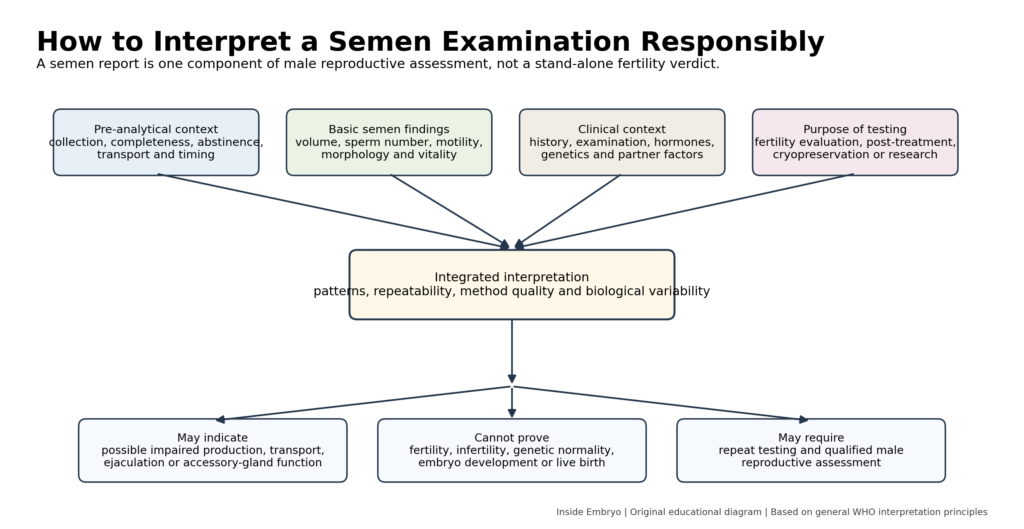
Factors Affecting Male Reproductive Processes or Results
| Factor | Possible influence | Practical consideration |
| Collection completeness | Loss of part of the ejaculate can alter volume and sperm number. | Record problems and interpret the sample accordingly. |
| Abstinence interval | Can influence volume, concentration and motility. | Follow the laboratory’s current collection instructions. |
| Illness or fever | May temporarily affect spermatogenesis and semen quality. | Timing and repeat assessment may matter. |
| Age and health status | May influence hormones, sexual function, DNA integrity and semen findings. | Use individual clinical context rather than age alone. |
| Medications and hormones | Some treatments suppress gonadotropins or affect ejaculation and sperm production. | Do not stop or change medication without medical advice. |
| Heat, toxins and gonadotoxic exposure | May impair testicular function depending on dose and duration. | Assess occupational, therapeutic and environmental history. |
| Smoking, alcohol and metabolic health | Associated with reproductive changes in some studies. | Associations do not prove one factor caused an individual result. |
| Genital-tract anatomy | Obstruction, varicocele or developmental conditions may affect findings. | Requires clinical assessment; not every finding needs intervention. |
| Laboratory method | Counting, motility and morphology show observer and instrument variation. | Use trained staff, validated methods and quality control. |
| Natural biological variation | Semen characteristics vary between ejaculates. | One specimen may not represent a stable long-term pattern. |
Interpretation of Findings
A semen result may suggest reduced production, impaired movement, altered morphology, incomplete collection, obstruction, ejaculatory dysfunction or accessory-gland disturbance. It guides further assessment but does not establish the cause without clinical correlation.
Reference limits do not divide men biologically into “fertile” and “infertile.” Population distributions overlap, and several semen characteristics may interact.
Biological variation includes differences between ejaculates, illness, abstinence, stress and medication exposure. Technical variation includes collection errors, delayed transport, temperature changes, counting error, staining quality and observer interpretation.
Advanced tests such as sperm DNA fragmentation, oxidative-stress assays or specialised functional tests may help in selected circumstances. They are not interchangeable, and predictive association does not prove improved management. Current AUA/ASRM guidance does not recommend sperm DNA fragmentation testing routinely in the initial evaluation.[5,6]
Common Errors and Misconceptions
| Error or misconception | Why it is incorrect | Correct understanding |
| Andrology means semen analysis. | The discipline also covers hormones, anatomy, sexual function, genetics and treatment. | Semen examination is one part of a broader field. |
| A normal semen report proves fertility. | Pregnancy depends on both reproductive systems and several biological stages. | The report reduces uncertainty but cannot guarantee conception. |
| One abnormal result proves permanent infertility. | Semen findings vary and may be temporarily affected. | Interpret the pattern and repeat when professionally indicated. |
| Low testosterone always means low sperm count. | Blood testosterone and intratesticular conditions are related but not equivalent. | Hormones require integrated interpretation. |
| Testosterone supplements improve male fertility. | External testosterone may suppress gonadotropins and spermatogenesis. | Treatment must match the underlying diagnosis. |
| Normal morphology means genetically normal sperm. | Morphology cannot reveal every chromosomal or DNA abnormality. | It is a visual classification with defined limits. |
| ICSI removes all male-factor risk. | ICSI assists sperm entry but cannot guarantee fertilisation or healthy development. | Underlying sperm and oocyte biology still matter. |
| Infertility is one partner’s fault. | Male, female, combined and unexplained contributors occur. | Evaluation should be respectful, parallel and non-blaming. |
Quality Control and Quality Assurance
Andrology laboratory quality begins before microscopy. The request, patient identity, label, collection information and chain of custody must agree. Traceability should continue through examination, processing, cryopreservation, transfer and disposal. Critical identification steps should not rely on memory.
Microscopes, warming devices, pipettes, counting chambers, centrifuges, cryostorage systems and automated platforms require qualification, maintenance and monitoring. Reagents and consumables need controlled storage and suitability checks.
Personnel require training and documented competency in counting, motility, morphology, vitality and sperm preparation. Internal quality control, external assessment where available, audits and corrective and preventive actions support reliability. WHO, ASRM and ESHRE provide frameworks, but laboratories must implement local requirements.[3,7,8]
Safety and Risk Management
Semen is human biological material and requires infection-control precautions. Laboratories need risk assessment for aerosols, centrifugation, sharps, disinfectants, spills and waste, with personal protective equipment and exposure procedures based on institutional policy.
Cryopreservation adds cold-injury, oxygen-displacement, tank-failure, identification and storage-continuity risks. Monitoring, alarms, emergency response and inventory control are essential.
Reproductive information is sensitive. Consent, confidentiality, secure reporting and controlled access are required. Genetic findings may affect relatives and future offspring, and reproductive results can cause distress or stigma.
Evidence and Current Practice
Well-established andrology includes endocrine regulation of testicular function, spermatogenesis, epididymal maturation, standardised semen examination and clinical assessment.
Evidence is more context-dependent for advanced sperm tests, antioxidants, selection technologies and prediction models. Changes in semen or laboratory endpoints do not necessarily demonstrate improved live-birth outcomes.
Artificial intelligence is being studied for sperm detection, motility, morphology and multimodal prediction. Dataset limitations, centre variation, annotation quality, interpretability, prospective validation and regulation remain important barriers.
Advantages and Limitations of Common Andrology Assessments
| Assessment or approach | Advantage | Limitation |
| Semen examination | Accessible overview of ejaculate and sperm characteristics. | Cannot independently diagnose fertility or identify every cause. |
| Hormonal testing | Assesses endocrine patterns affecting testicular function. | Values vary with timing, health and assay; they do not directly measure sperm competence. |
| Ultrasound or imaging | May identify structural or vascular findings. | An anatomical finding may not explain infertility. |
| Genetic testing | Can identify selected chromosomal or inherited causes. | Requires indication, consent and counselling; a negative result does not exclude all genetic factors. |
| Sperm DNA or functional tests | May provide information beyond basic semen parameters. | Methods and clinical utility differ; not routine for every initial evaluation. |
| Cryopreservation | Preserves an available reproductive specimen for possible future use. | Survival and future reproductive success are not guaranteed. |
WHO Standards, Ethics and Legal Considerations
Andrology should respect autonomy, privacy, informed consent and non-stigmatising communication. Male infertility should not be framed as failure or reduced masculinity, and counselling should include the individual being assessed.
Rules governing donation, storage duration, posthumous use, import, export, parentage, anonymity and infectious-disease testing differ widely. Professional guidance cannot replace national law or institutional policy.
The WHO’s first global infertility guideline, issued in 2025, promotes equitable, rights-based care, structured diagnostic pathways and psychosocial support while encouraging local adaptation.[9]
Practical Summary for Different Readers
| Reader | Main learning focus | Responsible use |
| Students and beginners | Learn the sequence: hormonal control → sperm production → maturation → transport → assessment. | Avoid treating terminology as a fertility verdict. |
| Embryologists and laboratory professionals | Connect sperm findings with biology, pre-analytics and method limitations. | Use validated SOPs, traceability and quality systems. |
| Clinicians and healthcare workers | Assess male reproductive health through history, examination and targeted tests. | Interpret semen results with the person and couple context. |
| Patients and general readers | Understand that male fertility involves more than sperm count. | Discuss personal findings with qualified professionals. |
Frequently Asked Questions
What is the difference between andrology and urology?
Urology covers the urinary system and many male genital conditions. Andrology focuses specifically on male reproductive health, fertility, hormones and sexual function, although the specialties overlap.
Is semen analysis the same as a fertility test?
No. It provides important information about one ejaculate, but fertility also depends on sexual function, anatomy, hormones, sperm function, the partner’s reproductive biology and chance.
Can semen parameters change over time?
Yes. Biological variation, illness, fever, collection conditions, medications and other exposures can change results.
What does azoospermia mean?
It means that spermatozoa were not found in the ejaculate after appropriate examination. It does not identify whether the cause is impaired production, obstruction or ejaculation.
Does a low sperm count mean natural conception is impossible?
Not necessarily. Probability may be reduced depending on the complete pattern and clinical situation, but one count cannot provide certainty.
Can testosterone treatment improve sperm production?
External testosterone may suppress the hormones needed for spermatogenesis. Anyone concerned about fertility should discuss testosterone or anabolic-hormone use with a qualified clinician.
What is sperm cryopreservation?
It is the storage of sperm at very low temperature for possible future use. It may support fertility preservation, but future survival and reproductive outcome cannot be guaranteed.
Are sperm DNA-fragmentation tests always required?
No. They may be considered in selected circumstances, but current professional guidance does not recommend them routinely in every initial male-fertility evaluation.
When should professional assessment be considered?
Assessment is appropriate for difficulty conceiving, abnormal semen findings, testicular symptoms, sexual or ejaculatory problems, previous gonadotoxic treatment, developmental conditions or concerns about fertility preservation.
Conclusion
Andrology integrates male reproductive anatomy, endocrine regulation, spermatogenesis, sperm maturation, sexual function and laboratory assessment. This framework explains why a semen report should be interpreted as a biological pattern within a clinical context rather than as a simple pass-or-fail fertility test.
Its practical value lies in identifying possible areas for further assessment, supporting safe laboratory practice and guiding responsible communication. Its limitations are equally important: no single semen parameter, hormone value, advanced sperm test or reproductive technology can guarantee conception, embryo development or live birth. Evidence-based andrology therefore depends on validated methods, qualified interpretation, respect for uncertainty and attention to the person’s overall reproductive and general health.
References
1. Zegers-Hochschild F, Dyer S, Racowsky C, et al. The International Glossary on Infertility and Fertility Care, 2025. Hum Reprod. 2026;41(6):892-909. doi:10.1093/humrep/deag029.
2. O’Donnell L, Smith LB. Endocrinology of the testis and spermatogenesis. In: Feingold KR, Adler RA, Ahmed SF, et al., editors. Endotext [Internet]. South Dartmouth (MA): MDText.com, Inc.; updated 2026 Jan 7. Available from: https://www.ncbi.nlm.nih.gov/books/NBK279031/
3. World Health Organization. WHO laboratory manual for the examination and processing of human semen. 6th ed. Geneva: World Health Organization; 2021. Available from: https://www.who.int/publications/i/item/9789240030787
4. Björndahl L, Kirkman-Brown J, Hart G, et al. The sixth edition of the WHO laboratory manual for the examination and processing of human semen: ensuring quality and standardization in basic examination of human ejaculates. Fertil Steril. 2022;117(2):246-251. doi:10.1016/j.fertnstert.2021.12.012.
5. Brannigan RE, Hermanson L, Kaczmarek J, et al. Updates to male infertility: AUA/ASRM guideline (2024). J Urol. 2024;212(5):789-799. doi:10.1097/JU.0000000000004180.
6. Schlegel PN, Sigman M, Collura B, et al. Diagnosis and treatment of infertility in men: AUA/ASRM guideline part I. Fertil Steril. 2021;115(1):54-61. doi:10.1016/j.fertnstert.2020.11.015.
7. Practice Committee of the American Society for Reproductive Medicine. Comprehensive guidance for human embryology, andrology, and endocrinology laboratories: management and operations: a committee opinion. Fertil Steril. 2022;117(6):1183-1202. Available from: https://www.asrm.org/practice-guidance/practice-committee-documents/comprehensive-guidance-for-human-embryology-andrology-and-endocrinology-laboratories-management-and-operations-a-committee-opinion-2022/
8. ESHRE Good Practice in the IVF Lab Working Group, Arroyo G, Barrie A, Coticchio G, et al. ESHRE recommendations on good practice in the IVF laboratory. Hum Reprod. 2026;deag096. doi:10.1093/humrep/deag096.
9. World Health Organization. WHO issues first global guideline on infertility [Internet]. Geneva: WHO; 2025 Nov 28. Available from: https://www.who.int/news/item/28-11-2025-who-issues-first-global-guideline-on-infertility
Educational Disclaimer
Educational Disclaimer: This article is intended for scientific and educational purposes only. It does not replace professional medical advice, clinical judgement, institutional policies, validated laboratory protocols, manufacturer instructions, regulatory requirements or formal professional training. Laboratory and clinical procedures should be performed only by appropriately qualified personnel. Readers should consult current official guidance, applicable laws and qualified healthcare professionals when making clinical, laboratory or personal health decisions.