By Manoj Kumar K, Embryologist
Beginner level | Primary category: Embryology & IVF Laboratory Science | Audience: students, new embryology learners, junior laboratory staff, healthcare learners, patients and interested readers | Jurisdiction: Global | Published: 18 July 2026 | Last reviewed/updated: 18 July 2026 | Estimated reading time: 12 minutes
Authored and editorially reviewed by Manoj Kumar K, Embryologist.
Who This Article Is For
This beginner article is for readers who want a clear introduction to what happens inside an in vitro fertilisation laboratory. It explains the purpose, main workflow, scientific environment, professional roles, quality safeguards and limitations of IVF laboratory science without giving an operational protocol or personal treatment advice.
Introduction
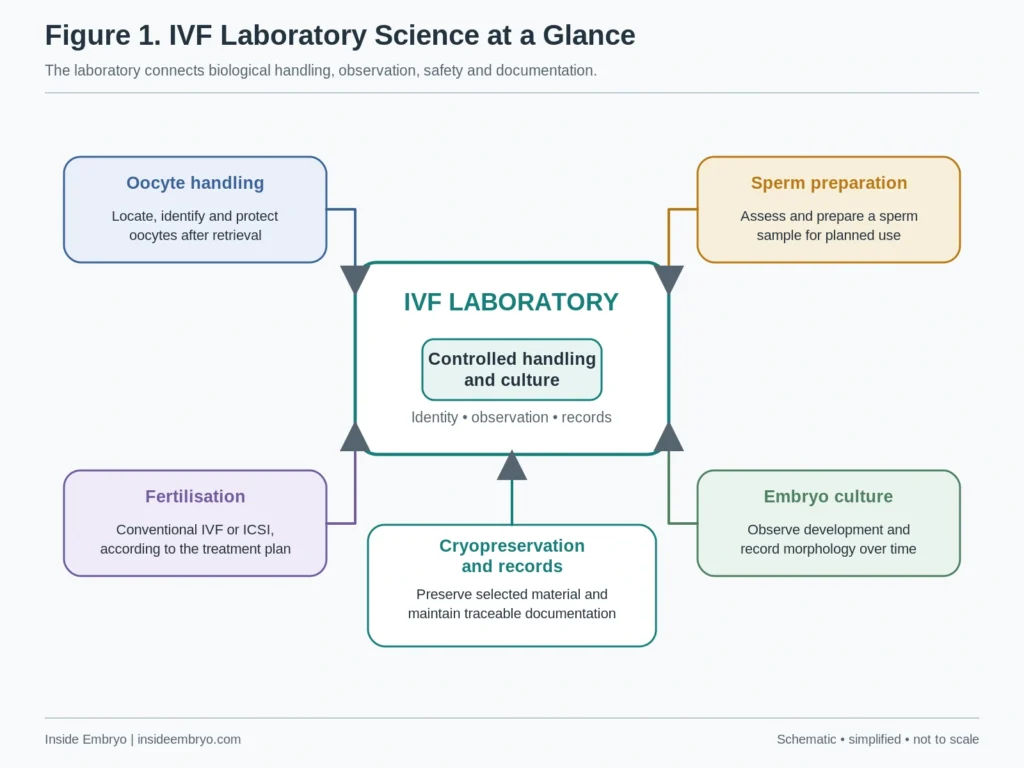
An introduction to IVF laboratory science begins with a simple idea: it is a specialised environment where oocytes, spermatozoa and preimplantation embryos are handled, observed and sometimes preserved outside the body. It forms one part of assisted reproductive technology (ART), alongside clinical assessment, oocyte retrieval, embryo transfer and follow-up.
Laboratory work supports living cells while protecting identity and safety. Embryologists use microscopes, incubators, micromanipulation and cryostorage systems, supported by detailed records. Technology does not “manufacture” pregnancy: biology, clinical factors and chance remain important, and no observation guarantees implantation or live birth [1,2].
This global overview explains concepts, not step-by-step technique. Practice must follow law, professional guidance, validated institutional procedures, competency requirements and manufacturer instructions. Explore the broader IVF Laboratory Science Knowledge Hub for connected learning topics.
Learning Objectives
Define IVF laboratory science and its place within assisted reproduction.
Identify the main cells, stages, equipment groups and professional responsibilities involved.
Describe the simplified pathway from specimen identification to embryo transfer preparation or cryopreservation.
Explain why environmental control, traceability, documentation and staff competency matter.
Recognise common misunderstandings and the limits of embryo grading and laboratory technology.
Key Takeaways
IVF laboratory science combines cell biology, embryology, andrology, technology and quality management.
Correct identity and traceability are required throughout every laboratory stage.
Oocytes, spermatozoa and embryos are sensitive living cells that require controlled handling conditions.
Conventional IVF and intracytoplasmic sperm injection are different fertilisation approaches, not competing guarantees.
Embryo morphology describes visible features; it does not directly reveal every genetic, metabolic or implantation property.
Quality systems reduce preventable variation and risk but cannot remove all biological uncertainty.
Table of Contents
Introduction to IVF Laboratory Science: Definition and Scope
IVF laboratory science applies biological, technical and quality principles when gametes and embryos are handled during assisted reproduction. “In vitro” means outside the body. “Fertilisation” is the ordered process through which sperm and oocyte interact and a zygote forms.
The IVF laboratory works within the fertility clinic. Clinical teams obtain consent, plan treatment and make clinical decisions; laboratory staff manage biological material within authorised roles and report observations. Current ESHRE guidance covers organisation, staffing, safety, quality, traceability, gamete handling, embryo culture, cryopreservation and emergencies [1].
The underlying biology connects directly with human reproductive biology, cellular biology and human embryology.
Essential Terminology
Table 1. Essential beginner terminology
| Term | Plain-language meaning | Why it matters |
| ART | Assisted reproductive technology involving oocytes or embryos outside the body. | IVF is one form of ART. |
| Gamete | A reproductive cell: an oocyte or a spermatozoon. | Gametes contribute genetic material at fertilisation. |
| Oocyte | The female reproductive cell handled in the laboratory. | Maturity influences which steps are possible. |
| Conventional IVF | Oocytes and prepared sperm are placed together. | It differs from direct sperm injection. |
| ICSI | Injection of one selected spermatozoon into an oocyte. | It may be used for defined clinical or laboratory reasons. |
| Zygote | The one-cell stage after fertilisation, before the first cleavage division. | Fertilisation assessment looks for expected features at an appropriate time. |
| Embryo culture | Maintaining embryos under controlled preimplantation conditions. | Conditions and observations require consistency. |
| Blastocyst | A preimplantation stage with a cavity and distinct cell groups. | Some embryos are cultured to this stage, depending on the treatment plan. |
| Cryopreservation | Very-low-temperature preservation for possible future use. | Requires validated methods, secure identity and long-term storage records. |
| Traceability | Following identity, material, actions and records throughout the process. | It is a central patient-safety requirement. |
These terms describe broad concepts. They do not replace a laboratory’s approved definitions, procedure documents or local regulatory terminology.
The Scientific Foundation: Living Cells Need Controlled Conditions
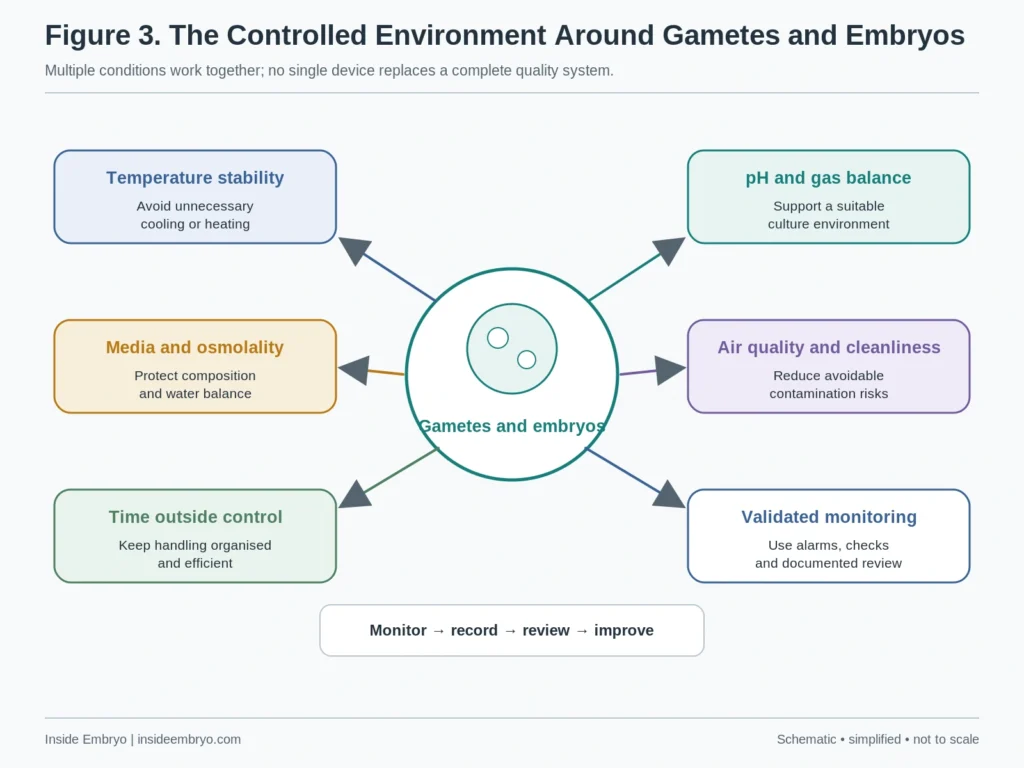
Oocytes, spermatozoa and embryos are living cells influenced by their surroundings. Laboratory work aims to minimise unnecessary change during required handling and observation. No single temperature, incubator or culture medium guarantees development; the environment works as a connected system.
Temperature, pH, gases, media integrity, osmolality, air quality, cleanliness and organised handling all matter. Equipment and consumables require appropriate selection, monitoring, maintenance and storage. These controls improve consistency but cannot overcome every biological limitation [1,2].
Sperm assessment and preparation are part of the same system. The WHO semen manual provides standardised methods designed to support quality and comparability [3]. Review related foundations in Andrology: 7 Essential Concepts in Male Reproductive Health.
The Main IVF Laboratory Workflow
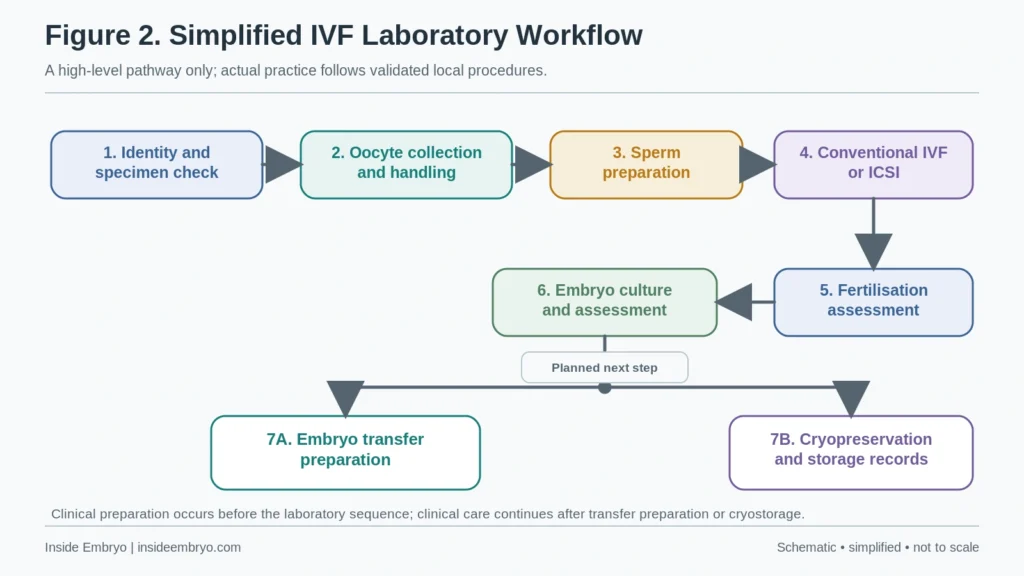
The pathway begins before microscopy. Treatment plans, consent, identity details and communication must be consistent. The sequence below is simplified; laboratories use validated workflows with defined roles, timing, witnessing and contingency plans [1,2].
1. Identity and Specimen Reception
Identity and documentation are confirmed before reproductive material is handled. Labels, records and witnessing systems support the process, but professional responsibility remains. Traceability continues through dishes, tubes, observations and storage locations.
2. Oocyte Collection and Handling
After clinical retrieval, laboratory staff identify oocytes in collected follicular fluid and handle them according to the fertilisation plan. The beginner-level focus is identification, protection and appropriate preparation—not operational settings.
3. Sperm Assessment and Preparation
A semen sample or surgically obtained specimen may be assessed and prepared for planned use. Method choice depends on the sample, treatment plan, validated procedures and judgement; no one method suits every situation [3].
4. Fertilisation Approach
In conventional IVF, prepared sperm and oocytes are placed together. In ICSI, one spermatozoon is injected into an oocyte. ICSI bypasses some interactions but does not guarantee fertilisation, embryo development, implantation or live birth. Selection requires clinical and laboratory context.
5. Fertilisation Assessment
At an appropriate time, the laboratory records expected fertilisation features. This is a stage-specific observation, not a prediction. Development may stop later, and atypical findings require current guidance and local policy [1,4].
6. Embryo Culture and Assessment
Embryos may be cultured through cleavage and, in some plans, to blastocyst. Embryologists record stage and morphology. The updated Istanbul consensus standardises assessment and ranking [4]. Morphology supports communication, but it is not equivalent to chromosomal status, metabolism or implantation competence.
7. Transfer Preparation or Cryopreservation
An embryo may be prepared for transfer, or reproductive material may be cryopreserved. Both pathways require identity control, records and communication. Storage also needs inventory monitoring, emergency planning and clear consent.
Why IVF Laboratory Science Matters
The IVF laboratory creates a controlled place for fertilisation, early development, observation and preservation. Its scientific value lies in supporting cells while producing reliable, traceable information for the wider care team. Its safety value lies in protecting identity, reducing avoidable errors and maintaining continuity when multiple people, devices and time points are involved.
Laboratory performance can influence whether preventable variation is reduced, whether observations are consistent and whether material remains safely stored. Yet IVF outcomes are shared and probabilistic. Oocyte and sperm biology, age, health, uterine factors, clinical decisions, embryo development and chance all contribute. It is therefore inaccurate to attribute every success or failure to the laboratory alone.
Factors That Can Influence Laboratory Observations or Results
Table 2. Factors that need context
| Factor group | Examples | Responsible interpretation |
| Biological factors | Oocyte maturity, sperm characteristics, embryo developmental capacity and individual health context. | Biology varies between individuals and cycles; normal findings do not guarantee an outcome. |
| Environmental factors | Temperature, pH, gases, air quality, media condition and time outside controlled settings. | These are managed as a system and monitored according to validated procedures. |
| Technical factors | Equipment performance, consumables, observation timing and method-specific variability. | Validation, quality control and maintenance reduce avoidable variation. |
| Human and organisational factors | Training, workload, communication, handovers, documentation and witnessing. | Competency and a strong safety culture are as important as equipment. |
| Clinical context | Treatment indication, ovarian response, insemination plan, transfer strategy and medical factors. | Laboratory observations must be integrated with qualified clinical judgement. |
A factor may affect a laboratory measurement, a biological process or both. Association does not automatically prove that one factor caused an individual outcome.
Common Misunderstandings and Correct Interpretations
Table 3. Common IVF laboratory myths
| Misunderstanding | Why it is misleading | Correct interpretation |
| “The best-looking embryo will definitely implant.” | Morphology is a visible surrogate and cannot reveal every biological property. | Grading supports ranking and communication; it does not guarantee pregnancy or live birth. |
| “ICSI is simply a better version of IVF.” | The techniques use different routes to fertilisation and have different indications. | The appropriate method depends on evidence, clinical context and laboratory judgement. |
| “A modern incubator can make any embryo develop.” | Equipment supports conditions but cannot create biological competence. | Technology reduces avoidable disturbance; it cannot override all cellular limitations. |
| “The embryologist decides the whole treatment.” | IVF care is multidisciplinary and governed by consent, clinical plans and regulation. | Embryologists work within defined laboratory responsibilities and communicate with the care team. |
| “Freezing guarantees the same result later.” | Cryopreservation is highly useful but survival, continued development and clinical outcome are not guaranteed. | Validated cryopreservation preserves an opportunity, not a promised outcome. |
Correcting these misunderstandings helps readers distinguish laboratory capability from biological certainty.
Benefits, Uses and Limitations
IVF laboratories can support fertilisation, document early development, prepare embryos for transfer and preserve oocytes, sperm or embryos. These functions can broaden family-building and fertility-preservation options.
Laboratory methods cannot guarantee development, restore competence to every cell or predict an individual outcome. Some technologies measure surrogate endpoints, and evidence for add-ons may be incomplete or difficult to generalise. Educational descriptions are not endorsements of products, tests or services.
Quality, Safety and Ethical Principles
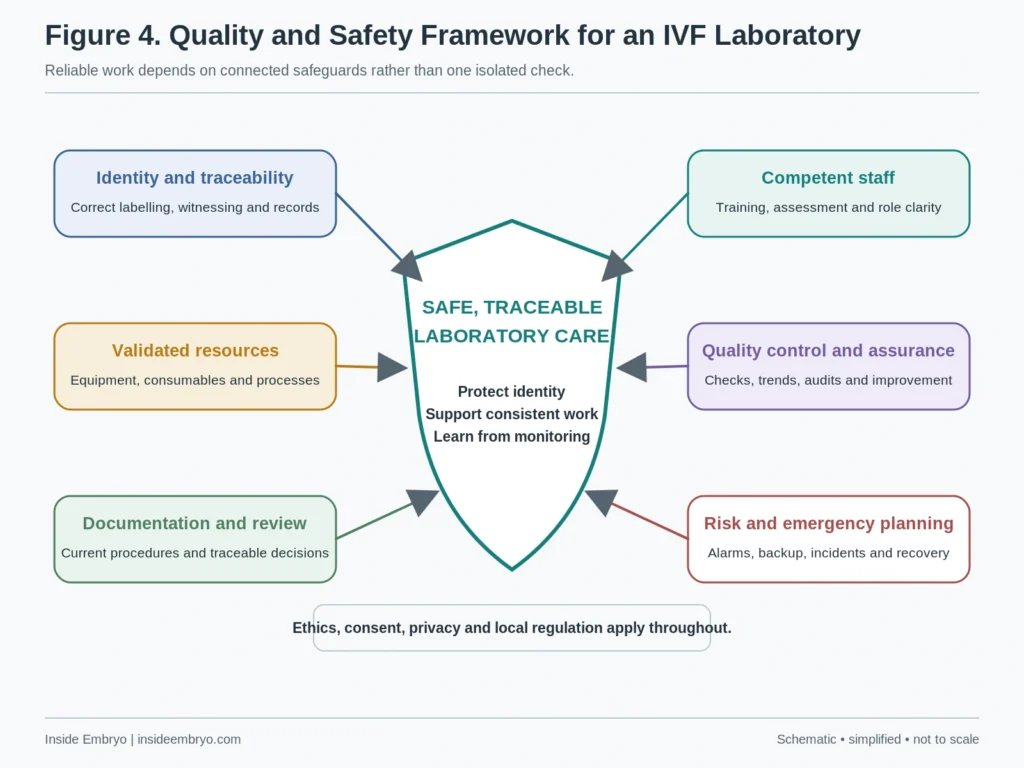
A quality management system connects policies, competent staff, equipment, monitoring, records, incident review, audits and improvement. Quality control checks defined requirements; quality assurance evaluates the wider system. Performance indicators track trends but do not guarantee an individual outcome [2,5,6].
Identity and traceability are essential. Laboratories also need competency assessment, controlled documents, validation, maintenance, infection safety, cryostorage safeguards and emergency plans. ISO 15189:2022 describes medical-laboratory quality and competence requirements, but its application to IVF depends on local scope and regulation [6].
Ethical duties include consent, privacy, respectful communication and responsible storage or disposition. Laws on gametes, embryos, donation, testing, storage and research vary; global guidance cannot replace current local requirements.
Evidence and Limitations
The newest major source used is ESHRE’s 2026 good-practice recommendation, updating the 2015 version and expanding andrology and embryo biopsy [1,10]. It combines evidence with expert consensus where stronger studies are limited. Good practice may therefore reflect professional agreement and risk management, not only randomised trials.
The Vienna consensus proposed performance indicators through expert agreement and acknowledged evidence limitations [5]. Morphology guidance standardises observation but does not turn appearance into a direct measure of genetic status or live birth [4]. Emerging technologies require clinical-outcome evidence, not technical performance alone.
This article follows the Inside Embryo Scientific References and Sources Policy and Editorial Policy and Scientific Review Process. Inside Embryo does not promote a clinic, manufacturer, product, medication, add-on or test. No material commercial source was required for this article.
Update note: Guidance, technology and regulation can change. Reviewed 18 July 2026; check newer official sources before professional use. Report factual or reference concerns through the Inside Embryo contact page or editorial policy.
When Professional Guidance Is Needed
Patients should contact their fertility clinic for personal questions about fertilisation reports, embryo development, grading, transfer plans, cryopreservation, storage, consent, legal options or treatment decisions. Students and laboratory staff should use qualified supervision and approved training for any practical work. A blog article cannot safely determine whether a result is normal, select a procedure or replace institutional competency assessment.
What to Remember
The IVF laboratory is one component of a multidisciplinary fertility service.
Its main responsibilities include controlled handling, observation, preservation, identity protection and documentation.
Conventional IVF and ICSI are different techniques chosen for specific contexts.
Embryo morphology is useful but limited; appearance is not a guarantee of genetic or implantation competence.
Quality depends on people, systems, equipment, records and a culture of safety.
Laboratory control can reduce avoidable risk but cannot remove biological uncertainty.
Frequently Asked Questions
Is an IVF laboratory the same as a fertility clinic?
No. It is one specialised part of a service that also includes medical care, nursing, counselling, administration and follow-up. Safe care depends on communication between them.
What does an embryologist do?
An embryologist handles and observes gametes and embryos, maintains traceability, operates laboratory systems, contributes to quality work and communicates findings. Duties and qualifications vary by jurisdiction and seniority.
What is the difference between conventional IVF and ICSI?
Conventional IVF places prepared sperm and oocytes together; ICSI injects one spermatozoon into an oocyte. Neither guarantees fertilisation or pregnancy, and selection requires context.
How long are embryos kept in the laboratory?
Culture duration depends on development, the treatment plan, laboratory policy and regulation. The clinic should explain the individual plan.
Does embryo grade predict pregnancy?
Grade describes and ranks morphology at a particular time. It cannot guarantee implantation, pregnancy or live birth or directly reveal every genetic or metabolic feature [4].
Are IVF laboratories regulated in the same way worldwide?
No. Laws, licensing, qualifications, storage rules and reporting duties differ by country or region. Global guidance supports principles; local requirements control practice.
Conclusion
This introduction to IVF laboratory science shows that the laboratory is not simply a room containing incubators and microscopes. It is a coordinated biological and quality system in which trained professionals handle sensitive cells, protect identity, document observations and support clinical care.
The central beginner lesson is balance: precision matters, but certainty is limited. Equipment, validated processes and competent staff can reduce avoidable variation and risk; they cannot guarantee fertilisation, embryo development, implantation or live birth. Responsible learning therefore combines scientific foundations with traceability, safety, ethics, current evidence and respect for individual clinical context.
More Articles on Inside Embryo
Introduction to Human Reproductive Biology: From Gametes to Implantation
Human Embryology: 8 Essential Stages from Fertilization to Organ Formation
Introduction to Cellular Biology: Structure, Function and the Life of a Cell
Andrology: 7 Essential Concepts in Male Reproductive Health
Infertility: 2026 Essential Guide for Better Understanding
References
7. World Health Organization. Infertility. Fact sheet. Updated 28 November 2025.
Short Author Profile
Manoj Kumar K is an Embryologist and the founder of Inside Embryo, an independent educational platform focused on assisted reproduction, human embryology and IVF laboratory science. His work combines laboratory perspective with evidence-based scientific education for students, laboratory professionals, clinicians, researchers and interested readers worldwide. Read the full author profile:
Educational Disclaimer
Educational Disclaimer: This article is intended for scientific and educational purposes only. It does not replace professional medical advice, clinical judgement, institutional policies, validated laboratory protocols, manufacturer instructions, regulatory requirements or formal professional training. Laboratory and clinical procedures should be performed only by appropriately qualified personnel. Laws, standards and professional requirements may differ between countries and may change over time. Readers should consult current official guidance and qualified professionals for clinical, laboratory or personal health decisions.